
The Affairs Sunday Brief · May 25, 2026
The North American — 77 | ONE FUTURE. THREE NATIONS (Longview in English & Spanish)
"Regional integration is not about giving up sovereignty. It is about pooling sovereignty to achieve together what none can achieve alone."
— Enrique Iglesias, former President of the Inter-American Development Bank
THE WEEK THAT WAS — Six Stories That Moved the Continent
1. The Room Where North America Was Decided — Today
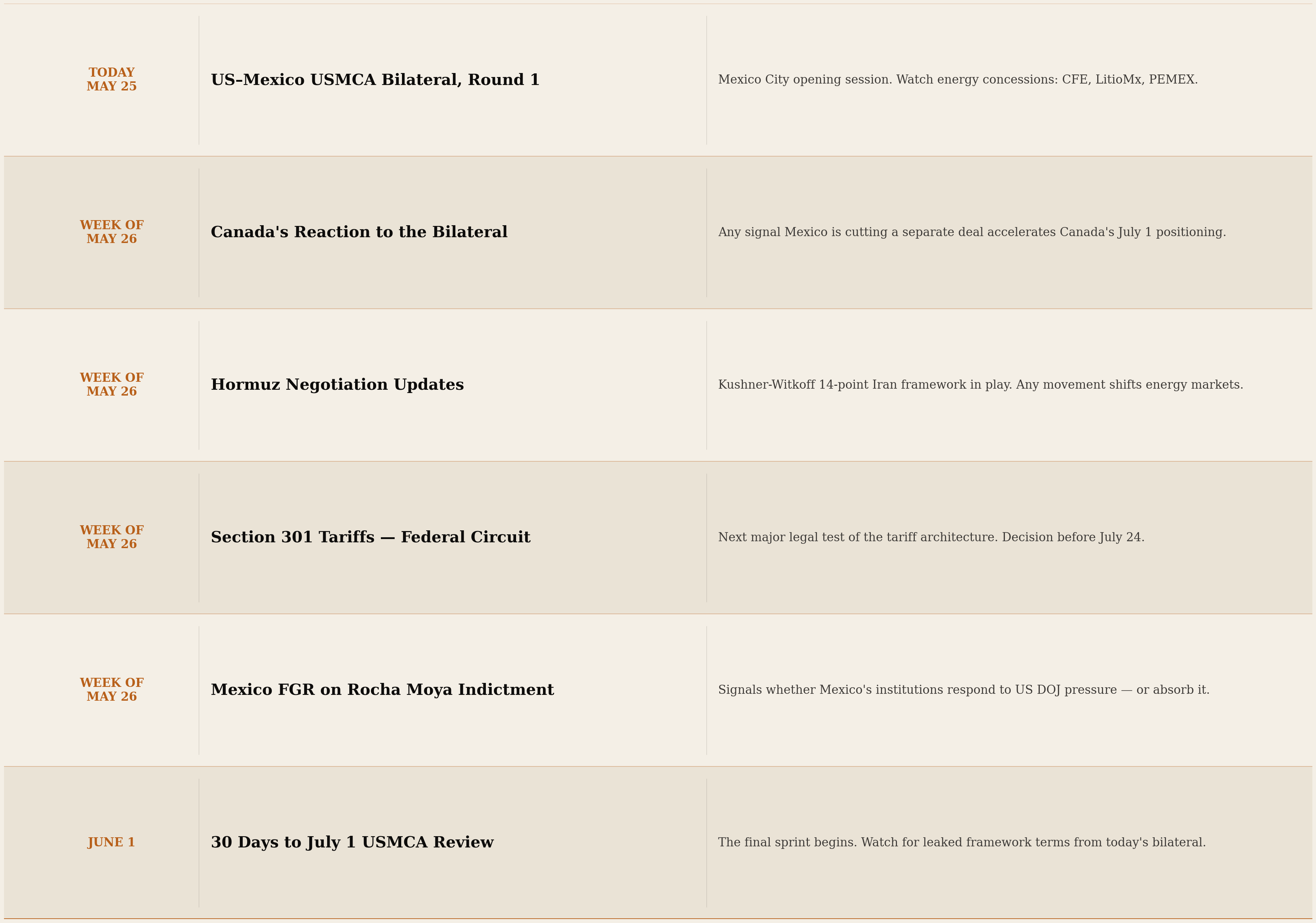
For the first time, US and Mexican negotiators sat down in Mexico City for the first official bilateral round of USMCA renegotiation. The agenda: rules of origin, manufacturing employment, and the exclusion of Chinese content from North American supply chains. Canada is not in this bilateral — Canada joins the formal trilateral on July 1.
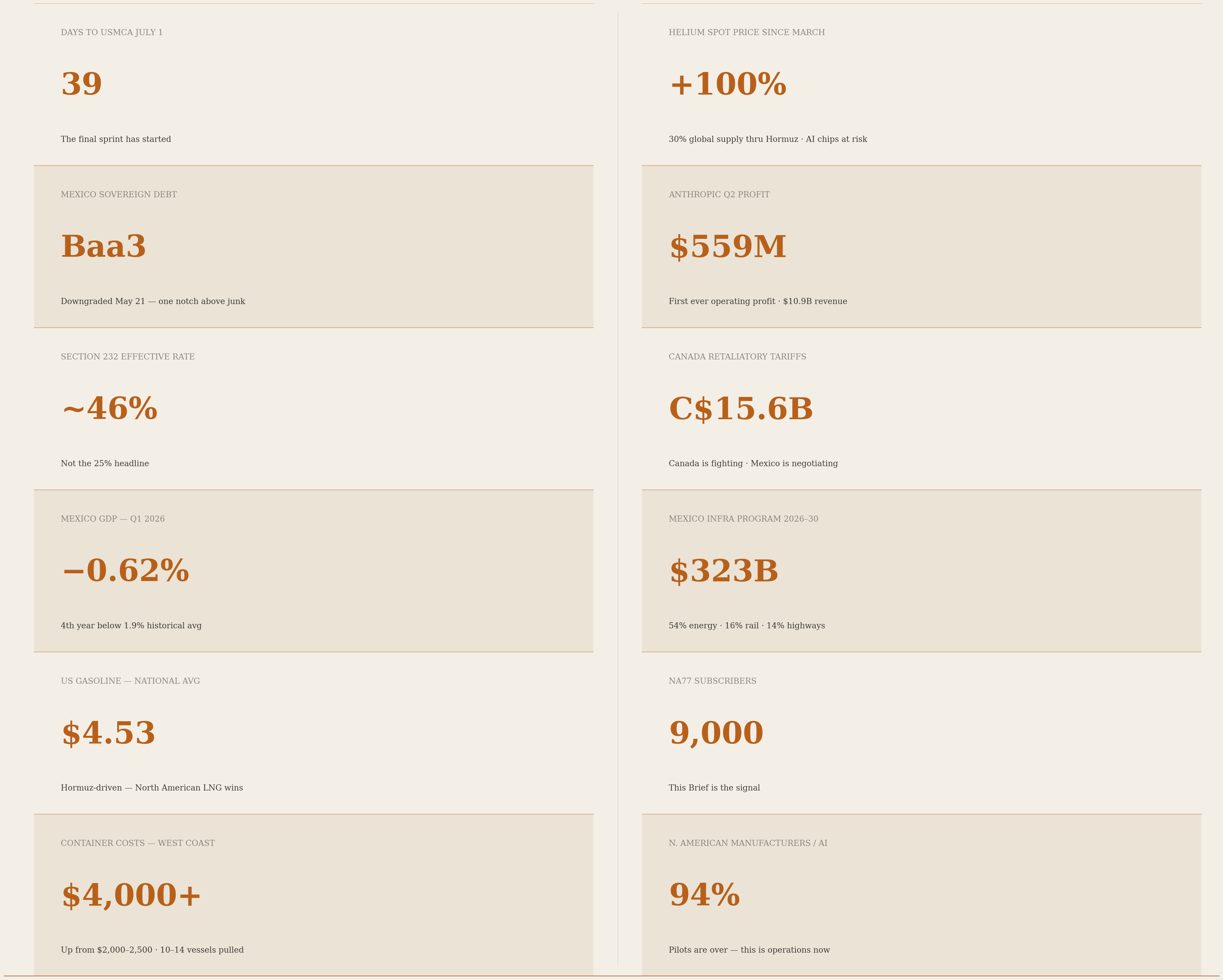
39 days to the July 1 decision node. If you are building supply chains that depend on USMCA’s duty-free status, the contingency planning window is now.
2. Trump in Beijing — Stalemate, Not Détente
President Trump completed a three-day state visit to China. China committed to $17B/year in US agricultural purchases, 200 Boeing aircraft, and both sides announced a “board of trade.” Then both governments released statements — and the statements barely overlapped. The Economist called it “a dysfunctional duo” failing to cooperate on AI safety, climate, and the Strait of Hormuz.
Tariffs remain at ~48%. Meanwhile, China is refusing to license Nvidia H200 chips to US partners operating in the country, and Xi is deliberately withholding further concessions until he sees how US midterms unfold in November. This is not détente — it is managed confrontation with a calendar attached.
For North America: every time Beijing and Washington disagree on what they agreed, the structural case for manufacturing inside the USMCA corridor grows stronger. Flex just committed $1B to Jalisco, Chihuahua, and Aguascalientes.
3. The Strait of Hormuz — Energy’s North American Moment
Iran has effectively closed the Strait of Hormuz since March 4 — the chokepoint for ~20% of global oil and 25% of LNG. US national average gasoline hit $4.53/gallon this week. Partial reopening is underway (54 ships transited the week of May 11–17, up from 25 the prior week), but the status quo will not return. North American LNG is gaining permanent market share in Asia and Europe.
The disruption is also triggering a helium crisis: the Strait carries approximately 30% of global helium supply, and spot prices have doubled since March. Helium is not just used in party balloons — it is a critical input for manufacturing the semiconductors that power AI data centers, and for hospital MRI machines. Separately, 10 to 14 container vessels have been pulled from US west coast routes, and container costs have spiked from $2,000–2,500 per container to $4,000+. North American logistics operators are absorbing the shock in real time.
North America is not just a manufacturing corridor. It is the most reliable energy corridor on the planet right now — and the helium crisis underscores how deep the supply chain interdependencies actually run.
4. Mexico’s $323 Billion Bet — Ambition, Downgrade, and a Governor in Crisis
President Sheinbaum announced MX$5.6 trillion (~$323B USD) in public-private infrastructure investment for 2026–2030 — 54% energy, 16% rail, 14% highways. The same week, Moody’s downgraded Mexico’s sovereign debt to Baa3 — one notch above junk — citing sustained fiscal weakness, a narrow revenue base, and continued PEMEX support.
Mexico’s GDP contracted -0.62% in Q1 2026 — the fourth consecutive year below its 1.9% historical average. And on April 29, the US DOJ unsealed an indictment against the Governor of Sinaloa, Rubén Rocha Moya, charging him with conspiring with the Sinaloa Cartel to secure his election in exchange for political protection. Rocha Moya took a leave of absence on May 2. These are not separate stories.
Ambition without institutional integrity does not build a country. It performs one.
5. AI Crosses the Shop Floor — And the Ledger
After three years of pilots, AI in North American manufacturing is now operations strategy. 94% of manufacturers report using some form of AI. AI-powered picking robots jumped from 14% to 32% since 2022. AI integration has cut energy use ~25% and reduced inventory holdings by 18%. The Big Four are now posting more AI vacancies than auditor positions. PepsiCo is running a digital twin program with Siemens and NVIDIA across its entire plant and supply chain.
And the AI companies themselves are now crossing into profitability: Anthropic posted its first-ever operating profit in Q2 2026 — $559M on $10.9B in revenue. OpenAI is preparing an IPO filing with Goldman Sachs and Morgan Stanley.
Together, Anthropic and OpenAI now account for approximately 89% of all AI startup revenues — a market consolidating around two poles faster than most analysts predicted.
The continent that leads in AI-enabled manufacturing will not just be the most cost-competitive — it will be the most responsive. In a world where disruption is the baseline, responsiveness is the new cost advantage.
🟠 QUICK SIGNALS — Also on the Radar
Mexico — EU Global Trade Agreement: Mexico and the European Union signed the modernized Mexico-EU Global Agreement this week — Sheinbaum, von der Leyen, and Costa signing together. The deal eliminates or reduces tariffs on virtually all goods and services between Mexico and the EU, establishes new rules on digital trade, sustainability, and government procurement. It diversifies Mexico’s export base at exactly the moment when USMCA terms are in flux.
Yokohama — Saltillo: Japanese tire giant Yokohama is building a $115M heavy machinery tire plant in Saltillo, Coahuila — a facility that was initially planned for the United States. The plant will produce mining and construction equipment tires. Yokohama also operates a separate $380M passenger tire facility near Saltillo since 2024. This is nearshoring from the US to Mexico, not from Asia.
VTech — Tijuana: VTech’s Tijuana operations are reporting “growing significantly” demand as US clients shift electronics manufacturing from China to Mexico. Cross-border electronics is accelerating, not slowing, despite tariff uncertainty.
Ken Griffin (Citadel): “AI agents are now doing PhD-level financial analysis in days that used to take months.” — Ken Griffin, CEO of Citadel, speaking at a financial conference this week. When the founder of one of the world’s most sophisticated hedge funds says AI is changing the pace of high-end analytical work, that is a signal about what is coming for every knowledge-intensive industry.
OpenAI / Musk: A jury deliberated for less than two hours before ruling in favor of OpenAI in Elon Musk’s lawsuit alleging breach of founding mission. The ruling rested on statute of limitations grounds. The trial clarified OpenAI’s IP ownership structure in ways that will matter for its IPO filing.
Naturgy — Nuevo León: Spanish energy company Naturgy confirmed $5.5 billion pesos (~$270M USD) in planned investment in Nuevo León energy infrastructure by 2030. Industrial energy supply in northern Mexico remains one of the continent’s most constrained bottlenecks.
AmperCap SPAC: A $125M Nasdaq-listed SPAC focused exclusively on US-Mexico integration announced its formation this week — one of the first financial vehicles designed specifically around the nearshoring thesis. Ticker not yet disclosed.
Tesla en México: The number of Teslas in circulation in Mexico nearly doubled between 2023–2024 — a difference of 33,000 units, more than the combined 2024 Mexico sales of Mercedes-Benz and BMW. (Whitepaper.mx via TUKÁN)
Rane Madras: The Indian auto parts company (steering and suspension systems; clients include VW, BMW, Volvo, Nissan) opened a greenfield facility in Aguascalientes through its subsidiary Rane Automotive Components Mexico (RACM) — a $31M investment, 300+ jobs. Executives said long-term Mexico investment depends directly on the T-MEC outcome. (Sources: MEXICONOW · Foundry Planet)
qomplement: Two Tec de Monterrey grads built an automation platform, moved to San Francisco weeks after launch, and were accepted into Y Combinator’s Spring 2026 batch — reportedly the only Mexican founders in that cohort. 20+ clients in six months, half in the US. (Source: Whitepaper.mx)
Court stays USMCA tariff ruling: The Court of International Trade struck down the 10% Section 122 tariffs on May 7. The Court of Appeals for the Federal Circuit immediately stayed the ruling on May 12. Section 301 tariffs are next — before July 24.
FreightWaves Borderlands: US-Mexico cross-border trade hit $84B in March, up 8.6% YoY. Werner Enterprises is doubling down on Mexico with an asset-based intermodal expansion. B-1 visa enforcement is intensifying at ports of entry, pressuring cross-border driver capacity.
🔵 DATA IN NUMBERS — Week of May 25 – May 31, 2026
🔵 EVENTS TO WATCH — Week of May 25 – May 31, 2026
📚 THE NA77 ARCHIVE — Catch up on our recent work
“Governments Are Not Accidents” — Live 3 piece series on why the political systems of the three nations reflect deliberate choices society & special interst groups have made— and what we can do to change our future today.
“The Board Is Set — North America Inside the Pause” — How the 90-day tariff pause reordered every assumption about the continent. Our most-read piece.
“Dr. Daniel Covarrubias — The Bridge” — A conversation with the leading analyst of the US-Mexico border economy on what the tariff architecture actually means for cross-border operators.
“México S.A. de C.V.” — The founding essay: why Mexico is not a country waiting to be discovered, but a company waiting to be understood.
⚪ THE LONGVIEW — English version (Spanish below)
The Table Is Incomplete. The Work Is Not.
The world is fracturing. That is not a metaphor.
The Strait of Hormuz remains the chokepoint for a fifth of global oil and a quarter of the world’s LNG. President Trump completed a three-day summit in Beijing and both governments published statements that barely overlapped. The two largest economies in the world, the two largest rivals from economic influence sitting together in the middle of a global storm; both know they have deep distrust, global ambitions and the risks. Clearly not the ideal times to bring calm to a storm that is being used to punish one of the two.
Both China and the US were unable to coordinate on AI safety, climate, or the energy crisis unfolding in real time. Tariffs between the two largest economies remain near 50%.
The world is dividing into competing blocs. Supply chains are being redrawn at historic speed. The race to control foundational AI infrastructure is not a technology story — it is a civilization story. And in the middle of all this, three nations that share a continent, 500 million people, and $30 trillion in combined GDP are still sitting in separate rooms.
That is the context for what opened today in Mexico City.
There is a chair missing at that table; Canada — the third nation, the country that completes the triangle — joins July 1, not today.
I name this plainly: the distance between Washington and Ottawa since President Trump’s second term began is real and documented.
He has said things Canadians have not forgotten and vice versa. Mark Carney’s speech of decoupling from the US economy at Davos was heard and applauded around the world; but the actions that followed speak louder than words: A deal with China and an immediate visit to Mexico with 200 of the top company CEOs of Canada is no small message.
There is not much we can do about the current relationship. What we can do is refuse to let it define the continent’s future because there is too much on the table that needs the 3 nations to agree on.
If the road to full trilateral integration runs through a US-Mexico bilateral first, then a US-Canada bilateral, then a Mexico-Canada corridor that builds its own institutional logic — so be it. Imperfect progress is still progress.
I advocate for North American Smart Integration — not uniformity, not the subordination of any nation’s identity, but the conscious building of a continent that plays to its own strengths.
The foundational truth of this vision: the United States, Mexico, and Canada are not three similar nations competing for the same things. They are three genuinely complementary civilizations & nations:
The United States brings capital scale, technological leadership, the world’s most dynamic innovation ecosystem, and the rule of law infrastructure that makes complex trade possible. And much more.
Mexico brings a young creative & hardworking workforce that is growing, strategic geography as the continent’s southern gateway, manufacturing depth, and energy assets the hemisphere needs. And much more.
Canada brings capital scale, rule of law and civility, natural resource sovereignty, institutional stability, sustainability culture, Arctic access, critical minerals, and a talent base that anchors the northern flank. And much more.
What one nation lacks, another holds in surplus. That is not a trade story. That is a civilization story.
This is why the USMCA conversation must move beyond tariffs and content rules. The continent I want to help build is a value community — three nations deciding together what standards they hold themselves to: on labor, on the environment, on AI governance, on shared natural resources, on the education of their children, on smart immigration and on shared vision.
These are the conversations that will determine whether North America leads the world or merely trades within it.
The argument for North American integration used to be primarily economic. That argument was always strong. Today it is existential. When the world’s two largest powers cannot coordinate on energy, AI, or basic supply chain stability — North America’s integrated civilization is not just a trade opportunity. It is the most valuable unrealized asset in the global order.
A word on Mexico, because this platform does not look away.
On May 21, Moody’s downgraded Mexican sovereign debt to Baa3 — one notch above junk — with GDP growth forecast below 1% for 2026. Days before that, former Sinaloa governor Rubén Rocha Moya was indicted by the US Department of Justice for allegedly conspiring with the Sinaloa Cartel to secure his election in exchange for political protection. Mexico’s institutions & political trust are under visible stress. The security situation in too many regions remains deeply alarming.
We are 130 million souls ready for a new era that we have been waiting for 100 years. The investment announcements are real. The infrastructure ambitions are real. The execution capacity and transparency remains to be seen.
The talent of the Mexican people is the most undervalued asset in the Western Hemisphere. But ambition without institutional integrity does not build a country. It performs one.
Mexico needs real transformation — not announced transformation. Institutions that function. Prosecutors who are not afraid. A political class willing to fix what is broken. A society that demands both.
The question that The North American — 77 will keep asking is whether our leaders are ready to lead the era they have been handed.
ONE FUTURE. THREE NATIONS.
— Eduardo Joffroy | The North American — 77 | May 25, 2026
⚪ THE LONGVIEW — Versión en español
La Mesa Está Incompleta. El Trabajo No.
El mundo se está fracturando. Eso no es una metáfora.
El Estrecho de Ormuz sigue siendo el punto de paso para una quinta parte del petróleo mundial y una cuarta parte del GNL del planeta. El presidente Trump completó una cumbre de tres días en Beijing y ambos gobiernos publicaron declaraciones que apenas coincidían. Las dos economías más grandes del mundo, los dos grandes rivales por la influencia económica global sentados juntos en medio de una tormenta global; ambos saben que tienen desconfianza profunda, ambiciones globales y los riesgos que eso conlleva.
Claramente no son los tiempos ideales para calmar una tormenta que está siendo utilizada para castigar a uno de los dos.
Tanto China como Estados Unidos fueron incapaces de coordinar sobre seguridad en inteligencia artificial, cambio climático o la crisis energética que se desarrolla en tiempo real. Los aranceles entre las dos economías más grandes del mundo se mantienen cerca del 50%.
El mundo se divide en bloques en competencia. Las cadenas de suministro se están redibujando a velocidad histórica. La carrera por controlar la infraestructura fundamental de la IA no es una historia tecnológica — es una historia de civilización.
Y en medio de todo esto, tres naciones que comparten un continente, 500 millones de personas y 30 billones de dólares en PIB combinado siguen sentadas en habitaciones separadas.
Ese es el contexto de lo que abrió hoy en la Ciudad de México.
Falta una silla en esa mesa; Canadá — la tercera nación, el país que completa el triángulo — se incorpora el 1 de julio, no hoy.
El distanciamiento entre Washington y Ottawa es real.
El presidente Trump ha dicho cosas que los canadienses no han olvidado, y viceversa. El discurso de Mark Carney sobre la dependencia economica con EUA en Davos fue escuchado y aplaudido en todo el mundo; pero las acciones que siguieron hablan más fuerte que las palabras: un acuerdo con China y una visita inmediata a México con 200 de los principales CEOs de Canadá no es un mensaje menor.
No hay mucho que podamos hacer en este momento respecto a la relación actual de dos naciones que han sido aliados toda la vida. Ya tendrán su momento para sanar las heridas y poner sus prioridades en orden. Lo que sí podemos hacer es negarnos a dejar que defina el futuro del continente, porque hay demasiado en juego que requiere que las tres naciones lleguen a acuerdos.
Si el camino hacia la integración trilateral plena pasa primero por un bilateral Estados Unidos-México, luego uno Estados Unidos-Canadá, luego un corredor México-Canadá con su propia lógica institucional — que así sea. El progreso imperfecto sigue siendo progreso.
Defiendo la Integración Inteligente Norteamericana — no uniformidad, no la subordinación de la identidad de ninguna nación, sino la construcción consciente de un continente que juegue con sus propias fortalezas.
La verdad fundamental de esta visión: Estados Unidos, México y Canadá no son tres naciones similares compitiendo por las mismas cosas. Son tres civilizaciones y naciones genuinamente complementarias:
Estados Unidos aporta escala de capital, liderazgo tecnológico, el ecosistema de innovación más dinámico del mundo y la infraestructura de estado de derecho que hace posible el comercio complejo. Y mucho más.
México aporta una fuerza laboral joven, creativa y trabajadora que sigue creciendo, geografía estratégica como puerta de entrada sur del continente, profundidad manufacturera y activos energéticos que el hemisferio necesita. Y mucho más.
Canadá aporta escala de capital, estado de derecho y civismo, soberanía sobre recursos naturales, estabilidad institucional, cultura de sostenibilidad, acceso al Ártico, minerales críticos y una base de talento que ancla el flanco norte. Y mucho más.
Lo que a una nación le falta, otra lo tiene en abundancia. Eso no es una historia de comercio. Es una historia de civilización.
Por eso la conversación del T-MEC debe ir más allá de los aranceles y las reglas de contenido. El continente que quiero ayudar a construir es una comunidad de valores — tres naciones que deciden juntas los estándares a los que quieren comprometerse: en materia laboral, ambiental, de gobernanza de la IA, de recursos naturales compartidos, en la educación de sus hijos, en migración inteligente y en visión compartida.
Estas son las conversaciones que determinarán si Norteamérica lidera al mundo o simplemente comercia dentro de él.
El argumento para la integración norteamericana solía ser principalmente económico. Ese argumento siempre fue sólido. Hoy es existencial. Cuando las dos potencias más grandes del mundo no pueden coordinarse en energía, IA o estabilidad básica de las cadenas de suministro — la civilización integrada de Norteamérica no es solo una oportunidad comercial. Es el activo más valioso e inexplotado en el orden global.
Sobre México, porque esta plataforma no le da la espalda a los datos:
El 21 de mayo, Moody’s rebajó la deuda soberana mexicana a Baa3 — un escalón por encima del grado especulativo — con un crecimiento del PIB proyectado por debajo del 1% para 2026. Días antes, el ex gobernador de Sinaloa, Rubén Rocha Moya, fue imputado por el Departamento de Justicia de Estados Unidos por presuntamente conspirar con el Cártel de Sinaloa para asegurar su elección a cambio de protección política.
Las instituciones mexicanas y la confianza política están bajo estrés visible. La situación de seguridad en demasiadas regiones sigue siendo profundamente alarmante.
Somos 130 millones de almas listas para una nueva era que hemos esperado 100 años. Los anuncios de inversión son reales. Las ambiciones de infraestructura son reales. La capacidad de ejecución y la transparencia están por demostrarse.
El talento del pueblo mexicano es el activo más subvalorado del hemisferio occidental. Pero la ambición sin integridad institucional no construye un país. Lo escenifica.
México necesita transformación real — no anunciada. Instituciones que funcionen. Fiscales que no tengan miedo. Una clase política dispuesta a corregir lo que está roto. Una sociedad que exija ambas cosas.
La pregunta que The North American — 77 seguirá haciendo es si nuestros líderes están listos para conducir la era que les ha tocado.
UN FUTURO. TRES NACIONES.
— Eduardo Joffroy | The North American — 77 | 25 de mayo de 2026