

🇲🇽 Ir a la versión en español ↓ | 🇺🇸 Jump to English version ↓
México lleva 500 años siendo administrado como una empresa privada en donde sus clientes no son los ciudadanos sino los que están en el poder.
No es metáfora. Es estructura. La compañía se fundó en 1521, ha cambiado de junta directiva cuatro veces, y nunca ha pagado dividendos a sus accionistas reales (los 130 millones de mexicanos cuyo trabajo, suelo y subsuelo financian la operación); solamente le pagaron dividendos a su mesa directiva y los que han mantenido el control del poder en México.
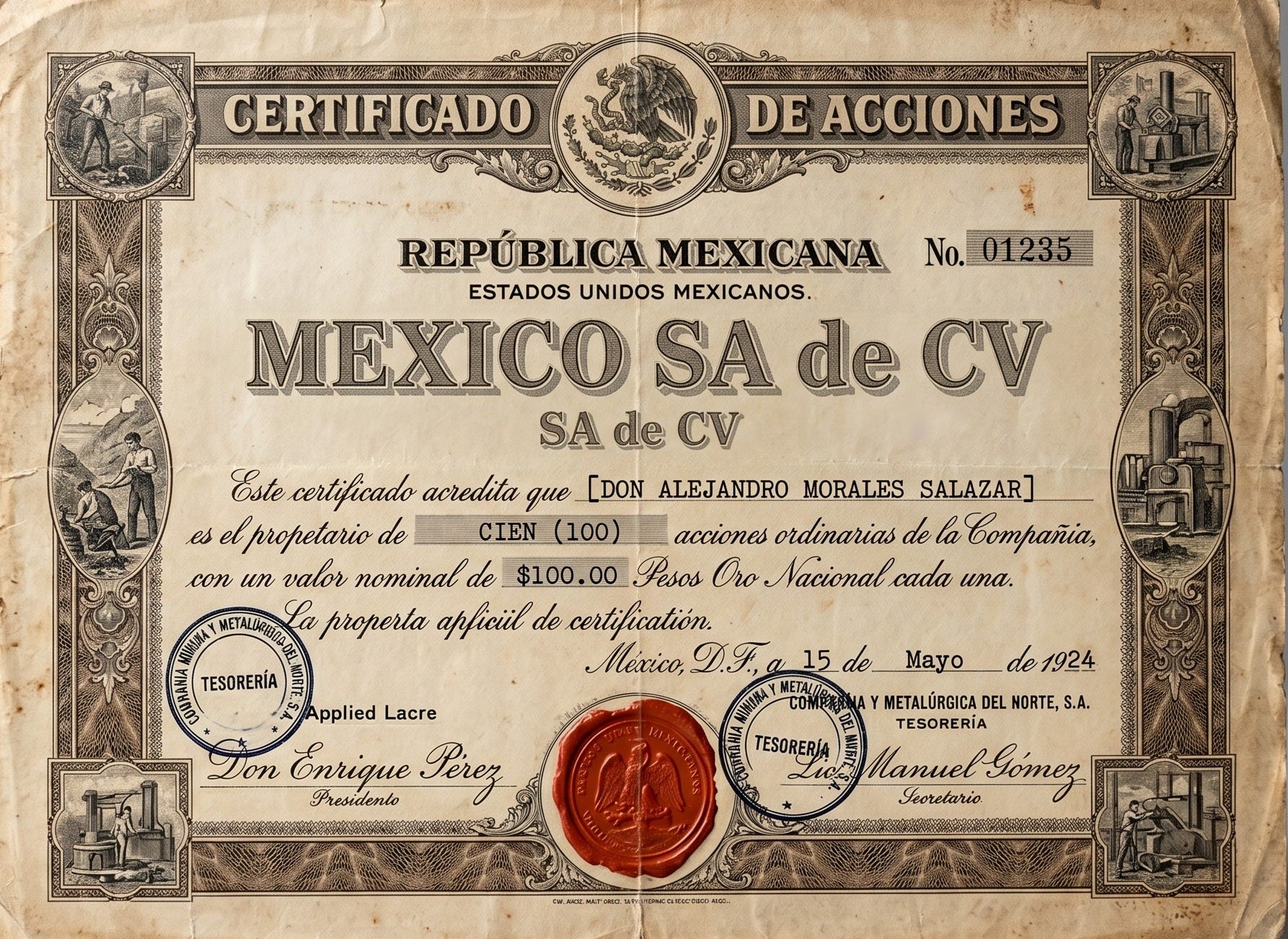
México S.A. de C.V. no existe, sin embargo así se ha operado el potencial del país desde hace 500 años por los que manejan el poder politico.
1521. Casa de Contratación. La colonia existe para alimentar a la corporación: plata hacia afuera, manufacturas hacia adentro, prohibición de comerciar con cualquier vecino.
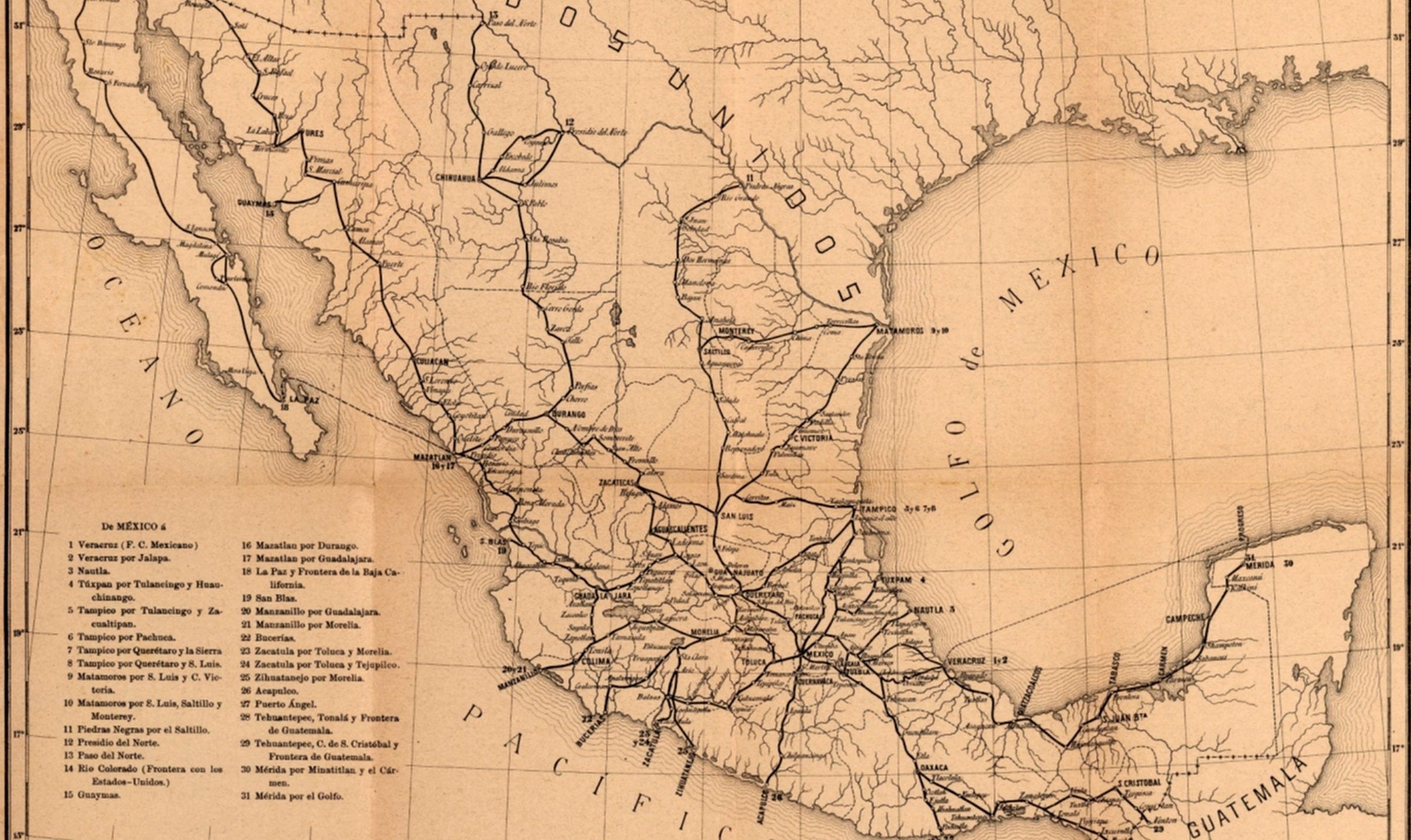
1821. La hacienda toma el lugar de la Corona. La red de caminos y postas que sale de Ciudad de México ya está diseñada para extraer hacia los puertos y hacia las fronteras, no para integrar entre ciudades. Cuando el Porfiriato llegue, no inventará el patrón — lo cableará en acero. El mapa de comunicaciones de 1885 no tiene líneas horizontales. No fue descuido. Fue diseño.
1910. La Revolución produce el monopolio más eficiente que México ha tenido, porque se llamó a sí mismo revolución. Pemex, CFE, banca, telecom, educación, medios. El dedazo fue una práctica de gobierno corporativo. Funcionó setenta años porque mantenía la ilusión de que la compañía pertenecía a la nación, cuando en realidad pertenecía al directorio.
1990. La privatización subasta el monopolio. Las rentas migran de manos públicas a manos privadas — Telmex, Televisa, los bancos post-Fobaproa — sin que el ciudadano notara que el cobrador había cambiado de uniforme.
2018. La cuarta refinanciación es distinta de las anteriores. Por primera vez en quinientos años, la compañía no intenta avanzar al siguiente sistema operativo — intenta reinstalar uno anterior. La privatización de energia se revierte. La energía se re-centraliza. Los órganos autónomos se debilitan. Una refinería se construye con la lógica energética de los años setenta, mientras el continente entero migra hacia generación distribuida y energías renovables.
Y aquí está la factura que México todavía no termina de procesar. Mientras la geografía le servía la oportunidad más grande de su historia moderna — el desacople comercial entre Estados Unidos y China, billones de dólares en cadenas de suministro buscando un nuevo hogar — la compañía decidió que ese era el momento perfecto para volver al pasado.
Nearshoring no es una promesa. Es una factura. Y la diferencia entre lo que México pudo capturar y lo que está capturando se mide en empleos que se fueron a Vietnam, en plantas que esperaban certeza energética y certeza jurídica, y no encontraron ninguna de las dos.
Cinco siglos. Cuatro modelos de propiedad. Un mismo sistema operativo: extraer del país, distribuir entre pocos, justificar el reparto con la palabra de moda — fe en el siglo XVI, orden en el XIX, revolución en el XX, mercado al cierre del milenio, transformación al inicio de éste.
Cada generación creyó que su reforma era la definitiva. Cada generación heredó la misma compañía con un nuevo logo.
Y sin embargo, la compañía sigue de pie.
Si una empresa sobrevive 500 años de mala administración y aún produce la economía número doce del mundo, eso ya no es un país. Es un stress-test aprobado por la historia.
El mexicano ha prosperado a pesar de su sistema, no gracias a él. Esa resiliencia debería haber sido la base de cualquier reforma seria. No lo ha sido. Las reformas se construyeron asumiendo que el mexicano era el problema. El mexicano ha sido, de hecho, el único activo que la compañía nunca supo administrar.
Aquí conviene una distinción que el debate público mexicano ha confundido por décadas.
Hay dos tipos de empresas grandes en este país. Las que aprendieron a competir cruzando fronteras — Bimbo, Bachoco, Cemex, Metalsa, Cydsa, Femsa, Gruma, Cinépolis, Mabe — y las que aprendieron a cobrar rentas de un mercado al que el sistema no permitía entrar a nadie más. Las primeras son la prueba de que el mexicano construye a escala mundial cuando el sistema es permeable. Las segundas son la prueba de lo que pasa cuando el sistema se sella.
El monopolio prefiere las segundas porque son controlables. El futuro de México depende de multiplicar las primeras.
México SA de CV ha invertido medio milenio en producir las segundas. La pregunta para esta generación es si va a invertir las próximas décadas en producir las primeras. Eso requiere convertir la compañía en otra cosa.
¿Por qué no crear el México Inc. (renovado) con un modelo de negocio totalmente nuevo y moderno en donde su función es ser una plataforma para que los ciudadanos y empresas privadas salgan a ganar al mercado y donde sea el referí para que se juegue bajo reglas claras y justas?
Una aceleradora es lo opuesto de un monopolio.
Un monopolio extrae de muchos para enriquecer a pocos. Una aceleradora invierte en muchos para que algunos construyan algo mayor que ellos mismos.
Esa es la inversión estructural que México nunca ha hecho en sí mismo y que podría ser el nuevo modelo de Mexico Inc.
La pregunta que nos debemos de hacer es: si el Estado va a seguir siendo el jugador principal de la economía, o si vamos a voltear el modelo para que los jugadores principales seamos los mexicanos. De esta forma el país recibe sus ingresos a través de los impuestos de una IP mucho más grande y con un rol mucho más claro en donde trata a los Mexicanos como siempre los debió haber tratado: Como sus clientes más importantes.
México Inc. podría convertirse en una especie de back office estratégico para México — invisible cuando todo funciona, decisivo cuando hace falta. El ciudadano y la empresa privada son la capa que produce. El Estado es la capa que sostiene. Esa es la arquitectura que México nunca construyó, porque la compañía de Mexico S.A. de C.V. estaba muy cómoda sin reportar a sus verdaderos dueños y sin atender a clientes.
Y aquí está la parte que México todavía no termina de decir en voz alta. Una aceleradora mexicana no funciona con capital local únicamente. No funciona con mercado interno únicamente. No retiene talento sin caminos hacia el norte. La aceleradora es continental por diseño, no por concesión. Capital de tres economías. Mercados de tres economías. Movilidad de talento entre tres economías.
El T-MEC no es un tratado comercial. Es nuestra cláusula antitrust.
Es la única infraestructura institucional que México ha aceptado en quinientos años que no fue diseñada para extraer de sus ciudadanos. Cada vez que la compañía estuvo a punto de abrirse de verdad, alguien convenció a los accionistas de que abrir la puerta era traición. La traición ha sido mantenerla cerrada.
La primera empresa del portafolio de la nueva aceleradora no será una startup. Será el ciudadano mexicano que ya sobrevivió cuatro versiones del monopolio sin que ningún sistema invirtiera en él.
Mexico Inc. será la empresa de todos. México S.A. de C.V. fue la empresa de unos pocos.
Es momento de dejar de ser clientes cautivos y convertirnos en los accionistas de nuestro propio futuro. México Inc es la visión para un nuevo y moderno modelo de país para un México listo para conectarse con Norteamérica como nunca antes.
— NA77 Un futuro. Tres Naciones.
¿Esta historia te importó?
Si NA77 vale tu tiempo, vale tu apoyo.
ENGLISH VERSION
Mexico S.A. de C.V.
The largest monopoly in Mexico is Mexico itself
For five hundred years, Mexico has been managed as a private company.
This is not a metaphor. It is structure. The company was founded in 1521, has changed boards of directors four times, and has never paid a dividend to its shareholders — the 130 million Mexicans whose labor, soil, and subsoil finance the operation. The corporate name has changed. The business model has not.
México S.A. de C.V. doesn’t exist but this is just how the country’s potential has been managed by those in power.
1521. Casa de Contratación. The colony exists to feed the corporation: silver out, manufactures in, prohibition on trading with any neighbor.
1821. The hacienda takes the Crown's place. Independence localized the monopoly without dissolving it. The road and postal network already radiating from Mexico City was designed to extract toward the ports and the borders, not to integrate between cities. When the Porfiriato came, it did not invent that pattern — it simply wired it in steel. The 1885 communications map has no horizontal lines. That was not an oversight. That was the design.
1910. The Revolution produced the most efficient monopoly Mexico has ever had, because it called itself a revolution. Pemex (state oil), CFE (state power), banking, telecom, education, media. The dedazo — the president’s finger choosing his successor — was a practice of corporate governance. It worked for seventy years because it sustained the illusion that the company belonged to the nation, when in reality it belonged to the board.
1990. Privatization auctioned the monopoly. The rents migrated from public hands to private hands — Telmex, Televisa, the post-Fobaproa banks — and the citizen never noticed that the collector had simply changed uniforms.
2018. The fourth refinancing is different from the others. For the first time in five hundred years, the company is not trying to upgrade to the next operating system — it is trying to reinstall an earlier one. Energy privatization is reversed. Energy is re-centralized. The autonomous bodies are weakened. A refinery is built on the energy logic of the 1970s, while the entire continent migrates toward distributed generation and renewables.
And here is the bill Mexico has not yet finished processing. While geography was serving Mexico its largest opportunity of the modern era — the commercial decoupling between the United States and China, trillions of dollars in supply chains looking for a new home — the company decided this was the perfect moment to go backward. Nearshoring is not a promise. It is an invoice. And the difference between what Mexico could have captured and what it is actually capturing is measured in the jobs that went to Vietnam, in the plants that arrived expecting energy certainty and legal certainty, and found neither.
Five centuries. Four ownership models. One operating system: extract from the country, distribute among a few, justify the distribution with the slogan of the era — faith in the sixteenth century, order in the nineteenth, revolution in the twentieth, market at the close of the millennium, transformation at the start of this one.
Each generation believed its reform was the definitive one. Each generation inherited the same company with a new logo.
And yet, the company is still standing.
If a company survives five hundred years of mismanagement and still produces the world’s twelfth-largest economy, that is no longer a country. It is a stress test that history has already passed. Mexicans have prospered in spite of their system, not because of it.
That resilience should have been the foundation of any serious reform. It has not been. Reforms were built on the assumption that the Mexican was the problem. The Mexican has been, in fact, the only asset the company never knew how to manage. The board never read its own balance sheet. So much so that today the country leans on the thirty million Mexicans who fled this management — whose remittances now exceed every dollar of foreign direct investment Mexico receives.
Here a distinction is worth drawing — one the Mexican public debate has confused for decades.
There are two kinds of large companies in this country. The ones that learned to compete by crossing borders — Bimbo, Bachoco, Cemex, Metalsa, Cydsa, Femsa, Gruma, Cinépolis, Mabe: the bakers, the cement-makers, the auto-parts engineers, the chemical innovators, the bottlers, the moviegoers, the appliance-makers. And the ones that learned to collect rents from a market the system would not let anyone else enter. The first kind is proof that the Mexican can build at world scale when the system is permeable. The second is proof of what happens when the system is sealed.
The monopoly prefers the second kind because they are controllable. Mexico’s future depends on multiplying the first.
Mexico S.A. de C.V. has invested half a millennium in producing the second. The question for this generation is whether it will invest the next decades in producing the first. That requires turning the company into something else.
An accelerator is not the opposite of a company. It is the opposite of a monopoly.
A monopoly extracts from many to enrich a few. An accelerator invests in many so that some can build something larger than themselves. That is the structural investment Mexico has never made in itself.
The question we have to ask ourselves is this: will the state remain the principal player in the economy, or will we invert the model so that Mexicans themselves become the principal players? In that model, the country draws its revenue through taxes on a far larger private sector, and its role is clearly defined: referee.
Mexico Inc. (renewed) could become the strategic back office of Mexico — invisible when everything works, decisive when it has to be. The citizen and private enterprise are the layer that produces. The state is the layer that supports. That is the architecture Mexico never built, because the company never wanted to stop running the stage.
And here is the part Mexico still does not say out loud. A Mexican accelerator does not work on local capital alone. It does not work on the domestic market alone. It does not retain talent without paths north. The accelerator is continental by design, not by concession. Capital from three economies. Markets across three economies. Talent mobility between three economies.
USMCA is the only antitrust suit Mexico ever lost — and won by losing.
It is the only institutional infrastructure Mexico has accepted in 500 years that was not designed to extract from its citizens. Every time the company was about to truly open, someone convinced the shareholders that opening the door was treason. The treason has been keeping it closed.
The first portfolio company of the new accelerator will not be a startup. It will be the Mexican citizen who already survived four versions of the monopoly without any system ever investing in him. The one who built a parallel economy, a family supply chain across the Río Bravo, a warehouse in Houston with a cousin inside. The one who already passed the due diligence of history.
Mexico Inc. is the new platform for every citizen. México S.A. de C.V. is the old platform that only benefits the few who hold a grip to its potential.
It is time to stop being captive customers and become the shareholders of our own future. Mexico Inc is the vision for a new modern Mexican Nation ready to connect with North America like never before.
— NA77 One future. Three nations.
Did this story matter to you?
If NA77 is worth your time, it’s worth supporting.