
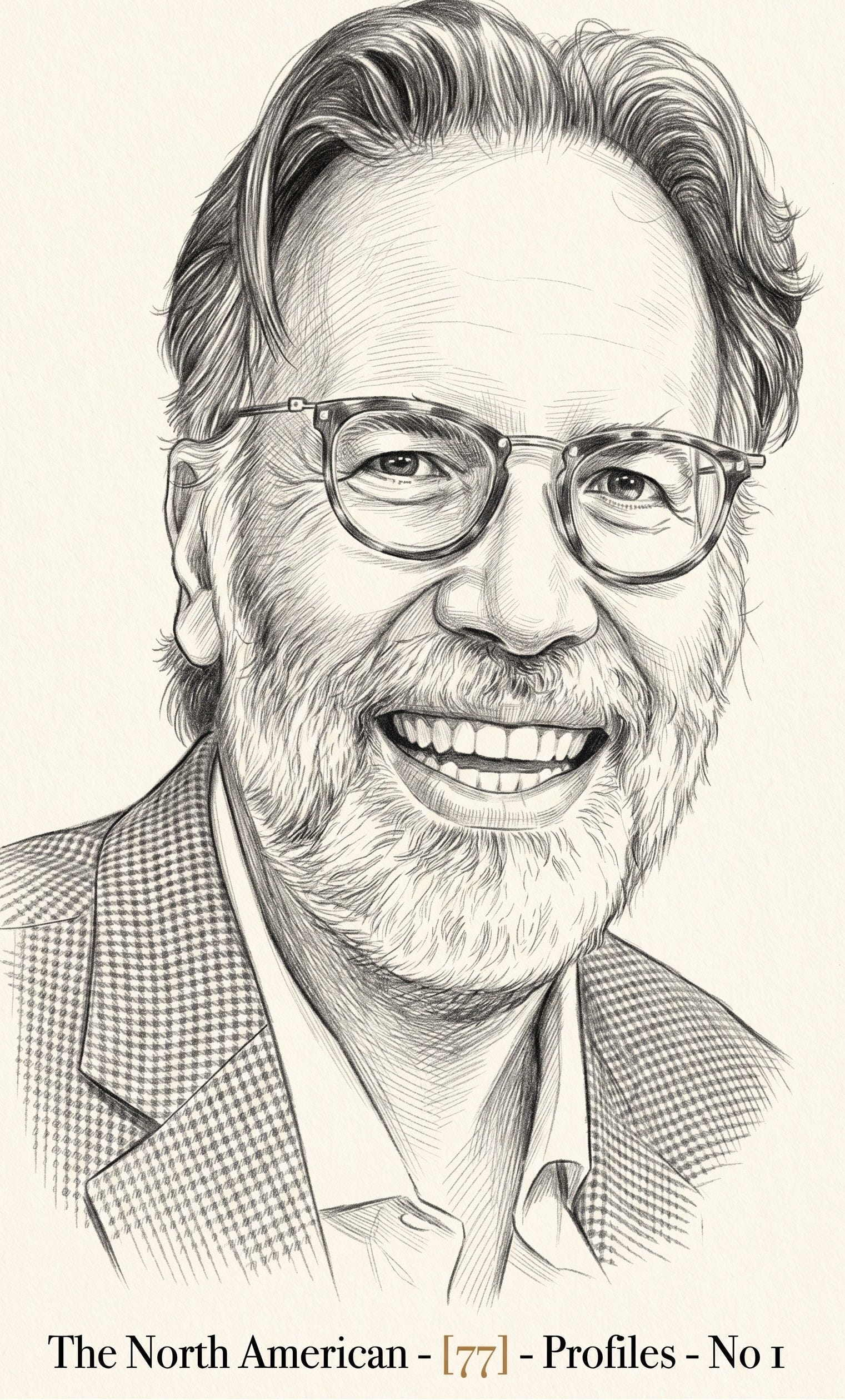
Dr. Daniel Covarrubias
El hombre que estudia el corredor. Profile №01 · Laredo, Texas · Mayo 2026

🇺🇸 Jump to English version ↓
0 — Intro
Tuvimos la oportunidad de entrevistar a Daniel Covarrubias via Zoom, Manuel Familiar y yo la semana pasada. Hablamos de diversos temas de Norteamérica y de nuestro dolor compartido por ver a México y a Estados Unidos en mejores dinámicas de colaboración. Hablamos de su pasión por la tecnología ( Labs) y sobre el impacto que está teniendo en la industria de Supply Chain. Hablamos de nuestra preocupación compartida de estar siendo vocales con nuestros colegas para que no se queden dormidos en una era de tanta disrupción. Entre muchas otras cosas mas que podran leer más abajo.
1 — El Inicio
Está sentado en Laredo, en el cruce comercial más grande del planeta. Frente a él, miles de tráileres pasan cada día rumbo al norte y al sur. Él los cuenta — o, más bien, los lee. Lee el peso de las cargas, la cadencia del tráfico, las horas de espera, los vacíos, las fricciones en los datos que nadie más observa. Y luego escribe. Cincuenta op-eds en cuatro años. Tres países. Dos idiomas. Una sola tesis: el comercio ya cruza la frontera. Las instituciones, no.
2 — La Identidad
El Dr. Daniel Covarrubias es, en su esencia, un traductor. No de idiomas — eso lo hace sin pensarlo — sino de sistemas. Toma el lenguaje técnico de las cadenas de suministro, los modelos econométricos del impacto comercial, los protocolos digitales del cruce fronterizo, y los convierte en argumentos que un alcalde de Laredo, un senador en Washington o un industrial en Monterrey puedan leer y accionar.
3 — Una Amistad de Más de Veinticinco Años
Daniel es mi amigo desde hace más de veinticinco años y mi colega en los temas que cruzan la frontera y a Norteamérica. Nos conocimos en el Tec de Monterrey, y la vida profesional nos volvió a cruzar — como nos cruza la geografía. Ambos somos de frontera, ambos comprometidos con ver un mejor futuro para nuestro continente y para nuestras fronteras.
Lo que distingue a Daniel es que ve lo que otros no ven, y lo ha visto desde hace mucho tiempo. Ha hecho su misión que toda la industria y las comunidades que viven del comercio transfronterizo despierten y se actualicen. Esa misión es la razón por la que Profile №01 de The North American — 77 le pertenece.
4 — El Trabajo
Covarrubias es director del Texas Center for Border Economic and Enterprise Development (TCBEED) en la A. R. Sanchez, Jr. School of Business de Texas A&M International University, cargo que asumió en julio de 2021. Su doctorado en Competitividad Empresarial y Desarrollo Económico es de Deusto Business School en España, con una maestría en Ciencia Política de TAMIU, un MBA de la Universidad de Texas en San Antonio, y la licenciatura del Tec de Monterrey. Es secretario ejecutivo y tesorero de la Association of Borderlands Studies.
Bajo su dirección, el Texas Center ha producido el análisis más exhaustivo hasta la fecha sobre el impacto laboral de la disrupción comercial trinacional.
El estudio en tres tomos publicado entre junio y octubre de 2025 — uno por país — concluye que 9.9 millones de empleos en Estados Unidos, México y Canadá están expuestos a la fragmentación de los flujos comerciales que sostienen 1.8 trillones de dólares en intercambio intra-regional anual. La metodología es propia. Los datos son auditables. La conclusión es difícil de descartar.
Acaba de fundar su Substack, The Bridge (thebridgedc.substack.com), lanzado el 30 de marzo de 2026, publica sobre comercio, tecnología y el futuro de Norteamérica, con gráficas interactivas en Datawrapper y herramientas complementarias de labs.drdanielcovarrubias.com. Su libro Navigating the New Era of U.S.-Mexico Trade: Infrastructure, Technology, and the Future of Cross-Border Trade (septiembre 2024) — disponible en Amazon — trata sobre el aceleramiento del comercio transfronterizo en Norteamérica y el impacto de las tecnologías exponenciales sobre los procesos logisticos del corredor — un campo que él ha llamado Logistechs: el impacto que las tecnologías exponenciales tienen en la logística.
Su sitio de labs (labs.drdanielcovarrubias.com) mapea el comercio transfronterizo en tres escalas: The Corridor (Laredo y Nuevo Laredo), Texas Border (los 11 puertos terrestres de Texas) y U.S.–Mexico Border (26 puertos a lo largo de 1,954 millas), acompañado de ocho op-eds interactivos en formato scrollytelling.
Además, ha publicado cincuenta op-eds en cuatro años — en Laredo Morning Times, Rio Grande Guardian, El Financiero y otras plataformas regionales y nacionales — y mantiene un boletín privado con más de mil suscriptores.
5 — La Visión Norteamericana
De ese enfoque emergen tres propuestas que han pasado de la teoría a la mesa política.
La Agencia Binacional de Aduana — co-autoría con Jerónimo Gutiérrez — propone fusionar funciones operativas de CBP y ANAM para cerrar la brecha digital y de protocolos que actualmente fragmenta el cruce comercial más importante del mundo.
El North American Industrial Coordination Council — co-autoría con Gerry Schwebel y NASCO Network — propone un marco trilateral para coordinar política industrial, no sólo arancelaria.
Y el North American Digital Initiative (NADICI) propone una estrategia continental de soberanía digital, partiendo de la premisa de que si Estados Unidos llega solo a la frontera de la IA, el resto del continente se vuelve riesgo de seguridad nacional para Washington antes de poder volverse socio.
Las tres propuestas comparten una arquitectura común: ninguna requiere concesiones unilaterales. Las tres parten del supuesto de que la integración ya existe en la práctica y de que el siguiente paso no es comercial — es institucional. Justo esas son las creencias fundamentales por las que existe The North American — 77.
6 — La Marca del Camaleón
Daniel cruza fronteras que pocos académicos cruzan a la vez.
Cruza la frontera de cultura e idioma — publica en inglés en Laredo Morning Times y Rio Grande Guardian, en español en El Financiero, y enseña en una universidad binacional.
Cruza la frontera disciplinaria — economista de formación, construye aplicaciones en Claude Code en su tiempo libre, y desarrolla marcos analíticos sobre inteligencia artificial aplicada a la logística Labs
Cruza la frontera académico-operativa — sus propuestas no se quedan en revistas indexadas; llegan al D.C. Forum, al North Capital Forum, al Cali-Baja Business Summit.
Cruza, finalmente, la frontera generacional — a una edad en la que la mayoría de sus pares se atrinchera en sus ideas y costumbres tradicionales, él se reinventa con cada herramienta nueva: Claude Code abierto en su terminal a las once de la noche, construyendo aplicaciones personales para entender por dentro lo que enseña por fuera.
Cruzó todas estas fronteras. Conservó su esencia: la disciplina del economista, la curiosidad del constructor, y la convicción de que el conocimiento existe para mover sistemas, no para decorarlos.
Es un verdadero Camaleón del Desierto — no tiene fronteras y se adapta a todas las condiciones.
7 — En Su Voz
“Estados Unidos está peleando con China la supremacía de la inteligencia artificial, y todos aquí queremos que Estados Unidos gane. Pero lo que no va a estar padre es que si Estados Unidos llega a la meta y gana, y México se quedó allá, y Canadá también se quedó bien rezagado. Pues eso va a ser una crisis de seguridad nacional.”
— Sobre la urgencia de una iniciativa digital continental · Abril 2026.
“Jerónimo Gutiérrez y yo escribimos el tema de la Agencia Binacional de Aduana porque la brecha digital entre CBP y ANAM es operativa. Las dos agencias no se comunican. No hay protocolos compartidos. Estamos corriendo el cruce más importante del mundo a base de fe.”
— Sobre la realidad operativa del cruce fronterizo · Abril 2026.
“Las personas que más valen son las que le entienden al modelo de negocio y que le entienden al tema de la tecnología. No necesariamente que sean ingenieros, pero que le entiendan a la tecnología también. Ese match… eso para mí vale oro.”
— Sobre el perfil que el siglo XXI norteamericano requiere · Abril 2026.
7.5 — La Pregunta Abierta
Daniel y Jerónimo Gutiérrez han propuesto algo que el corredor necesita con urgencia y que el momento político quizás aún no permite: una Agencia Binacional de Aduana que fusione operativamente a CBP y ANAM en una sola capa funcional. La propuesta es técnicamente sólida, está institucionalmente precedida — el Acuerdo Canadá-Estados Unidos de Preinspección de 2015 ofrece una plantilla — y es económicamente necesaria.
Pero requiere que México haga algo que históricamente no ha estado dispuesto a hacer: ceder soberanía operativa en la frontera a cambio de autoridad continental compartida.
¿Puede una Agencia Binacional de Aduana existir realmente dentro de la doctrina de soberanía mexicana — o es precisamente el tipo de idea limpia que el sistema fue diseñado para rechazar?
El siguiente capítulo de Daniel, y el de Norteamérica, podrían ser el mismo capítulo.
El white paper de la Agencia Binacional de Aduana aborda esto directamente: soberanía preservada a través de gobernanza balanceada, no fusión de agencias.
8 — Lo Que Sigue
Tres líneas de trabajo definen el siguiente ciclo de Covarrubias.
Primero, completar y lanzar el libro — un manual práctico, dice él, no un tratado académico — que destila cuatro años de investigación sobre cómo las tecnologías exponenciales reconfiguran el cruce fronterizo.
Segundo, profundizar la agenda tecnológica del Texas Center: el piloto de drayage transfronterizo con vehículos eléctricos en colaboración con el Texas A&M Transportation Institute, financiado por NADBank — que evalúa si los camiones de drayage eléctrico pueden absorber una parte de los 18,000 cruces comerciales diarios en Laredo, con implicaciones para las emisiones, los costos de combustible y la resiliencia del corredor —, y el marco “Why Not A.I.” aplicado a la logística aduanal.
Tercero, llevar la conversación digital al espacio continental — abogando por una iniciativa norteamericana de inteligencia artificial antes de que el rezago entre los tres países se convierta en el siguiente factor de riesgo geopolítico.
A partir de este año, Covarrubias se integra a The North American — 77 como colaborador editorial fundador.
9 — El Puesto de Escucha
Lecturas esenciales
The Binational Customs Agency — con Jerónimo Gutiérrez, 2025
NAICC — North American Industrial Coordination Council Proposal — con Gerry Schwebel y NASCO Network, 2025
NADICI — North American Digital Initiative — diciembre 2025
North American Trade Integration at Risk — Análisis de impacto laboral (México · EE.UU. · Canadá), 2025
OpEd 50 — End of Year — diciembre 2025
Dónde leerlo
The Bridge en Substack — The Bridge
Labs (labs.drdanielcovarrubias.com)
Personal Website · Texas Center
Laredo Morning Times · Rio Grande Guardian · El Financiero
Su libro
Navigating the New Era of U.S.-Mexico Trade: Infrastructure, Technology, and the Future of Cross-Border Trade — Daniel Covarrubias, Ph.D., septiembre 2024 — Disponible en Amazon
Contacto institucional
dcova@tamiu.edu · TAMIU A. R. Sanchez, Jr. School of Business · TCBEED
Nota del Editor
Daniel es mi amigo desde hace más de veinticinco años. Lo invitamos a dar pláticas en Trade Hub Summit del 2023 a 2025 en la Ciudad de México. He leído cada uno de sus papers. No solo me impresiona la dimensión y atención al detalle de sus propuestas, su claridad — sino sobre todo su enfoque y su consistencia. Daniel escribe cada semana mientras dirige un centro de investigación, enseña, asesora a NASCO Network, y construye aplicaciones en Claude Code en su tiempo libre — y está por lanzar tecnologías al mercado.
The North American — 77 existe para amplificar a personas como el Dr. Daniel Covarrubias: esenciales para el futuro de un mejor Norteamérica.
Eduardo Joffroy · Editor in Chief
The North American - 77
Si encuentras valor en NA77, te invitamos a que te suscribas y que nos ayudes a correr la voz con tus contactos:
English version:
Dr. Daniel Covarrubias
The man who studies the corridor.
Profile №01 · Laredo, Texas · May 2026
0 — Intro
Last week, Manuel Familiar and I had the chance to sit down with Daniel Covarrubias over Zoom. We covered a range of North American questions and our shared frustration at watching Mexico and the United States fail to build the collaborative dynamics this continent deserves. We talked about his passion for technology and the impact it is having on the supply chain industry. We talked about a worry we hold in common — being vocal with our colleagues so they don’t sleep through an era of this much disruption. Among many other things you’ll find below.
1 — The Beginning
He sits in Laredo, at the largest commercial crossing on the planet. In front of him, thousands of trucks roll north and south every day. He counts them — or more accurately, he reads them. He reads the freight weights, the cadence of the traffic, the wait times, the gaps, the frictions in the data nobody else observes. Then he writes. Fifty op-eds in four years. Three countries. Two languages. One thesis: trade already crosses the border. The institutions do not.
2 — The Identity
At his core, Dr. Daniel Covarrubias is a translator. Not of languages — that he does without thinking — but of systems. He takes the technical idiom of supply chains, the econometric models of trade-impact analysis, the digital protocols of border crossing, and converts them into arguments a Laredo mayor, a Washington senator, or a Monterrey industrialist can read and act on.
3 — A Friendship of More Than Twenty-Five Years
Daniel has been my friend for more than twenty-five years and my colleague on every question that crosses the border and the continent. We met at Tec de Monterrey, and our professional lives kept crossing — the way geography keeps us crossing. Both of us are border people, both committed to a better future for our continent and our crossings.
What sets Daniel apart is that he sees what others do not see, and he has been seeing it for a long time. He has made it his mission for the industry and the communities that live from cross-border trade to wake up and modernize. That mission is the reason Profile №01 of The North American — 77 belongs to him.
4 — The Work
Covarrubias is Director of the Texas Center for Border Economic and Enterprise Development (TCBEED) at the A. R. Sanchez, Jr. School of Business at Texas A&M International University, a role he has held since July 2021. His Ph.D. in Business Competitiveness and Economic Development is from Deusto Business School in Spain, with an M.A. in Political Science from TAMIU, an MBA from the University of Texas at San Antonio, and a B.A. from Tecnológico de Monterrey. He serves as Executive Secretary and Treasurer of the Association of Borderlands Studies.
Under his direction, the Texas Center has produced the most comprehensive analysis to date of the labor impact of trinational trade disruption. The three-volume study released between June and October 2025 — one per country — concludes that 9.9 million jobs across the United States, Mexico, and Canada are exposed to the fragmentation of trade flows that sustain $1.8 trillion in annual intra-regional exchange. The methodology is original. The data is auditable. The conclusion is hard to dismiss.
He has just launched his Substack, The Bridge (thebridgedc.substack.com), launched March 30, 2026, publishes on trade, technology, and the future of North America, with interactive Datawrapper charts and companion tools from labs.drdanielcovarrubias.com. His book Navigating the New Era of U.S.-Mexico Trade: Infrastructure, Technology, and the Future of Cross-Border Trade (September 2024) — available on Amazon — is about the acceleration of cross-border trade in North America and the impact of exponential technologies on the corridor’s logistics — a field he calls Logistechs: the impact that exponential technologies have on logistics.
His labs site (labs.drdanielcovarrubias.com) maps cross-border trade at three scales: The Corridor (Laredo and Nuevo Laredo), Texas Border (all 11 Texas land ports), and U.S.–Mexico Border (26 ports across 1,954 miles), accompanied by eight interactive op-eds in scrollytelling format.
He has also published fifty op-eds in four years — across Laredo Morning Times, Rio Grande Guardian, El Financiero, and other regional and national outlets — and maintains a private newsletter with more than a thousand subscribers.
5 — The North American Lens
Out of that stance, three proposals have moved from theory to the policy table.
The Binational Customs Agency — co-authored with Jerónimo Gutiérrez — proposes fusing operational functions of CBP and ANAM to close the digital and protocol gap that currently fragments the world’s most important commercial crossing.
The North American Industrial Coordination Council — co-authored with Gerry Schwebel and NASCO Network — proposes a trilateral framework to coordinate industrial policy, not merely tariffs.
And the North American Digital Initiative (NADICI) proposes a continental digital-sovereignty strategy, on the premise that if the United States reaches the AI frontier alone, the rest of the continent becomes a national-security liability to Washington before it can become a partner.
The three proposals share an architecture: none requires unilateral concession. All three begin from the premise that integration already exists in practice and that the next move is not commercial — it is institutional. Those are precisely the founding convictions of The North American — 77.
6 — The Camaleón Mark
Daniel crosses borders few academics cross simultaneously.
He crosses the border of culture and language — publishing in English in Laredo Morning Times and Rio Grande Guardian, in Spanish in El Financiero, teaching at a binational university.
He crosses the disciplinary border — economist by training, he builds applications in Claude Code in his free time and develops analytic frameworks for artificial intelligence applied to logistics.
He crosses the academic-operational border — his proposals do not stay in indexed journals; they reach the D.C. Forum, the North Capital Forum, the Cali-Baja Business Summit.
He crosses, finally, the generational border — at an age when most of his peers entrench in their ideas and traditional habits, he reinvents himself with each new tool: Claude Code open in his terminal at eleven at night, building personal applications to understand from the inside what he teaches from the outside.
He crossed all of these borders. He kept his essence — the discipline of an economist, the curiosity of a builder, and the conviction that knowledge exists to move systems, not to decorate them.
He is a true Camaleón del Desierto — he has no borders, and he adapts to every condition.
7 — In His Voice
“The United States is racing China for AI supremacy. Everyone here wants the United States to win. But if the U.S. reaches the finish line alone, with Mexico left behind and Canada equally lagging — that’s not a victory. That’s a continental security crisis.”
— On the urgency of a continental digital initiative · NA77 session, April 2026. Translated from Spanish.
“Jerónimo Gutiérrez and I wrote the Binational Customs Agency proposal because the digital gap between CBP and ANAM is operational. The two agencies don’t communicate. There are no shared protocols. We are running the world’s most important crossing on faith.”
— On the operational reality of the U.S.–Mexico border · NA77 session, April 2026. Translated from Spanish.
“The people who matter most right now are the ones who understand the business model and the technology. They don’t need to be engineers. They need to be fluent in both. That match — that’s gold.”
— On the profile the 21st-century North American economy requires · NA77 session, April 2026. Translated from Spanish.
7.5 — The Open Question
Daniel and Jerónimo Gutiérrez have proposed something the corridor urgently needs and the political moment may not yet permit: a Binational Customs Agency that operationally fuses CBP and ANAM into a single functional layer. The proposal is technically sound, institutionally precedented — the 2015 Canada–U.S. Preclearance Agreement offers a template — and economically necessary.
But it requires Mexico to do something it has historically been unwilling to do: cede operational sovereignty at the border in exchange for shared continental authority. Can a Binational Customs Agency actually exist within the political reality of Mexican sovereignty doctrine — or is it precisely the kind of clean idea the system was designed to refuse?
Daniel’s next chapter, and North America’s, may be the same chapter.
The BCA white paper addresses this directly: sovereignty preserved through balanced governance, not the merger of customs agencies.
8 — What’s Next
Three lines of work define Covarrubias’s next cycle.
First, completing and launching the book — a practical manual, he insists, not an academic treatise — that distills four years of research on how exponential technologies are reshaping the border crossing.
Second, deepening the Texas Center’s technology agenda: the cross-border electric drayage pilot with the Texas A&M Transportation Institute, funded by NADBank — which tests whether electric drayage trucks can absorb a share of the 18,000 daily commercial crossings at Laredo, with implications for emissions, fuel costs, and the resilience of the corridor —, and the “Why Not A.I.” framework applied to customs logistics.
Third, taking the digital conversation to the continental scale — advocating for a North American AI initiative before the lag between the three countries becomes the next geopolitical risk factor. Beginning this year, Covarrubias joins The North American — 77 as a founding editorial collaborator.
9 — The Listening Post
Essential Reading
The Binational Customs Agency — with Jerónimo Gutiérrez, 2025
NAICC — North American Industrial Coordination Council Proposal — with Gerry Schwebel and NASCO Network, 2025
NADICI — North American Digital Initiative — December 2025
North American Trade Integration at Risk — Tariff impact analyses (Mexico · U.S. · Canada), 2025
OpEd 50 — End of Year — December 2025
Where to Read Him
The Bridge on Substack
Labs (labs.drdanielcovarrubias.com)
Laredo Morning Times · Rio Grande Guardian · El Financiero
His Book
Navigating the New Era of U.S.-Mexico Trade: Infrastructure, Technology, and the Future of Cross-Border Trade — Daniel Covarrubias, Ph.D., September 2024 — Available on Amazon
Institutional Contact
dcova@tamiu.edu · TAMIU A. R. Sanchez, Jr. School of Business · TCBEED
Editor’s Note
Daniel has been my friend for more than twenty-five years. We invited him to speak at Trade Hub Summit for three consecutive years of the event in Mexico City. I have read every one of his papers. What impresses me is not only the scale and the attention to detail of his proposals, or their clarity — it is, above all, his focus and his consistency.
Daniel writes every week while running a research center, teaching, advising NASCO Network, and building applications in Claude Code in his free time — and is about to bring his own technologies to market. The North American — 77 exists to amplify people like Dr. Daniel Covarrubias: essential to the future of a better North America.
Eduardo Joffroy · Editor in Chief
The North American — 77
If you find value in NA77 please help us by subscribing and if you can, please recommend us to your contacts: