
Governments Are Not Accidents. They Are Reflections.
Governments Are Mirrors of Societies; Why societies produce the leaders they produce — and why North America cannot afford another generation of pretending. Paper 1 of II.

By Eduardo Joffroy G
Paper I of III of the Series: The Reflexions of Our Nations
Leer en Espanol: Los Gobiernos son Reflejos de la Sociedad
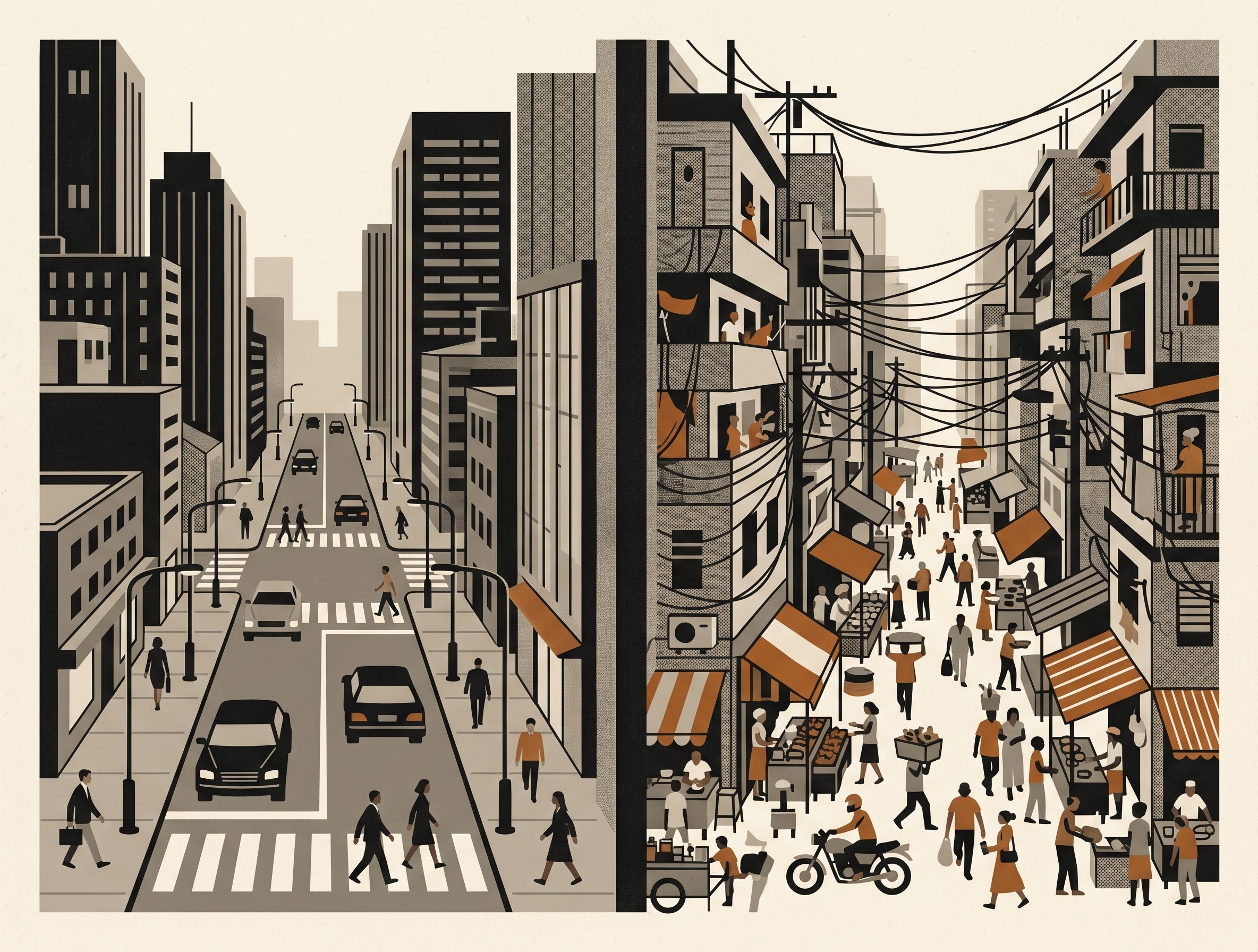
From Clinton to Trump. From Fox to Sheinbaum. Thirty years of watching North American politics from both sides of a single line.
A note on scope. I have lived these years primarily from the U.S.–Mexico seam. Canadian politics, I have observed from outside; my understanding is informed but not lived. This essay focuses on the two democracies I know in my bones. Canada will receive its own treatment, on its own terms, in a future paper of this series.
The pattern that came out of those decades was not partisan, and not even particularly national. It was structural.
Governments are not accidents. They are reflections.
The leaders a nation produces — and the leaders it tolerates — are a measure of the nation itself: of what it believes, what it has been taught, what it can still imagine.
Good leaders do exist. Some of them have given decades of their lives to public service, often at real personal cost, and have shaped their countries for the better. But even the best leader cannot give a country something its citizenry has not yet built. The country we have, in the end, is the country we are building together — day by day, election by election, conversation by conversation.
This is not a moral claim. It is an observation.
I grew up crossing the U.S.–Mexico border every day for thirteen years of childhood. By the time I was twelve, I had spent more hours of my life standing in border lines than most people will spend in a lifetime.
What the border taught me, more than anything else, was that the difference between the two countries was not geography or weather or even economy. It was a difference of expectations.
On the U.S. side, the city was always clean, the police enforced the law, and citizens and visitors alike respected the rules, the laws, and the culture — because if you didn’t, there were consequences. The rule of law was less a written code than a daily habit of mind.
On the Mexican side, meters away in distance and miles away in reality; the expectations inverted. The streets were always dirty and nobody did anything about it. The city lights were never uniform and nobody complained. The streets were disorderly, without signage — and that was just how things were. You ran red lights and there were no consequences. If a police officer did happen to stop you, before writing a ticket he would offer you a quick way out. You did not expect the rule that was written to be the rule that was applied. And so the everyday behavior of ordinary citizens adjusted.
Mexicans did not collectively fail to keep order. Mexicans, in the absence of any expectation that the state would keep order, organized our daily lives around its absence.
This is the deepest layer of the mirror. A government reflects the behaviors, customs, and habits of its citizens — and the behaviors, customs, and habits of its citizens reflect the government they have learned to expect.
The relationship is bidirectional. It produces, over generations, a civic equilibrium — a society and its state shaping one another into the form they will both have to live with.
Before either country had its first president, each had its first sentence. Those sentences predicted everything that followed.
The United States declared itself into existence in 1776:
We hold these truths to be self-evident, that all men are created equal, that they are endowed by their Creator with certain unalienable Rights, that among these are Life, Liberty and the pursuit of Happiness.
Mexico declared itself in 1917, after a revolution that had cost a million lives. Article 39 of the new constitution:
La soberanía nacional reside esencial y originariamente en el pueblo. Todo poder público dimana del pueblo y se instituye para beneficio de éste.
Both texts place sovereignty in the people.
But the countries they constituted are differently configured.
The American framers wrote a state designed to guarantee the conditions under which citizens would pursue their own ends.
The Mexican framers wrote a state designed to deliver outcomes — education, land, work, dignity — directly to its citizens.
The American state was constituted as a platform.
The Mexican state was constituted as an actor.
Two opposite bets, written into the founding documents. Each country has spent a century living out the consequences.
What each country built — and what each one became
The bet either country made at its founding did not produce results immediately. Both took roughly a century to produce their peaks.
The American peak ran from the end of the Second World War to the mid-1970s. Three decades during which the country built the conditions of modern life as the world now knows it.
The interstate highway system rebuilt the country’s geography. The G.I. Bill produced the most educated generation in human history. Mass home ownership was broadly distributed for the first time anywhere on earth. Wages and productivity rose together — meaning a worker’s pay grew with the value the worker produced, the basic mechanism of a functioning middle class. American universities became the destination of the world’s best minds.
American science put humans on the moon. American culture — Hollywood, jazz, rock and roll, Broadway, the novel — became, for the first time in modern history, a culture exported globally on its own merits rather than imposed by empire. American corporations built the consumer goods, the airliners, the computers, the pharmaceuticals, and eventually the software that shaped twentieth-century life everywhere.
And underneath all of that, quieter but more consequential than any single industry, the United States built something no other country in history has built at scale: a financial system designed to allow ordinary citizens to accumulate wealth alongside the country itself.
Wall Street made it possible for a worker with a regular paycheck to own a piece of the American economy through bonds, mutual funds, and eventually the S&P 500 — an index that has compounded at roughly ten percent annually since 1957. Warren Buffett, who has spent a lifetime watching this system from inside it, has said that the only thing he holds true is to never bet against the American economy.
The reason that line carries weight is that the system has, for seventy years, allowed any American with the discipline to save to participate in the wealth of the country. That is not an accident of culture. That is the platform working precisely as the founding bet intended.
It is true that this prosperity was not equally available to every American at the same moment. Black, Native, Latino, and Asian Americans confronted barriers that white Americans did not — barriers that took the civil-rights movement, generations of legal reform, and ongoing social work to begin dismantling. We will examine that fuller story in the next paper of this series.
But the structural fact holds: the platform model, working as designed, produced the most powerful civilization the modern world had seen. The wealth was real. The opportunities were real. The trajectory was upward.
Mexico’s peak was shorter and less internationally recognized — but inside its own borders, no less real. From roughly 1940 to 1970 — the period economists came to call the Mexican Miracle — Mexico grew at an average of 6.6 percent annually for three decades, one of the fastest sustained growth rates anywhere in the world during that period. Industrial production expanded at eight percent a year. Inflation held at three percent. The population doubled while the economy grew sixfold. Primary-school enrollment tripled. The Instituto Politécnico Nacional and the Tec de Monterrey were founded. Mexican manufacturing diversified into steel, automobiles, textiles, consumer goods.
A real Mexican middle class began to form in Mexico City, Monterrey, Guadalajara — smaller than the American version, but visible. The state-as-actor model, working as designed under the conditions of mid-century state-led development, produced the most prosperous Mexico the modern world had seen.
But Mexico never built the equivalent of the American financial platform. The Bolsa Mexicana de Valores has, today, roughly 130 listed companies. The New York Stock Exchange and NASDAQ have more than 6,000 between them. The Mexican stock market exists, but it is not the wealth-creation engine for ordinary Mexicans that Wall Street has been for ordinary Americans — because it was never designed to be, and because the Mexican majority has never had the surplus income that would have made the question of investing relevant. Mexican culture has not been a culture of saving, investing and compounding. Not because Mexicans are different. Because the system did not produce the conditions in which a culture of compounding could form.
Here too, the opportunity was not equally distributed. But the Mexican story of inequality is structurally different from the American one, and it is important to name precisely.
In Mexico, the citizens who built businesses and wealth during these decades were the smart and the determined — Mexican families who fought through a system whose rules changed constantly, sometimes from one presidency to the next.
Echeverría in the 1970s took private land. Salinas in the 1990s privatized public assets. Peña Nieto in 2013 opened the energy and telecommunications sectors to private capital. AMLO from 2018 closed those reforms and rebuilt the state’s central role. Each abrupt reversal destroyed the patient long-horizon investment that lasting prosperity requires.
The Mexicans who succeeded did so despite the constant rule-changing, not because the system was open to them. They built around the instability. They paid its price. The families behind Bimbo, Cemex, Femsa, Modelo, Gruma — and the directors and chefs and engineers who carried Mexico’s name onto world stages — proved that Mexican talent and ambition could compete at the highest global level when the work was done in the open, in real markets, against real competitors, without political shortcuts.
The Mexicans who did not succeed were not blocked by their fellow citizens. They were blocked by a system designed, from the founding constitution onward, to place the largest opportunities in political hands — to be distributed through political networks, to political clients, on political timelines.
This is the precise diagnosis. Mexico’s problem is not its haves and its have-nots. Mexico’s problem is a state that has always been the gatekeeper of the largest opportunities, and a political class that has always treated those opportunities as currency to be traded rather than as a public commons to be built for everyone.
Whether by design or by accumulated political convenience, the result has been the same. A majority that cannot save cannot accumulate. A majority that cannot accumulate cannot become independent of political patronage. A majority that is not independent of political patronage votes the way patronage requires.
Then the world changed, and the two models adapted differently.
The American model bent toward financialization. Beginning in the late 1970s, the share of corporate profits going to finance began to climb. Wages decoupled from productivity — workers continued to produce more, but the gains began flowing increasingly to capital rather than to labor. Manufacturing left the heartland. The promise of college as a path to middle-class life began to require debt that the resulting wages could no longer service. The platform that had once secured broad citizen prosperity became, by degrees, a platform for capital extraction. The original bet still works for the top of the American distribution. It has stopped working, in any reliable way, for the middle.
The Mexican model did not adapt — because it could not adapt without rebuilding its underlying assumption. The state-led, inward-looking development strategy that had worked under conditions of protected markets and managed currencies broke against the realities of the 1980s — the oil shock, the debt crisis of 1982, the collapse of import substitution as a global development strategy. Mexico spent that decade in fiscal emergency. NAFTA in 1994 opened the Mexican economy to North American integration but did not reform the underlying state-centric architecture. The democratic opening from 1988 to 2000 modernized Mexico’s political institutions without changing its economic ones. Pemex and CFE, the engines of Mexican Miracle-era growth, became fiscal anchors instead. Today, Mexico’s economy grows at one to two percent in a good year. The country that grew at 6.6 percent for three decades now struggles to grow at two percent for one.
Both countries, in other words, are operating today at a fraction of their own historical peaks. This is not the story of nations that failed. This is the story of nations that succeeded, brilliantly, under one set of conditions — and have not yet figured out how to renew themselves under another.
The American renewal will require rebuilding the platform so that prosperity flows broadly again, not only to the top.
The Mexican renewal will require something harder — a citizenry that decides, together, to build a system in which opportunity is open to everyone, not concentrated in political hands and distributed through political favor.
That is not a fight between Mexicans. That is a fight every Mexican has a stake in winning.
The playing fields of the United States and Mexico are far from similar. It is much harder to earn in Mexico than it is in the United States, and the evidence is one of the most consequential migrations of the modern era. More than ten million Mexicans have built their lives in the country next door. The money they send home — las remesas (Remitencies) — has become the single largest source of foreign income for Mexico, surpassing oil, surpassing foreign investment, surpassing tourism.
Roughly sixty-three billion dollars in 2024 alone. A nation’s largest export is its own working-age citizens. No statistic captures the playing-field gap more honestly than that one.
There is a popular saying across Mexico — tenemos el gobierno que nos merecemos. It was first written by Joseph de Maistre, an eighteenth-century French monarchist who used it to argue that revolution against tyranny was futile. In his hands, it was a justification for political passivity.
That use is wrong. But the structural observation underneath is not. Societies produce their governments. The question is whether the producing is conscious or unconscious — whether a society is building the conditions of its political life or merely suffering them.
This is the question North America cannot afford to keep avoiding.
We are two democracies in two different kinds of crisis. The United States has, over the past seventy-plus years, watched the system it built to make its private sector great become extractive of its own middle class. Trust in the federal government has collapsed from 77 percent in 1964 to 17 percent today. The ordinary American citizen is exhausted by a system that no longer lets him retire in peace.
Mexico has, over the same period, watched its state become the central actor in everything — politically, economically, increasingly militarily — while individual Mexican excellence has flourished anyway, despite the state rather than through it. The Mexican citizen who stayed is, by most measures, afraid.
Both crises are real. Both could send their countries back decades if they are not addressed. Both, addressed honestly, hold the possibility of the largest renewal North America has seen in a century.
The next piece in this series — Paper II — The Broken Reflection — examines both nations in depth: how the United States got to seventeen-percent trust, how Mexico got to a state-centric democracy with an electorate that keeps voting for more of it, and what these two paths have in common underneath their opposite shapes.
The third — Paper III — Building the Citizenry — examines what each country can actually do about it. The honest version. Not left, not right. Not partisan, not utopian. The patient, generational work of becoming the kind of countries that produce the governments their citizens deserve.
For now, the foundation.
Governments are mirrors. The reflection we see is the reflection we built. Mirrors do not crack from the front. They crack from the back, slowly, in places we do not look — in the daily expectations we set for our governments, and in the daily standards we set for ourselves.
The mirror is not somewhere out there. The mirror is us.
Eduardo Joffroy is the founder & editor in chief of The North American — 77, a bilingual editorial platform on North America Integration.
Great essay! I think the lesson for today is how both countries can reward the hard work and brilliance of its people. Rather than, in the case of the United States, being extractive of the middle class, and in Mexico getting the government out of wealth distribution to enable their own people to have agency in building wealth.
The strongest insight here is that the real border is not only geographic but institutional: two societies separated by different expectations about whether rules will be applied, whether public order will be maintained, and whether authority can be trusted.
I would only sharpen the mirror metaphor. Governments do not merely reflect societies; they also train them. Over time, institutions teach citizens what to expect. If rules are applied consistently, people organize themselves around law. If rules are negotiable, people organize themselves around negotiation, favor, avoidance, or survival.
That is why the comparison between the United States and Mexico is so useful. The question is not whether one people is more civic than another. It is how each system produced different expectations — and how those expectations then reproduced the system. The hard work of renewal is not just choosing better leaders, but rebuilding the civic expectations that make better leadership possible.
I look forward to your analysis of Canada.