
MEXICO: The Neighbor That Chose to Ignore the Global Order (Series)
Paper 2 of 3 English version

A NOTE ON MONETARY SCALE
This document uses the U.S. monetary convention: $1 billion = 1,000 million = one thousand million. $1 trillion = 1,000 billion = one million million. In Spanish, a “billón” equals a U.S. trillion — not a U.S. billion. All amounts in U.S. dollars unless stated otherwise.
Mexico did not change because it did not have to. And those who controlled the power made sure it never would.
The Destruction Mexico Never Had
The most powerful starting point of this argument is counterintuitive: Japan, Germany, and South Korea transformed precisely because they had no choice.
Japan was devastated. Two atomic bombs. American occupation. A constitution rewritten from the outside. Germany was literally divided into four occupation zones. South Korea emerged from a war with three million dead and an economy reduced to ashes.
Total destruction forced them to reinvent from zero — with new rules, new institutions, a new architecture of power. It was not will. It was existential necessity.
Mexico was never forced into that reset.
The PRI won the Revolution. Consolidated power. And built a system that worked well enough to survive — but not well enough to prosper. Stability became its trap.
This is the central thesis: Mexico did not change because it did not have to. And those who controlled the power designed the system so it would never have to.
The PRI System: A Business, Not a Government
The PRI was not a political party in the modern sense. It was a privilege distribution system. It ran on circular logic: a union leader supported the PRI in elections; the PRI protected him from competition; his members had guaranteed jobs even if they were unproductive; the cycle repeated for decades.
Every actor in the system — union bosses, businessmen with state concessions, governors, media companies, business chambers — had an implicit agreement: political support in exchange for economic protection.
Opening the system institutionally — real rule of law, real competition, an independent judiciary — would have broken that contract with all of them simultaneously.
It was not a lack of vision. It was that the vision was incompatible with the interests of those who controlled the system.
The Technocrats Who Knew — and Chose the Half-Reform
The men who designed Mexico’s economic policy in the 1980s and 1990s were not ignorant. They were the exact opposite.
Pedro Aspe — PhD from MIT. Secretary of Finance under Salinas. Jaime Serra Puche — PhD from Yale. Negotiated NAFTA. Ernesto Zedillo — PhD from Yale. President of Mexico. Agustín Carstens — today runs the Bank for International Settlements.
These men had studied at the same universities as the economists who built the institutions of South Korea and Singapore. They knew the theory. They knew that without strong institutions, free trade does not produce convergence. They knew.
Those Who Actually Wanted Change — and Couldn’t
It would be intellectually dishonest to argue that every Mexican politician with technical training chose to protect the system. Many genuinely wanted to change it. The problem was not lack of intention — it was the architecture of power that contained them.
Mexico’s political system is structurally designed to resist deep reform. Not by accident. By design. Every actor — unions, concession holders, media, governors — holds an implicit contract with whoever is in power: protection in exchange for loyalty. Touching one piece threatens the entire system.
A Secretary of Finance who wanted to impose transparency on PEMEX first needed the President’s backing, who needed the oil union’s support for his party, which in turn depended on the funds that same union was siphoning from PEMEX. The circle could not be broken from inside any single position.
Mexican society has grown accustomed to this system. And the system feeds on a society that lives in complacency, believing there is nothing more to be done. Both perpetuate each other.
Historian Sarah Babb documented this in Managing Mexico: the technocrats used the 1982 debt crisis as leverage to advance their economic agenda. But that agenda had a very clear limit: they could liberalize trade, privatize companies, open the capital account. What they could not touch was the architecture of power.
The answer is obvious: the personal cost of transforming the system that put them where they were was too high. And they chose. The PRI created that architecture. MORENA perfected it.
The Three Families of Power That Did Not Want Competition
Corporate Monopolies
Carlos Slim acquired Telmex in 1990 with a seven-year guaranteed monopoly written into the privatization contract. The OECD documented that Mexicans were paying two to three times more for telecommunications than the developed-country average.
It was not capitalism. It was rent. And rent requires political protection to survive.
Corporatist Unions
The SNTE — the teachers’ union — had 1.4 million members. Teaching positions were inherited, sold, transferred as private property. Elba Esther Gordillo was simultaneously the most powerful union leader in Mexico and a key political operator. A functional education system would have destroyed the union’s power. That is why there was no functional education system.
The Media
Televisa and TV Azteca controlled 94% of open television in Mexico. In exchange for favorable coverage, they received renewed concessions and protection from competitors.
These three actors formed a triangle of convenient stagnation: businessmen had protected markets, unions had guaranteed positions, media had concessions. And the political system that sustained them all perpetuated itself through them.
NAFTA Was Designed Exactly This Way
When Salinas negotiated NAFTA, the operational objective — documented in economist Aaron Tornell’s NBER work — was to use NAFTA as a substitute for institutional reform, not as its companion.
NAFTA was an institutional shortcut. And like all shortcuts, you got there faster but to the wrong place.
When the European Union admitted the countries of Eastern Europe — Poland, Hungary, the Czech Republic — it demanded full institutional convergence as a condition of entry. Mexico entered NAFTA with none of those requirements. And that was a choice — by everyone who signed.
The Cultural Trap: The Ghost of Sovereignty
The Mexican Revolution left in the country’s political DNA a deep allergy to anything that resembled foreign influence. But the narrative of absolute sovereignty was captured and strategically deployed by those who benefited most from a closed system.
The language of sovereignty was the perfect shield for protecting private interests disguised as national causes.
MORENA understood this mechanism better than anyone. It did not dismantle it. It perfected it. The rhetoric of popular sovereignty was updated with new vocabulary — “el pueblo bueno,” “la transformación” — but the architecture is the same.
The Three Windows Mexico Let Pass
1982 — The debt crisis forced deep economic reforms. Institutional reform could have been included. It was not.
1994 — NAFTA opened the economy. Institutional convergence could have been demanded as a condition, as the EU did with Eastern Europe. It was not.
2000 — The political transition under Fox came after 71 years of PRI rule. It was the historic moment to break the power triangle. It was not broken.
At each of those windows, vested interests proved more powerful than transformation.
PEMEX: The Most Indebted Oil Company in the World
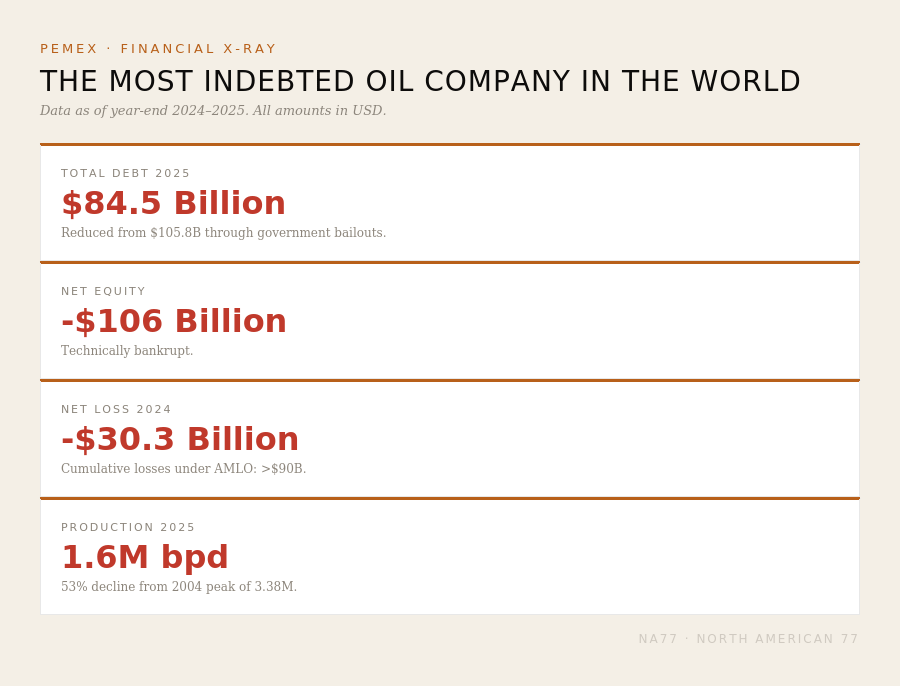
PEMEX has recorded net profits in only three of the past fourteen years (2012, 2022, and 2023). Its standalone credit assessment from Moody’s is “ca” — the lowest on its scale. Without government backing, every major rating agency agrees PEMEX would be near default.
The Mechanism That Destroyed PEMEX
The Derecho de Utilidad Compartida (DUC) captured up to 74% of the value of extracted hydrocarbons. An academic study documented that the government historically extracted 98.46% of PEMEX’s income, leaving less than 10% for reinvestment. In 2005, the government captured $49.9 billion from PEMEX — equivalent to 108.5% of pre-tax profits.
Average annual capital expenditure fell from $17.8 billion (2010–2014) to $7.1 billion (2018–2022), a 60% decline during a period when maintaining aging infrastructure and declining fields demanded more investment, not less.
From Revenue Generator to Fiscal Liability
In the first eleven months of 2025, PEMEX contributed Ps.221 billion (~$11.8 billion) to the government but received Ps.392 billion (~$21 billion) in transfers — a net fiscal deficit of ~$9 billion. Analysts estimate PEMEX’s total fiscal deficit to the government in 2025 at approximately $31 billion — the largest in the company’s 87-year history.
Four Oil Companies. Four Models. Four Outcomes.
Saudi Aramco produces 184 barrels per employee per day. PEMEX produces 12. With roughly double the workforce, PEMEX produces one-eighth of Aramco’s output. This is not a geology problem. It is a management, union, and political capture problem.
Dos Bocas: A $20 Billion Case Study
If anyone needs a single case to understand why Mexico did not enter the new global order, the Olmeca refinery — Dos Bocas — tells it in one story. Original budget: $8 billion. Final cost: over $20 billion — 2.5x over budget. According to the Mexican Institute of Chemical Engineers (IMIQ), it is one of the most expensive refineries in the world.
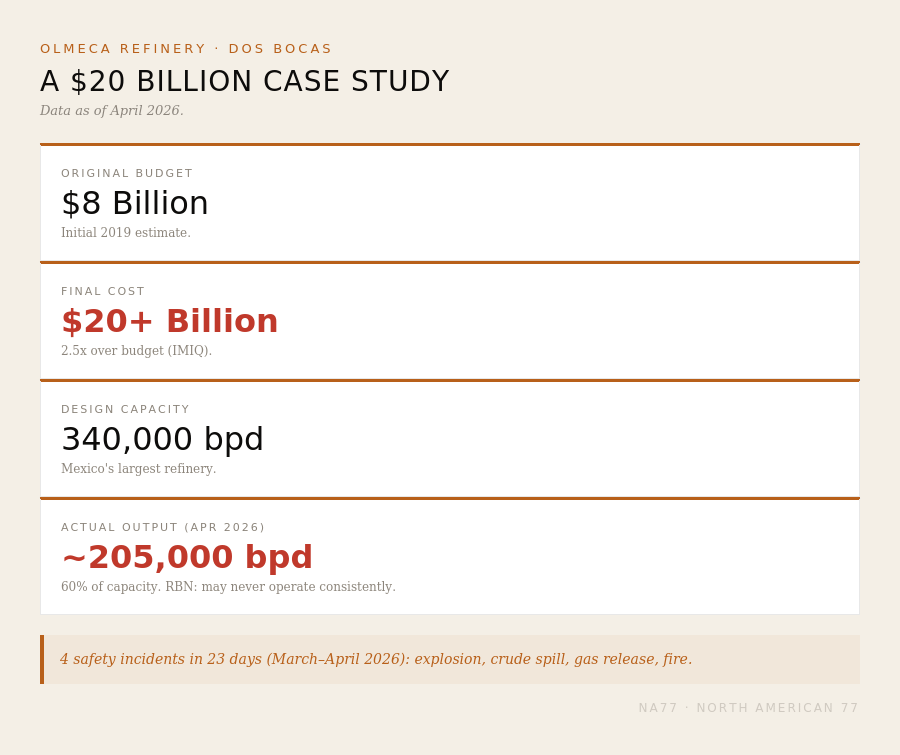
Design capacity: 340,000 barrels per day. Reality as of April 2026: approximately 205,000 barrels — 60% of capacity. At its peak gasoline output (June 2025), it reached 79,000 bpd before falling to 41,000 in August — barely a quarter of the 170,000 it was designed for. RBN Energy projects the refinery will not achieve full startup until 2028, and that there is a possibility it may never achieve consistent operations.
In just the last three weeks of March–April 2026, the refinery logged four safety incidents: an explosion, a crude oil spill in the Río Seco affecting fishing communities, a gas release, and a fire in the coke storage warehouse visible for kilometers. This is not bad luck. This is what happens when a $20 billion project is built on political logic instead of business logic.
What was the business plan? There is no public one that justifies the investment with a return analysis. What exists is a political promise: energy sovereignty. But while Mexico’s gasoline imports hit 388,000 barrels per day in September 2025 — the highest of the year — and PEMEX’s crude output fell to 1.37 million bpd, the promise contradicts reality. Mexico spent $20 billion on a refinery that refines crude that grows scarcer every year, in a region with a fragile power grid that cannot sustain it.
The reason is simple: Mexico as a country functions as a business divided among political groups and their partners. Dos Bocas was not an investment decision. It was a power decision. The budget doubled because no one independent was watching. The refinery does not run at capacity because the political inauguration was prioritized over engineering. And every Mexican is paying the $20 billion bill.
CFE: The System’s Other Petty Cash Box
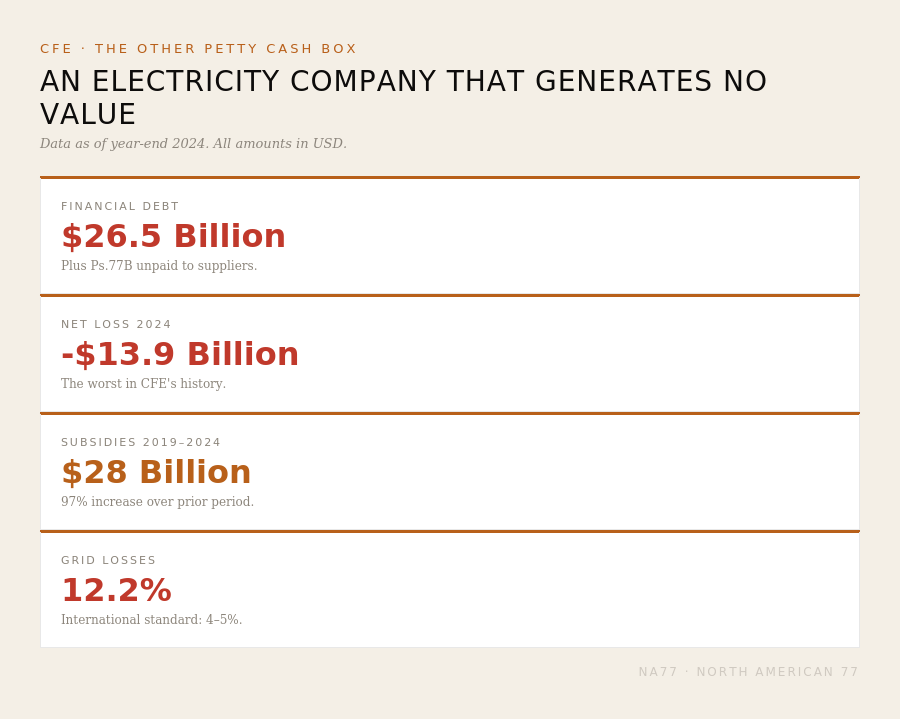
89% of residential users receive subsidized electricity, with subsidies covering an average of 47% of their bills. Under AMLO, 80% of CFE contracts were awarded through no-bid direct awards. IMCO ranks CFE as the government entity with the highest corruption risk in procurement.
In 2021, CFE built only 52 kilometers of new transmission lines — 0.05% of the total grid. Actual infrastructure investment reached just 21% of what its own development plan deemed necessary.
The 2024 Counter-Reform
The constitutional reform approved after MORENA’s congressional sweep eliminated the independent regulators (CRE and CNH), reintegrated the grid operator CENACE into CFE, mandated that CFE supply at least 54% of electricity generation, and — in a last-minute amendment — removed the clause making the state responsible for the energy transition.
Mexico’s ranking in renewable energy investment attractiveness dropped from 7th to 33rd. The three clean energy auctions held under the prior reform had driven prices from $47.7/MWh to $20.5/MWh and attracted $2.4 billion in investment commitments. No auction has been held since 2018.
Telmex: When a Monopoly Does Generate Wealth
THE COUNTEREXAMPLE
In 1990, Carlos Slim acquired Telmex for approximately $1.8 billion — with a seven-year guaranteed monopoly written into the contract. What happened next is important to acknowledge: Slim built on that monopoly one of the largest telecommunications companies in the world.
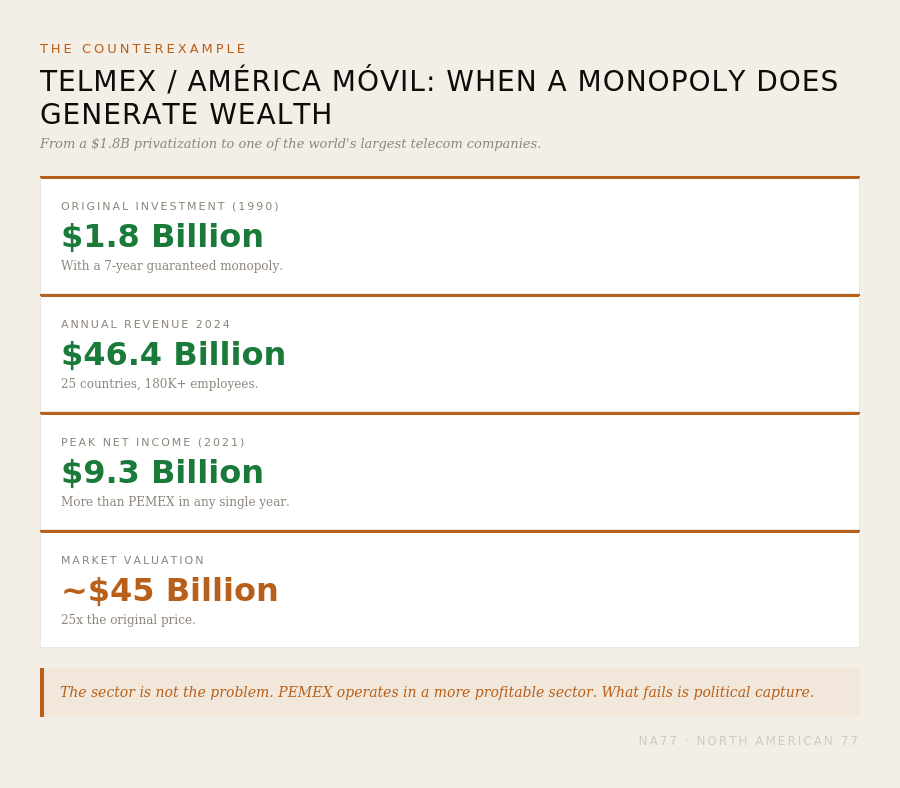
More than PEMEX has earned in any single year in its history.
The argument is not that privatization is the answer. The argument is that the sectors where PEMEX and CFE operate are not bad sectors. They are extraordinarily profitable when managed with discipline. What fails is not the business. What fails is political capture.
The difference between Telmex and PEMEX is revealing: one generates private wealth with social cost; the other generates neither wealth nor social benefit. At least with Telmex, someone invested, built infrastructure, created productive jobs, and paid taxes. With PEMEX, citizens funded the company, politicians managed it, the union enriched itself, and in the end everyone owes money to everyone.
The Wealth Mexico Chose Not to Create
ENERGY SOVEREIGN WEALTH FUNDS
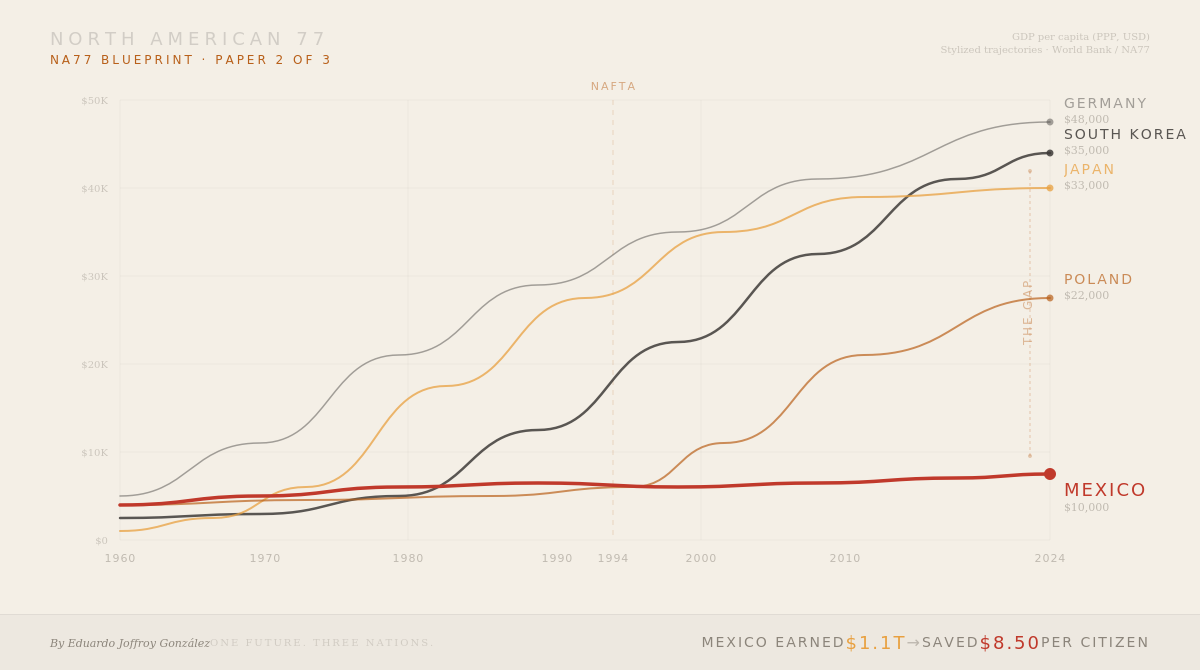
Mexico earned approximately $1.1 trillion in government petroleum revenue between 1990 and 2024. Had it saved 50% of this revenue in a sovereign wealth fund earning 6.5% annually, that fund would today be worth approximately $1.65 trillion — the second-largest sovereign wealth fund in the world.
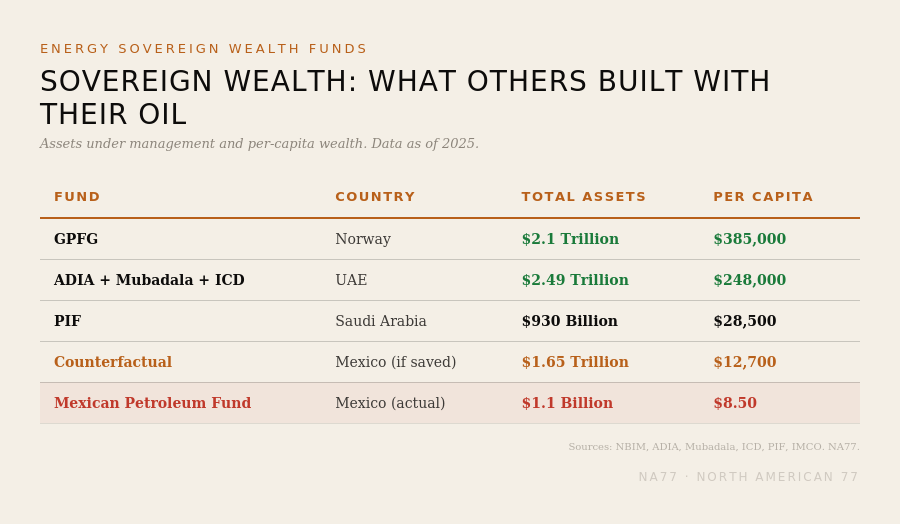
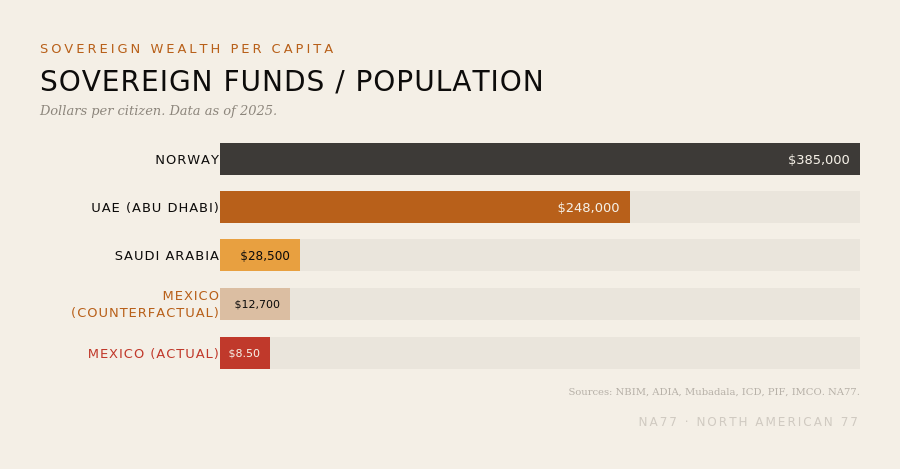
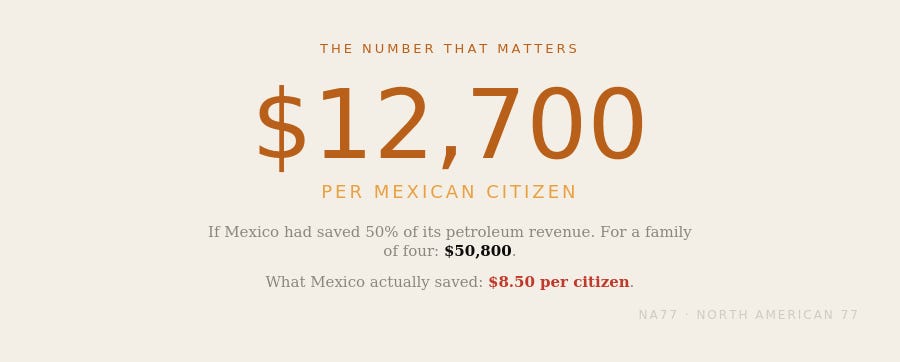
For a family of four: $50,800. What Mexico actually saved: $8.50 per citizen.
Mexico’s Petroleum Fund was legally designed to replicate the Norwegian model. It contains a fatal architectural flaw: the savings threshold (petroleum revenue exceeding 4.7% of GDP) has never been triggered. 99.5% of all funds were transferred immediately to the annual federal budget.
The Final Irony
In May 2025, Norway’s sovereign wealth fund divested entirely from PEMEX (~$140 million in holdings), citing “unacceptably high” corruption risks spanning 2004–2023. The very model Mexico failed to replicate now refuses to invest in Mexico’s oil company.
Documented Corruption: Names and Facts
Carlos Romero Deschamps (1993–2019)
Led the PEMEX union for 26 consecutive years. 100,000 members. Declared salary: $1,800/month. 11 family members on the PEMEX payroll. 12 federal investigations. Zero arrest warrants. Died in 2023 in complete impunity.
Pemexgate (2000)
PEMEX transferred Ps.1.6 billion to the union. Ps.500 million in cash was diverted to finance the PRI’s presidential campaign. The Federal Electoral Institute imposed a historic one-billion-peso fine. Romero Deschamps obtained an amparo preventing prosecution — guaranteed by a deposit of Ps.10,000 (~$500).
Emilio Lozoya Austin (2012–2016)
PEMEX CEO. Received >$10 million in bribes from Odebrecht. Orchestrated the acquisition of Grupo Fertinal for $635 million — a plant that had been inactive for 14 years. Documented losses: >$619 million. Arrested in Spain in 2020. Released to house arrest in 2024.
Luz y Fuerza del Centro (2009)
Calderón deployed 40,000 federal police to occupy 103 facilities overnight, terminating 44,300 workers. The union (SME) had presided over electricity losses of 32% — versus 11% at CFE and a 4–5% international standard.
Norway Divests from PEMEX (2025)
The world’s largest sovereign wealth fund sold its entire PEMEX position (~$140M), citing unacceptable corruption risks. The model Mexico failed to replicate now refuses to invest in Mexico’s oil company.
The Cost No One Wants to Calculate
Every year a Mexican child spent in an education system designed to protect the union was a year of lost human capital. Every decade an entrepreneur operated under rules designed to protect monopolies was a decade of innovation that never existed. Every electoral cycle where citizens had to choose the least bad option was a cycle where real political talent was excluded by design.
The distance between what Mexico is and what it could be has a technical name: the institutional convergence gap. But it has a more honest name: it is the future the system owes to millions of Mexicans who never had the chance to live in a country that operated at the level of their own talent.
Mexico does not need to be saved.
It needs to breathe.
The very parties that should be building the vision for the next 100 years are the ones cutting off its oxygen. Institutional convergence is not a favor to be asked of the system. It is a debt the system owes its own people.
Part III will turn the mirror toward the United States and Canada. Because a Tier-1 Mexico cannot exist inside a North America that tolerates protectionism or complacency.
NA77 · ONE FUTURE. THREE NATIONS. · na77.substack.com
Eduardo, this is an excellent analysis of Mexico's political and economic architecture. You make it clear that the country's current challenges stem from the structure of power (not from a lack of talent or potential in its people). For a future piece, it would be fascinating to explore the specific conditions or scenarios that could realistically shift this architecture, especially considering the immediate impact such changes would have on entrenched monopolies and corporatist unions.
Talking about Mexico in abstract makes it sound like the system is the problem. But the system is a reflection of a large part of the Mexicans whi love privileges. People who think they are entitled to economic aid. Middle classes who complain but don't hesitate to use political connections to trick the system to get a juicy pension fund or a cheap house.