
MÉXICO: El Vecino que Decidió Ignorar el Orden Global (English version below)
Una serie en 3 partes sobre el país que pudo haber sido… y el que todavía puede ser

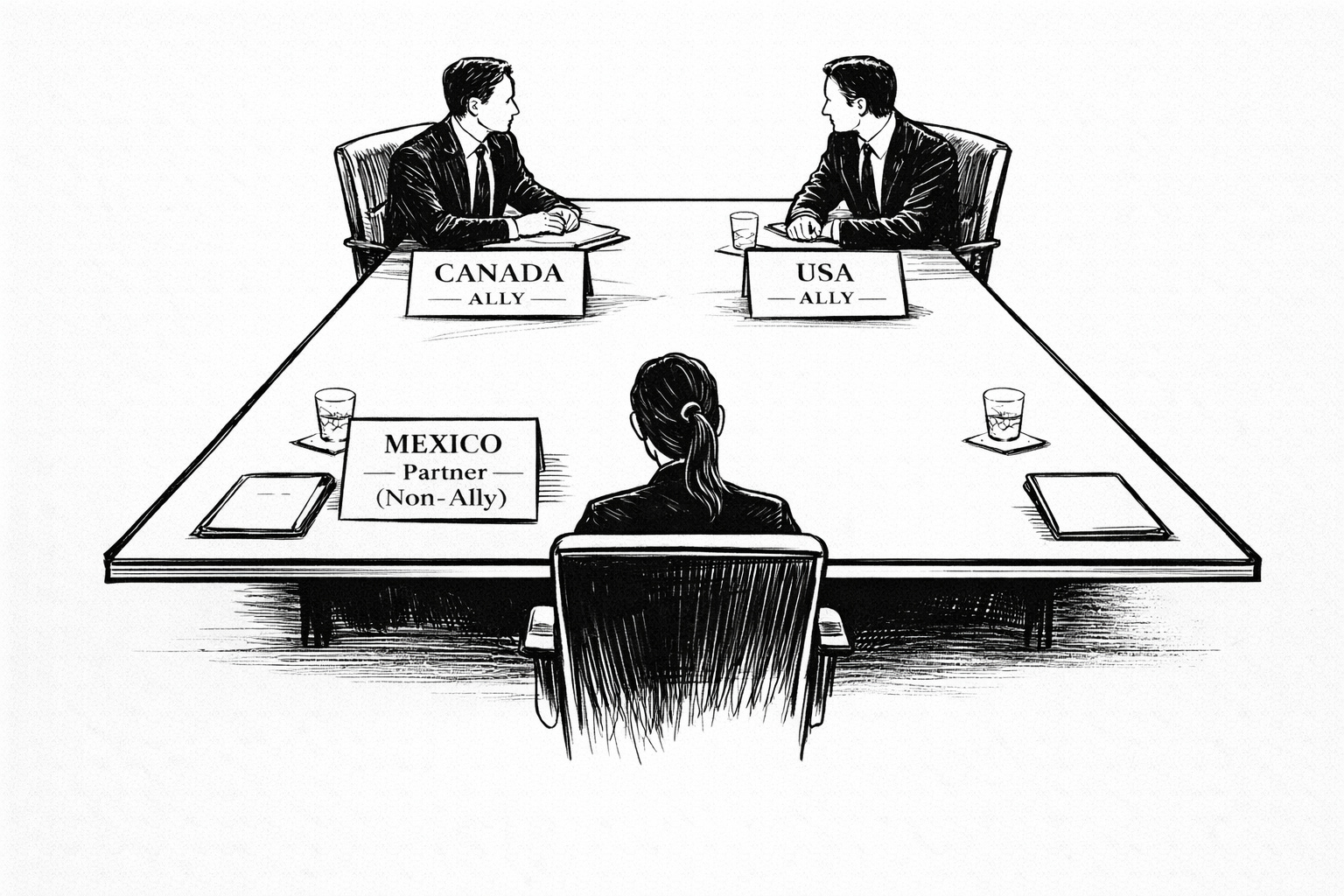
México ha tenido durante más de siete décadas (desde 1950) una ventaja que prácticamente ningún otro país en el mundo ha tenido —con excepción de Canadá—: ser vecino directo del sistema económico y político más poderoso y exitoso de la historia moderna.
Lo vimos formarse, lo vimos madurar y lo vimos reinventarse. No como observadores lejanos, sino desde dentro de su dinámica. Vivimos su crecimiento, nos beneficiamos de su expansión y fuimos testigos directos de cómo construyó instituciones, mercados y poder.
Y aun así, decidimos no adoptarlo.
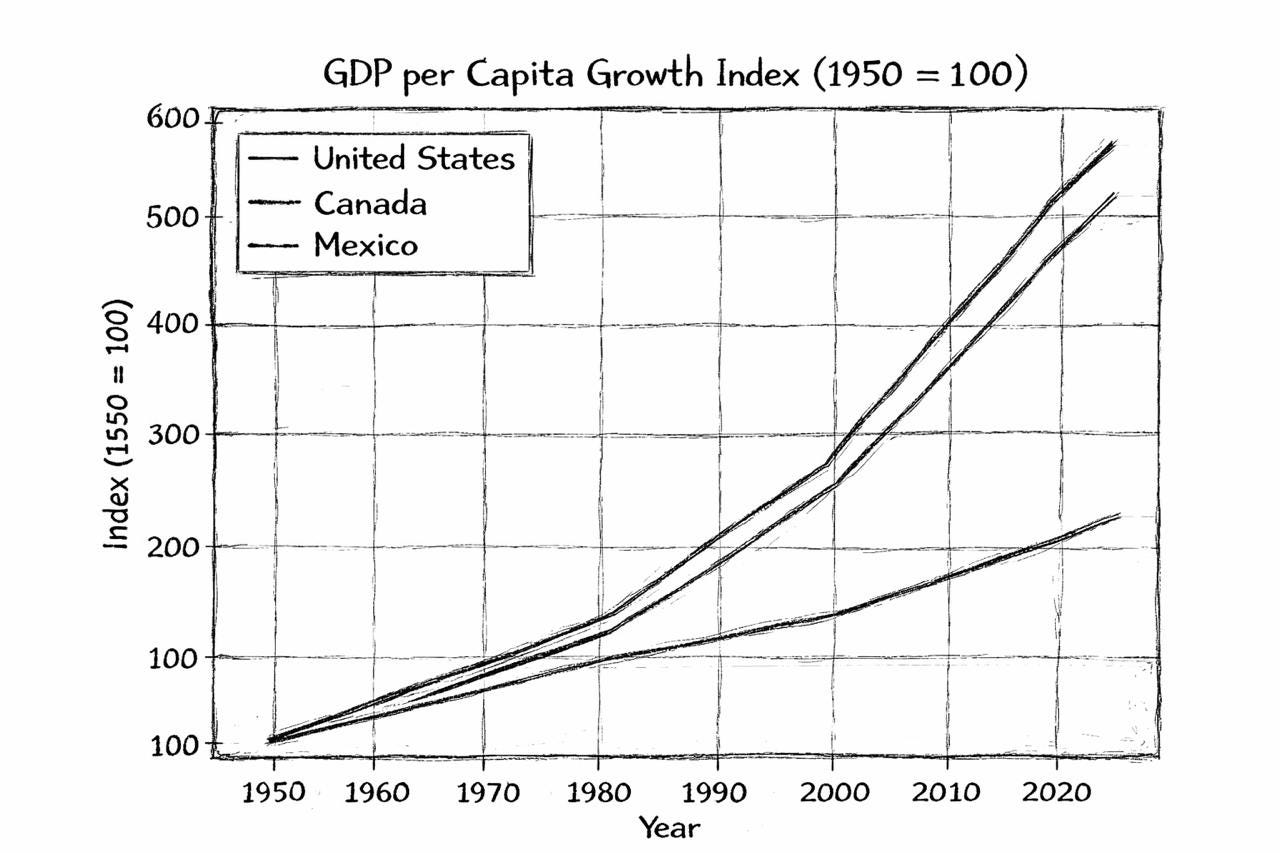
Esta no es una crítica cómoda. Es una conversación incómoda que México ha evitado por demasiado tiempo. Porque la realidad es clara: México no está donde está por falta de talento, ni por falta de recursos, ni por falta de oportunidad. México está donde está porque decidió jugar su propio juego, en lugar de integrarse plenamente al sistema que dio luz al orden global liderado por su vecino más cercano.
Durante años, adoptamos la cultura americana, consumimos sus marcas y, quienes tuvimos acceso, aprovechamos sus instituciones educativas. Pero nunca construimos las instituciones necesarias para que México pudiera pertenecer al grupo de aliados estratégicos de ese sistema. Nos conformamos con ser un participante periférico, un país que compite por debajo de su verdadero potencial.
México nunca decidió alinearse plenamente al sistema que ha definido el orden global moderno. Un sistema imperfecto, sí, pero que ha demostrado funcionar bajo principios claros: libertad individual como base, educación como motor de movilidad, estado de derecho como garantía universal, aplicación de la ley sin excepción, democracia funcional, balance de poderes, instituciones que trascienden gobiernos, y una estrategia económica orientada a fortalecer la iniciativa privada, incentivos a la innovación, el desarrollo e impulso de largo plazo, y un comercio global seguro y justo bajo un sistema que funciona.
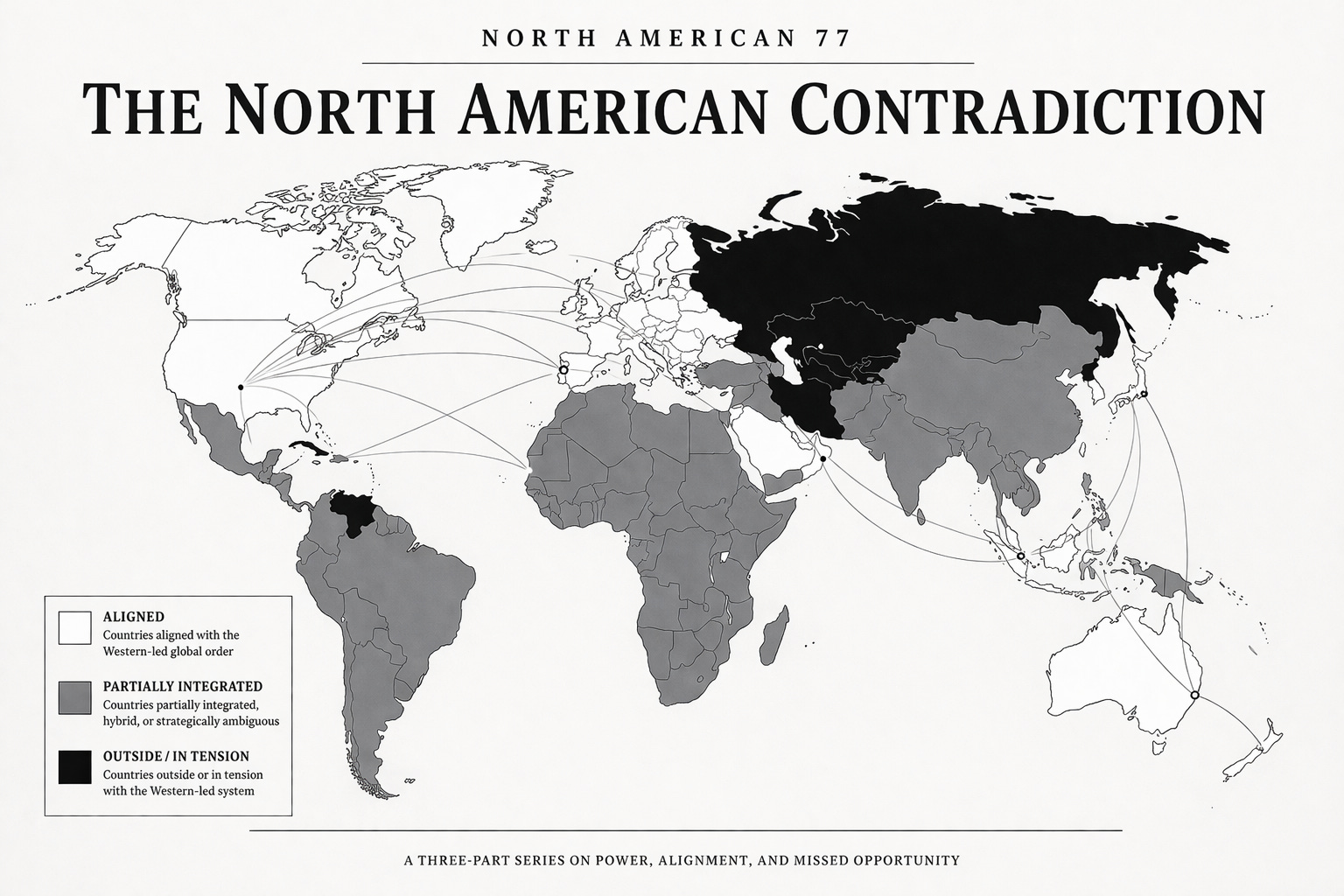
Mientras países como Canadá, Reino Unido, Alemania, Francia, Japón, Corea del Sur, Singapur o Israel entendieron ese sistema y lo ejecutaron con gran éxito, México decidió operar bajo su propia lógica. Un modelo que, con el tiempo, ha compartido características con economías que han limitado su desarrollo por decisiones internas más que por falta de capacidad.
El costo de ese camino no es teórico. Es generacional. Millones de mexicanos han tenido que buscar oportunidades fuera del país porque no encontraron dentro de México un sistema que les permitiera crecer y sobre todo asegurar dignidad a sus familias.
Hoy, el contexto global cambió.
El orden posterior a la Segunda Guerra Mundial ya no es incuestionable. China compite abiertamente por influencia económica y geopolítica. Estados Unidos enfrenta nuevos retos, nuevas prioridades y un evidente cansancio frente a un sistema internacional que ha sostenido por décadas.
Durante mucho tiempo, México operó bajo la premisa de que podía mantenerse al margen, beneficiándose del sistema sin alinearse completamente a él. Ese tiempo terminó.
México ya no puede ignorar una realidad fundamental: forma parte de un sistema más grande que el suyo —el sistema Norte Americano—. Un sistema donde la estabilidad, la seguridad y la protección estratégica han sido, en gran medida, garantizadas por Estados Unidos.
Pero esa garantía no es automática, ni permanente, ni incondicional.
México enfrenta una decisión clara: alinear sus instituciones, su sistema económico y su visión de país con ese bloque, o enfrentar las consecuencias de seguir operando bajo una lógica incompatible con el entorno en el que está inserto.
Por eso México nunca ha sido realmente un aliado estratégico de Estados Unidos. Ha sido un socio conveniente, pero no confiable a nivel estructural.
México no necesita más diagnósticos. Los ha tenido por décadas. Lo que ha faltado es ejecución: empoderar a su gente a través de educación real y tomar decisiones de Estado que alineen al país con principios institucionales que han probado generar prosperidad.
Siempre entendimos el sistema que teníamos enfrente. Lo que nunca hicimos fue adoptarlo como propio.
La pregunta ya no es si México puede cambiar.
La pregunta es si México está dispuesto a hacerlo antes de que el entorno lo obligue… o lo deje atrás.
Final versión Español - Start of English version
MEXICO: The Neighbor that Chose to Ignore the Global Order
A three-part series on the country that could have been… and the one it still can become
For more than seven decades (since the 1950s), Mexico has had an advantage that almost no other country in the world has had —with the exception of Canada— direct proximity to the most powerful and successful economic and political system in modern history.
We watched it form, we watched it mature, and we watched it reinvent itself. Not as distant observers, but from within its sphere of influence. We experienced its growth, benefited from its expansion, and witnessed firsthand how it built institutions, markets, and power.
And yet, we chose not to adopt it.
This is not a comfortable critique. It is an uncomfortable conversation that Mexico has avoided for far too long. Because the reality is clear: Mexico is not where it is today due to a lack of talent, resources, or opportunity. Mexico is where it is because it chose to play its own game, rather than fully integrate into the global order led by its closest neighbor.
For years, we adopted American culture, consumed its brands, and those with access benefited from its educational institutions. But we never built the institutions necessary for Mexico to truly belong to that system’s inner circle of strategic allies. We settled for being a peripheral participant —a country competing below its true potential.
Mexico never made the decision to align with the new world order system. An imperfect system, yes —but one that has proven to work under clear principles: individual freedom as a foundation, education as a driver of mobility, rule of law as a universal guarantee, consistent enforcement, functional democracy, real balance of powers, institutions that outlast governments, and an economic strategy built to strengthen private enterprise, to incentivize innovation, long-term development and secure & fair global trade through a reliable system.
While countries like Canada, the United Kingdom, Germany, France, Japan, South Korea, Singapore, and Israel understood this system and executed within it, Mexico chose to operate under its own logic. A model that, over time, has shared characteristics with economies that have limited their own development not due to lack of capability, but due to internal decisions.
The cost of this path is not theoretical. It is generational. Millions of Mexicans have had to seek opportunities abroad because they could not find within Mexico a system that allowed them to grow and to live with dignity.
Today, the global context has changed.
The post–World War II order is no longer unquestioned. China is openly competing against the US for global economic and geopolitical influence. The United States is facing new challenges, new priorities, and a visible fatigue with the global system it has sustained for decades.
For a long time, Mexico operated under the assumption that it could remain on the margins —benefiting from the system without fully aligning to it. That time is over.
Mexico can no longer ignore a fundamental reality: it is part of a larger system —the North American system. One where stability, security, and strategic protection have been, to a large extent, guaranteed by the United States of America.
But that guarantee is not automatic. Nor permanent. And certainly not unconditional.
Mexico faces a clear decision: align its institutions, its economic system, and its long-term vision with that bloc —or face the consequences of continuing to operate under a model that is incompatible with the environment it is part of.
This is precisely why Mexico has never been a strategic ally of the United States. It has been a convenient partner, but not a structurally reliable one.
Mexico does not need more diagnostics. It has had them for decades. What has been missing is a statewide decision and nationwide execution: empowering its people through real education, maximizing opportunities, ensuring nationwide security and making state-level decisions that align the country with institutional principles that have consistently generated prosperity in other nations and most notably, in the United States.
We have always understood the system in front of us.
What we never did was adopt it as our own.
The question is no longer whether Mexico can change.
The question is whether Mexico is willing to do so before the environment forces it… or leaves it behind.
gracias por leer. Ahi viene 3 mas de esta serie.
weak governance!!