
Water Series PI: Spending the Water We Inherited
It is a test of whether North America can act together before scarcity turns neighbors into enemies.

An employee came to work in our Monterrey a few years back with a black eye. Two of her neighbors attacked her the night before while they waited in line for the same water truck, carrying the same empty buckets, hoping there would be enough for everyone. The reason for the violence was desperateness and fear.
Monterrey's water crisis peaked in June and July of 2022, when a severe drought tied to a persistent La Niña pattern, on top of years of overuse, dropped the Cerro Prieto dam to under 1% capacity, the worst failure since 1984. It wasn't just weather: a metro area that had grown past 6 million people was drawing on infrastructure sized for a much smaller city, while agriculture took roughly 70% of the state's water and heavy industrial users like Heineken and Ternium kept extracting through the shortage.
The government imposed scheduled rationing by zone, but distribution ran along income lines, and in July residents protested and even burned pipes to block water being diverted toward wealthier parts of the city.
That is what scarcity does once when it becomes real; violence is right in the other side of it. Even before these events hit Monterrey, I had been thinking about water for years, but that moment changed how I understood it.
Scarcity is usually presented through percentages, reservoir elevations, and drought maps. Sometimes conversations that seem to be too far away from us.
Nothing really matters until things start to change in your day to day. With real consequences come, unexpected human behavior against each other; patience transforms into suspicion & anger; Neighbors become enemies, regions accuse other regions of stealing, while the water itself keeps moving beneath, across, and beyond the lines we’ve drawn.
Warning signs
In 2018, I attended a water convention in Rosarito, Baja California, with my friend Culver Van Der Jagt, founder of the water-saving technology & company Sink Twice. Through him I began paying attention to the 1944 treaty governing water the U.S. and Mexico share, on both the Colorado and the Rio Bravo. It felt distant from the convention floor back then, but today as I look back, It seems like the foundation underneath it.
Since that trip to Rosarito in search of opportunities with Sink Twice, Culver has kept me updated with studies, statistics & raw data on the water situation specifically in certain regions of the US & Mexico. Culver’s detailed descriptions and hard data that ground his arguments kept me with an antenna on my head on everything water related.
He even helped me check my apartment and apartment building for leaks and to lower my water consumption by over 50% through very specific tactics and practices that work incredible.
A big part of my life is in Arizona and Sonora, spending lots of time in Tucson & Nogales specifically. On one occasion I took road trip with my wife to Page, Arizona with the intention to see the Horseshoe Bend, Antelope Canyon and Buckskin Gulp; there is a sight that is hard to miss crossing the Arizona-Utah border; Lake Powell and the white mineral rings around the Lake walls.
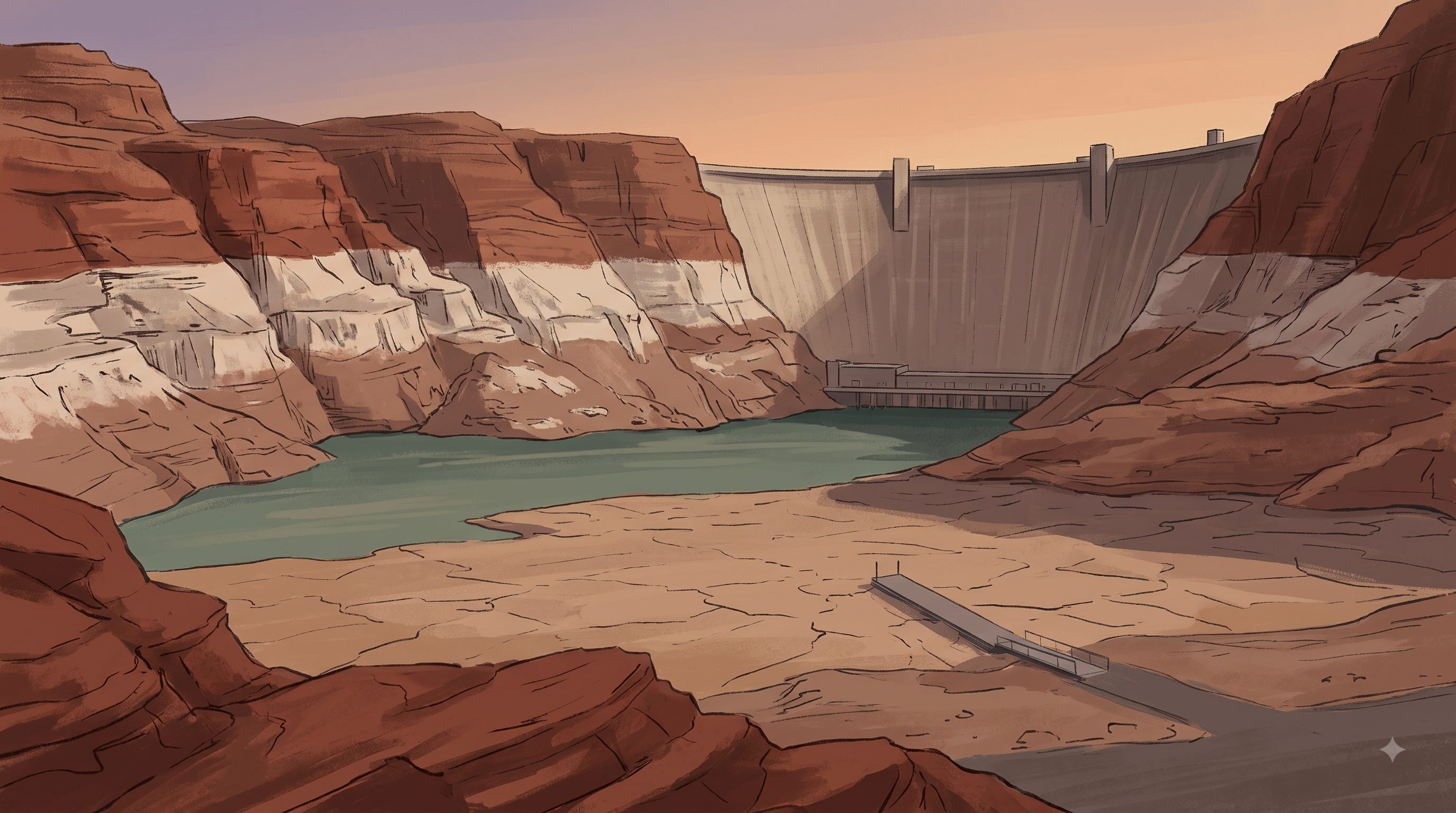
(Digital drawing of Lake Powell running out of water)
In Sonora, where I grew up, my family had a summer home at the beach town San Carlos overlooking the third green of a golf course called San Carlos Country Club. That green hasn’t really been green in over 20 years, because there hasn’t been enough water to maintain it.
When we were kids in the 80’s we used to run and play on golf course as it was our private green huge backyard. Those memories are priceless. As an adult and a father today, seeing the transition from green to desert has been a hard pill to swallow. I had always wished that my son would be able to live the same experiences that I did in that same house but things had never been the same ever since the water scarecity.
The whole Country Club neighbourhood had a different face, home values plummeted and the development changed owners many times and for the worse.
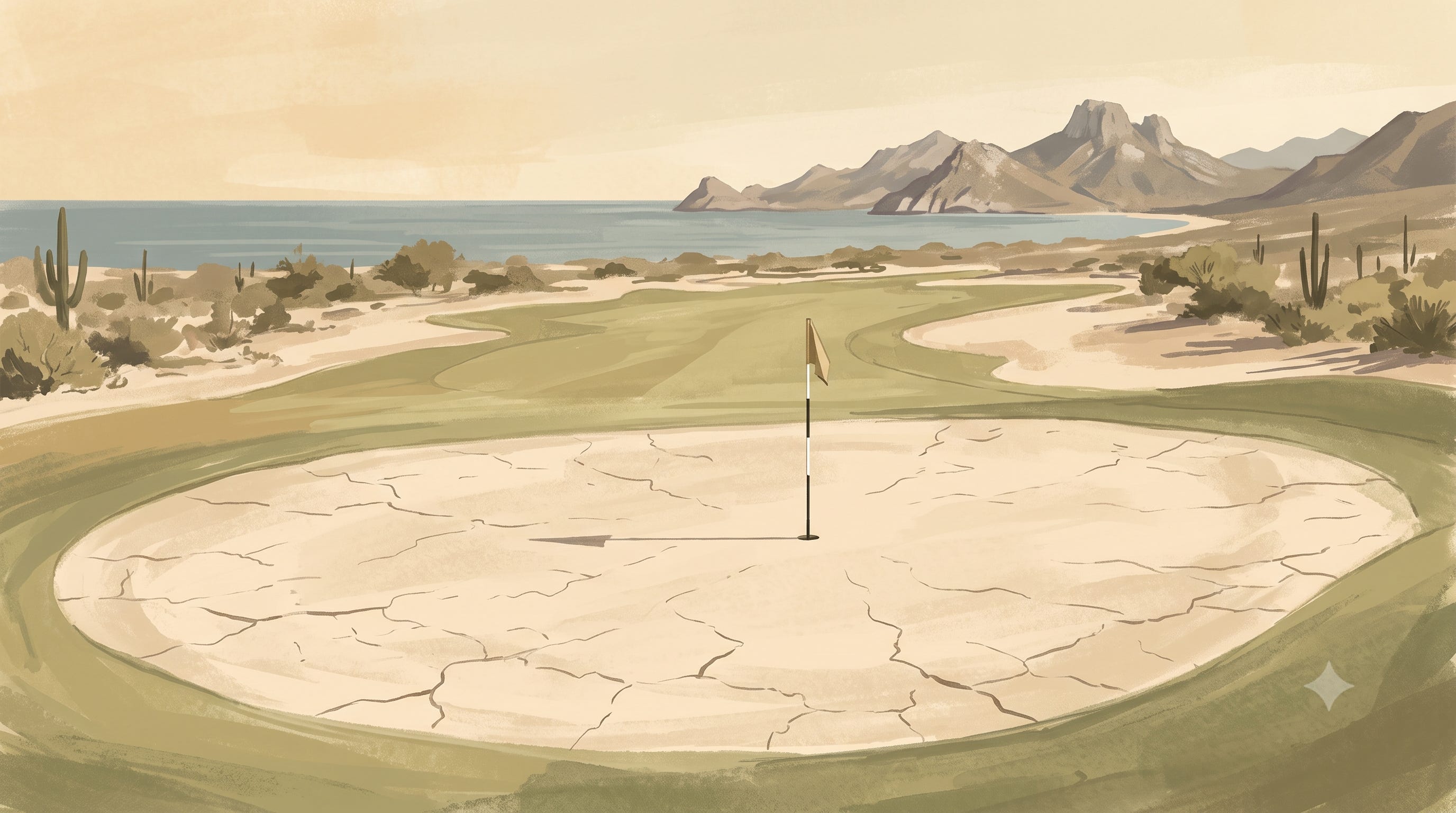
Without water, there is no life.
Elsewhere in the state of Sonora around 2002, a huge fight over the El Novillo reservoir turned Ciudad Obregón (highly agricultural region) against Hermosillo (Capital of Sonora), each side certain the other was stealing its water.
Six hundred miles east, the Rio Bravo is already failing the same test, its own shared reservoirs running low, its own border cities rationing.
Monterrey had its own crisis. Mexico City later feared its Cutzamala system could reach “Day Zero.” These places share no watershed, they are different systems entirely.
But the pattern repeats: when water supply weakens and institutions fail to prepare, scarcity turns social before anything else and what lies ahead is pure doubt.
A Record Written in Snow
This spring, I went looking for evidence of how bad the Western snowpack had become. What I found was worse than I expected. According to the USDA’s Natural Resources Conservation Service, 67 % of 1,575 snow measurement sites across the American West tied or set record lows on April 1. Among long-running snow courses with 70-plus years of data, 65% recorded their lowest or second-lowest snowpack on record.
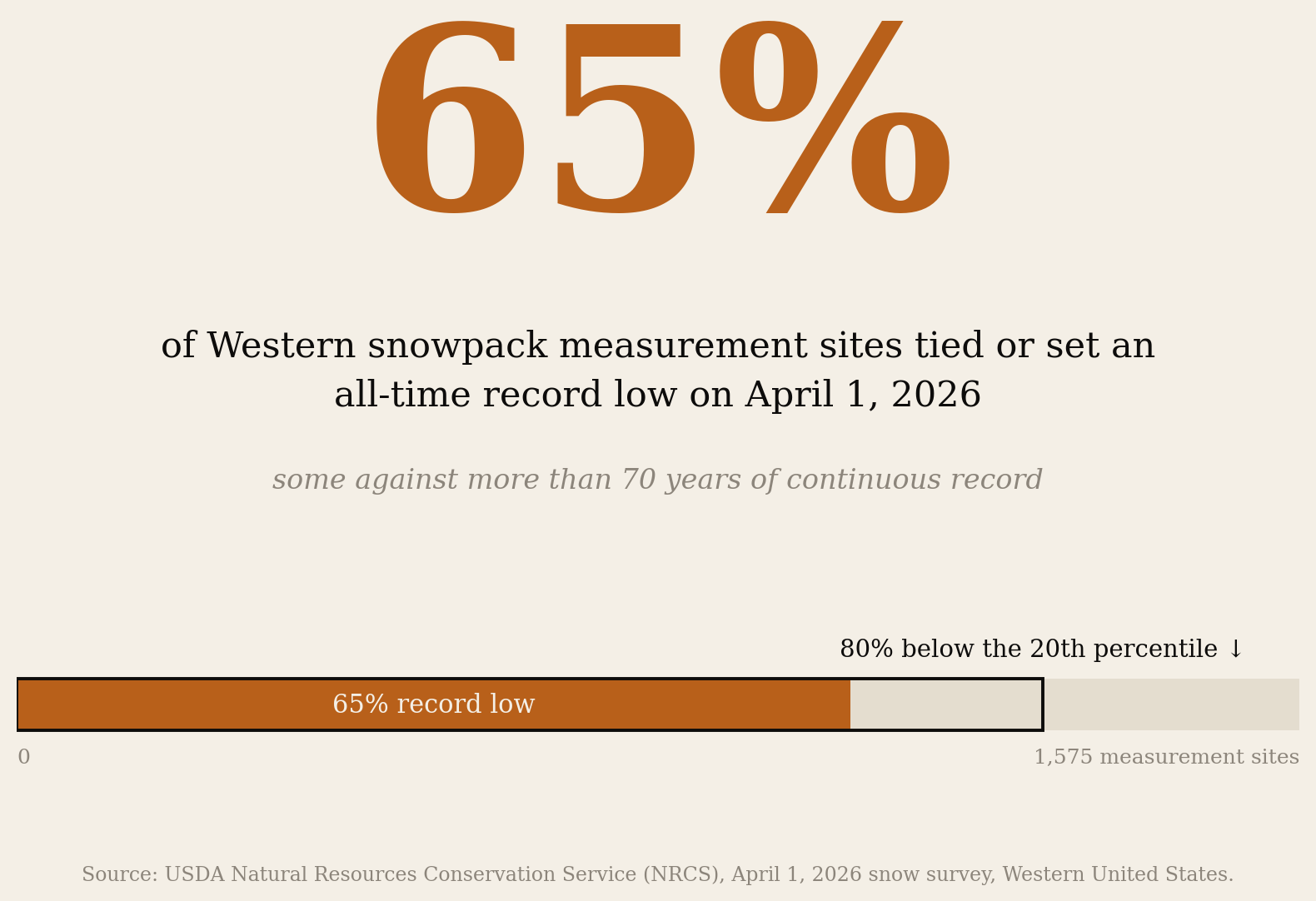
The Snow in the Rocky Mountains is the Colorado River’s principal savings deposit. When it fails to accumulate, less water reaches the farms, cities, and reservoirs below.
By the end of June, Lake Powell held roughly 24 % of its live capacity. By early August, Lake Mead had fallen to its lowest recorded elevation since it was filled nearly 90 years ago.
North America is already operating under this condition with no clear plans in sight.
The Inheritance
The modern Southwest was built on an extraordinary promise: that dams, canals, treaties, and engineering could make an arid region reliably productive. Hoover Dam began storing water in Lake Mead in the 1930s and Glen Canyon Dam created Lake Powell three decades later. That storage let wet years cover dry ones. It turned desert into farmland and made cities like Phoenix, Las Vegas, and Los Angeles possible.
A full reservoir makes annual consumption look sustainable even when withdrawals exceed what the river can reliably replace. By 1988, the Bureau of Reclamation’s own data mark the year the basin’s annual use caught up with its annual supply.
Every year since, the region has drawn against a margin built in the 50 years before it. It was not income. It was savings.
The deeper problem isn’t only that less snow is falling. It’s that North America has built cities, farms, and expectations around more water than this river can now be trusted to provide.
One River, Fragmented Governance
The Colorado River supports roughly 40 million people, 30 Tribal Nations, seven U.S. states, and two Mexican states, one physically connected system governed through a patchwork of treaties, compacts, and court decisions built across a century of different political eras.
The seven U.S. basin states had deadlines in November 2025 and February 2026 to agree on how to manage the river once current rules expire (They missed both).
On July 31, the federal government released its own proposal instead: Arizona, California, and Nevada could face combined cuts of up to 3 million acre-feet a year through 2036. Mexico is already receiving nearly 6 percent less than its base Colorado River allocation this year, an 80,000 acre-foot cut under the new framework.
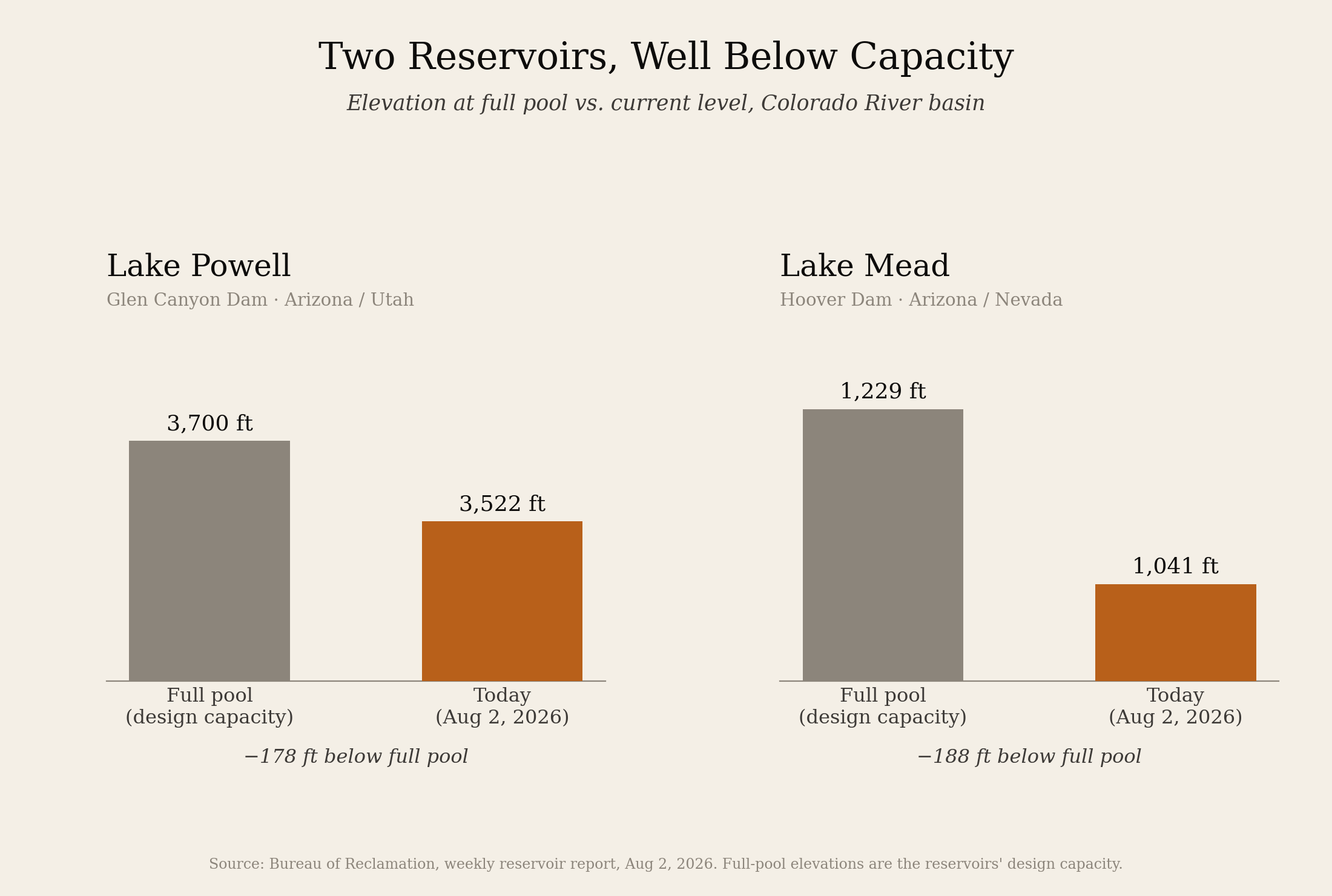
Every side here believes that waiting protects its own position, and that’s exactly why voluntary cooperation keeps breaking down. None of this stays regional. Cut farm production in the basin and the price shows up in a supermarket a thousand miles away. Push people out of a community that’s turned too expensive or too unsafe, and they carry that pressure into someone else’s housing market.
Canada never draws a drop from the Colorado, and Canadians still eat the food grown with it. A region can’t keep its water crisis behind its own border. It exports the consequences right along with the produce, on water it no longer has to spare.
Beyond Day Zero
Mexico City was once warned that parts of its water system could reach Day Zero in June 2024. The date arrived, rain came, and the capital did not run dry. Cape Town faced a similar countdown in 2018, and avoided disaster through severe conservation, infrastructure work, public cooperation, and eventually, rain.
Don’t mistake either outcome for proof that things simply work out. Murray-Darling, Australia’s own shared basin, had a real plan in place and still collapsed into water theft and political crisis, because enforcement could never match peoples fears & ambitions. A dramatic date can mobilize people. It can also convince them a crisis is one event, so that once the date passes and the tap still runs, the danger looks exaggerated.
Scarcity rarely arrives like a switch flipping off. It arrives through higher prices, deeper wells, and unequal access. The real question isn’t when a system reaches zero. It’s how much damage we accept before we change course.
The Ledger Comes First
Fear is not a water strategy. What comes next in this series is an honest ledger, in the Colorado basin and on the Rio Bravo alike, of where the water goes and who carries the cost of conserving it. Shorter showers matter, but household discipline cannot replace agricultural reform, infrastructure investment, and real cooperation between governments that don’t yet trust each other with this.
What We Owe the Future
The most important fact about the Colorado River isn’t that it might disappear on a particular date. It’s that we inherited a margin of security we didn’t build, and inheritance carries an obligation as much as it carries a gift. We didn’t design the treaties, dams, and incentives that produced this crisis. But we will decide whether to defend them unchanged until the reservoirs fail, or adapt them while adaptation is still possible.
I began paying attention to this at a convention in Rosarito eight years ago. It became real to me on an ordinary morning in Monterrey, on the face of someone I knew. Since then, I’ve watched white rings expand around reservoirs, golf courses turn brown, and data that raises the hairs on my neck.
What happens next won’t be decided by the river. It will be decided by whether three countries that already move trade, labor, and capital across these borders can learn to move responsibility across them too, before scarcity decides it for us
Sources:
USDA Natural Resources Conservation Service (nrcs.usda.gov), Bureau of Reclamation, Glen Canyon Dam operations (usbr.gov), CNN, August 7, 2026 (cnn.com), Los Angeles Times, December 2022 (latimes.com), sinktwice.com, Wikipedia, Treaty relating to the utilization of waters of the Colorado and Tijuana Rivers and of the Rio Grande (en.wikipedia.org), climate-diplomacy.org, Acueducto Independencia case study (climate-diplomacy.org), Heraldo de Tamaulipas (heraldodetamaulipas.com), Texas Public Radio (tpr.org), Bureau of Reclamation Final EIS and public statements, CONAGUA, National Geographic (nationalgeographic.com), Crikey, June 2026 (crikey.com.au), The Conversation (theconversation.com).