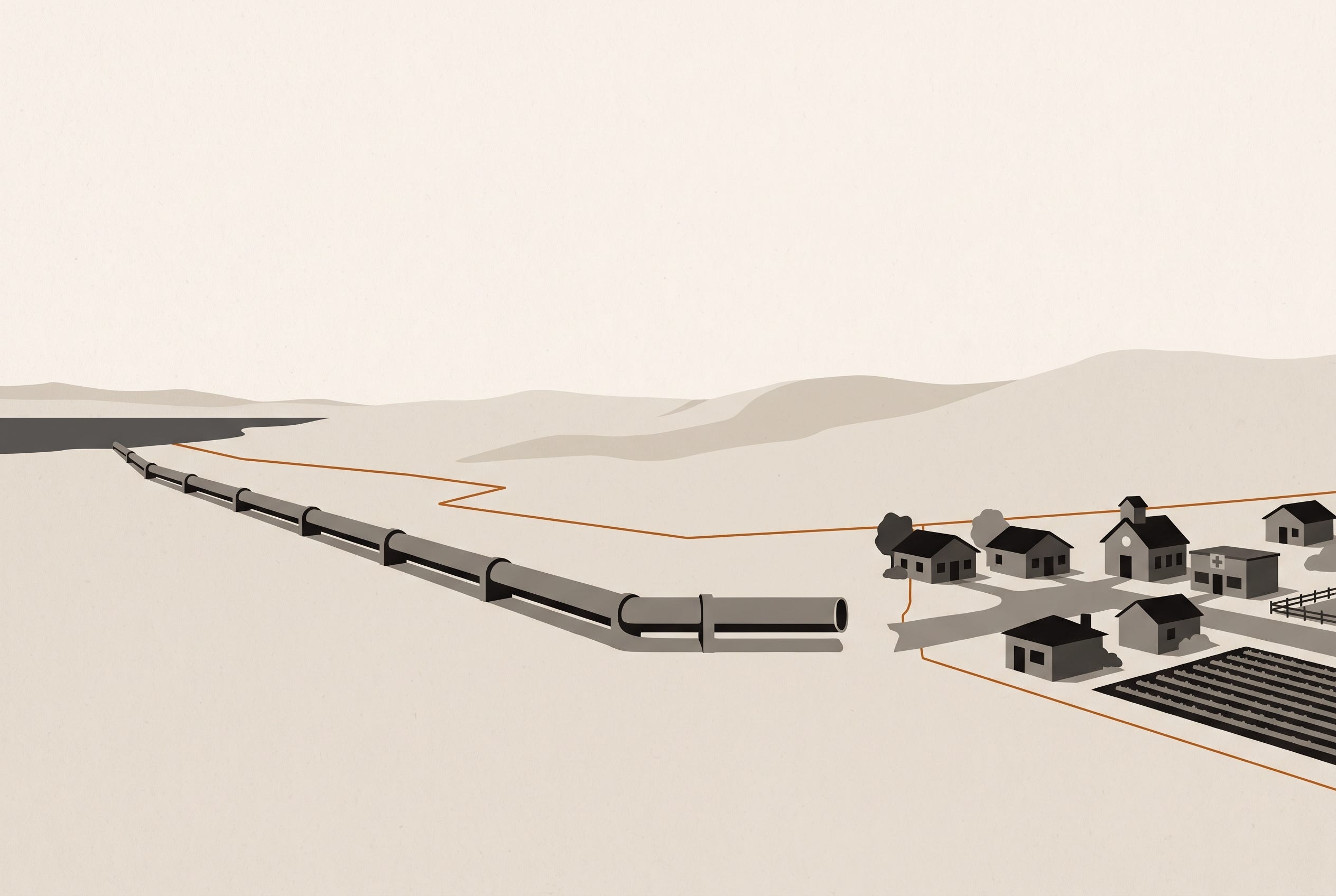
On August 20, Texas’s monitored water-supply reservoirs were 75.8 % full; That sounds comforting, but along the border the numbers change drastically, [Amistad was at 38.4 % and Falcon at 24.4 % (https://waterdatafortexas.org/reservoirs/statewide).
In the first paper of this series, I argued that North America is spending water it inherited from past generations: reservoirs accumulated in wetter decades, governed by documents that are no longer aligned with today’s reality.
Once an inheritance begins to run down, scarcity begins to present itself. An honest ledger could show us where the water goes, whose claim is protected, and who is asked to absorb the loss. But even if we could have these ledgers, what do we do about constitutions, contracts, priority dates, permits, infrastructure, geography, and political leverage that are misaligned with reality? The river delivers water downhill but our institutions decide who receives it first.
Where our Water Runs to
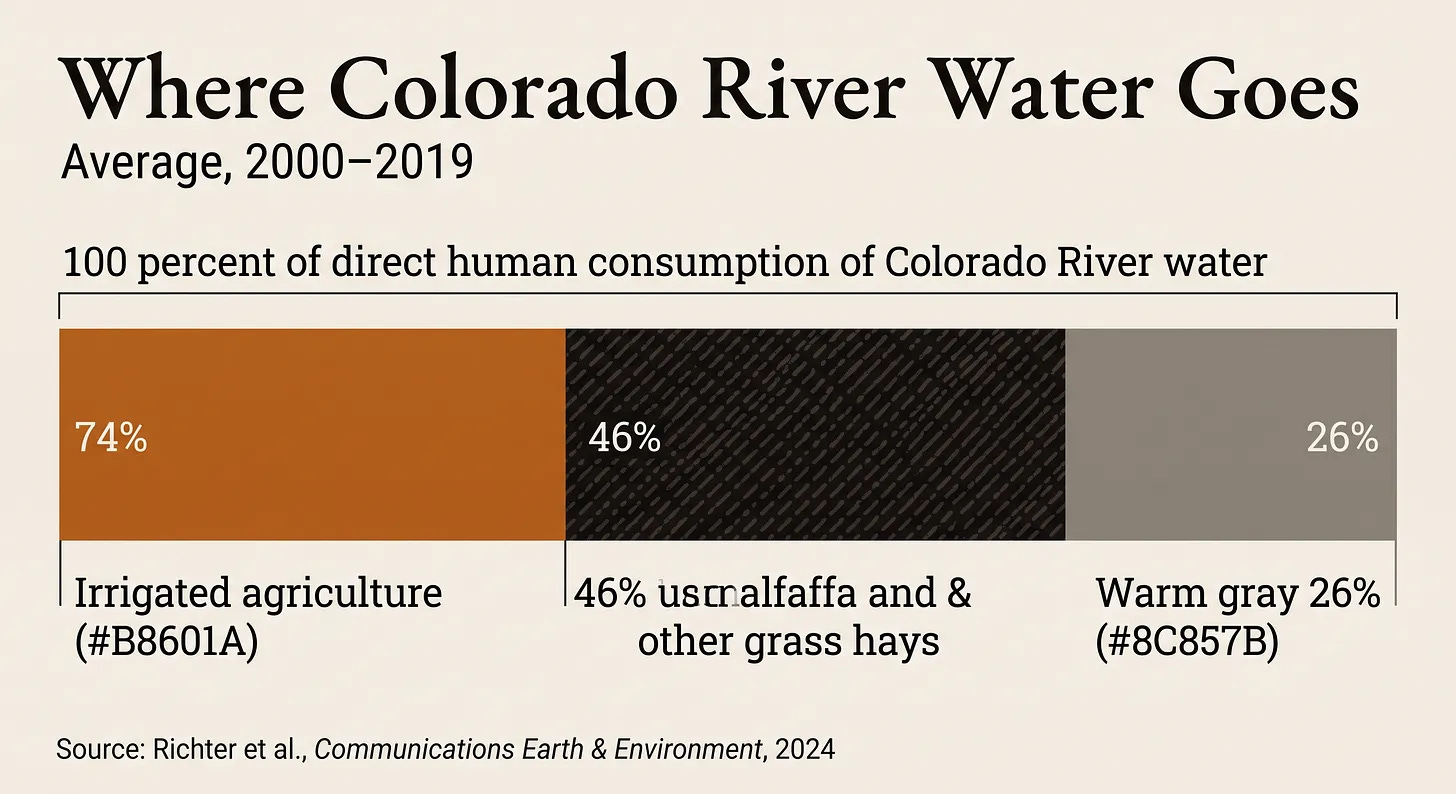
The clearest accounting of the Colorado River covers average consumption from 2000 to 2019. It found that [irrigated agriculture represented 74 % of direct human use] (https://www.nature.com/articles/s43247-024-01291-0).
Alfalfa and other grass hays used 46%—more than every municipal, commercial, and industrial user combined.
Farmers are just responding to the demands. Alfalfa survives drought, requires relatively little labor, and supports the dairy and cattle industries. A farmer planting the crop that pays is behaving rationally.
The irrationality belongs to a system that prices the product while hiding the water beneath it.
Household conservation is ever more necessary: Shorter showers, re-balancing toilets, checking for leaks are all civic acts and part of a culture of stewardship that we basically don’t have.
The biggest water users must carry the biggest share of conservation. That means changing how we farm, what our supply chains reward, and what our public policies allow.
Digital infrastructure: Lawrence Berkeley National Laboratory estimated that [U.S. data centers directly consumed 66 billion liters of water in 2023] (https://eta-publications.lbl.gov/sites/default/files/2024-12/lbnl-2024-united-states-data-center-energy-usage-report.pdf), about 17.4 billion gallons.
Agriculture remains the dominant user, but the rapid arrival of data centers reveals the same governing habit: new demand is approved locally while scarcity is carried regionally.
The Water Hidden Inside Trade
Water also crosses borders without appearing on a customs form.
Every tomato, berry, avocado, and cut of meat carries the water required to produce it. A foundational North American water-footprint study estimated that Mexico exported [26.1 billion cubic meters of virtual water per year](https://doi.org/10.13140/RG.2.2.28970.93125).
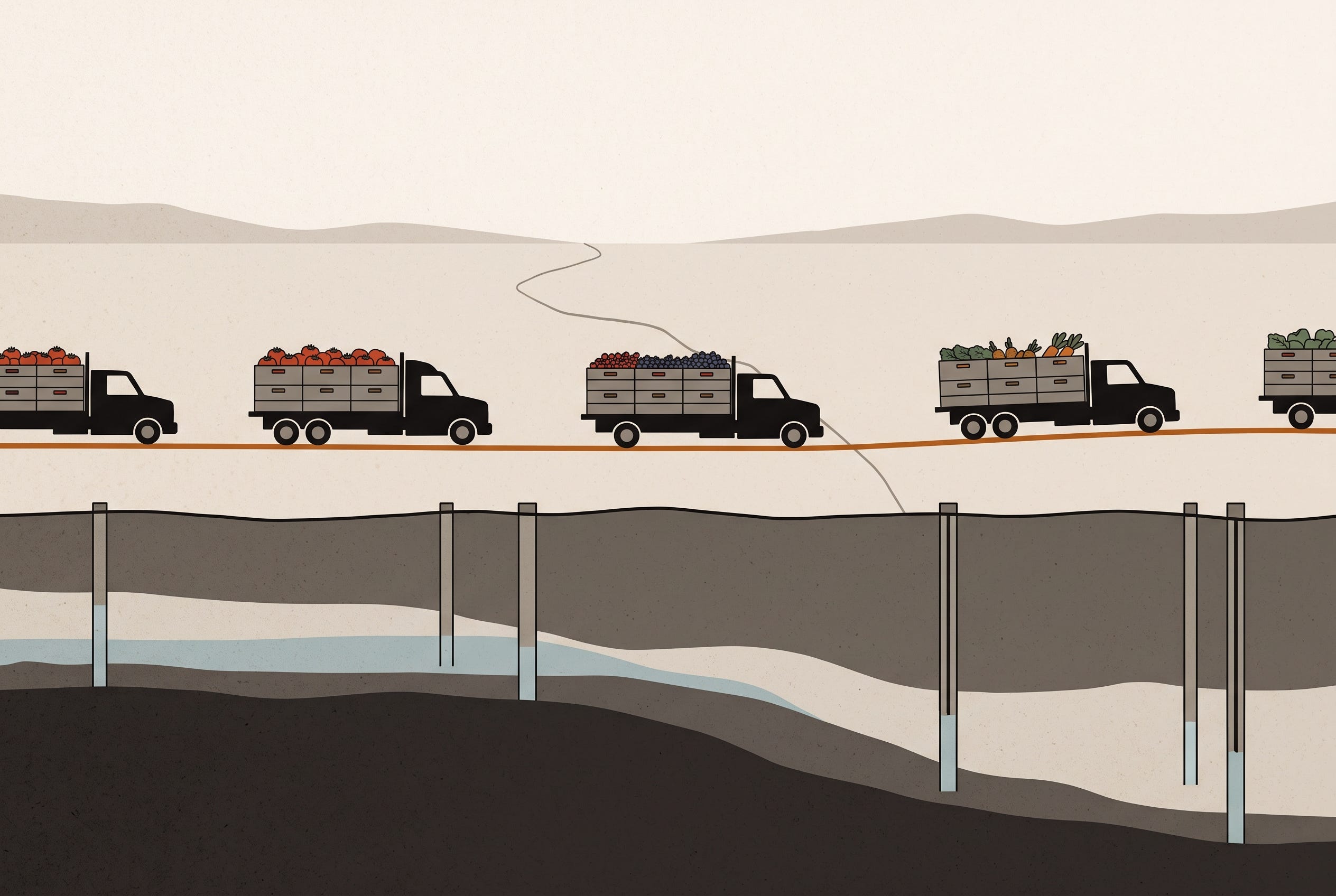
79% of those exports were agricultural, and 79% went to US consumers and well that water ends up on US territory but this is never measured or tracked. The estimate relies on older trade data, but the mechanism has only become more important as continental agricultural trade has grown.
San Quintín makes the mechanism visible; The official groundwater table lists annual recharge of 24.3 million cubic meters and extraction of 62.2 million, leaving [a deficit of 37.9 million cubic meters a year (https://sigagis.conagua.gob.mx/gas1/sections/Edos/BajaCalifornia/bc.html). The produce leaves the valley and behind a depleted water system.
Trade records the value and weight of a shipment but the condition of the well left behind sits outside the record. North America can congratulate itself for an efficient supply chain while moving environmental debt toward the communities with the fewest alternatives.
When Water Becomes Leverage
The Rio Grande/Rio Bravo shows how that order is enforced when water becomes political leverage.
Under the 1944 Water Treaty, Mexico is expected to deliver an average of 350,000 acre-feet a year to the United States over five-year cycles from six named Mexican tributaries.
The cycle that ended on October 24, 2025, carried a benchmark of 1.75 million acre-feet. The [International Boundary and Water Commission recorded deliveries of 884,861 acre-feet](https://ibwcsftpstg.blob.core.windows.net/wad/WeeklyReports/Current_Cycle.pdf), leaving a shortfall of roughly 865,000.
The drought is real, but it does not explain everything. For decades, we have allocated more water than the Rio Grande/Río Bravo can reliably provide, while upstream irrigation commitments take their share before the river reaches the border.
The pain falls on both sides. Texas farmers lose crops and income. Mexican farmers watch their own reservoirs shrink while facing pressure to send more water north.
By January 2026, the dispute had moved beyond the river. Senator John Cornyn asked the U.S. Trade Representative to raise Mexico’s treaty obligations during the USMCA review. Water had become part of the trade negotiation.
A river obligation had become trade leverage.
This is how scarcity turns neighbors into competitors. The farmers of Texas and Chihuahua inherited the treaty, yet each is encouraged to see the other as the reason the canal is dry. Governments defend their own obligations as law and describe the other side’s constraints as politics.
They fight over what they believe is right and theirs but they ignore they share the ground, the air, the rivers, the dams, the infrastructure, the communities and the economies that drive their businesses.
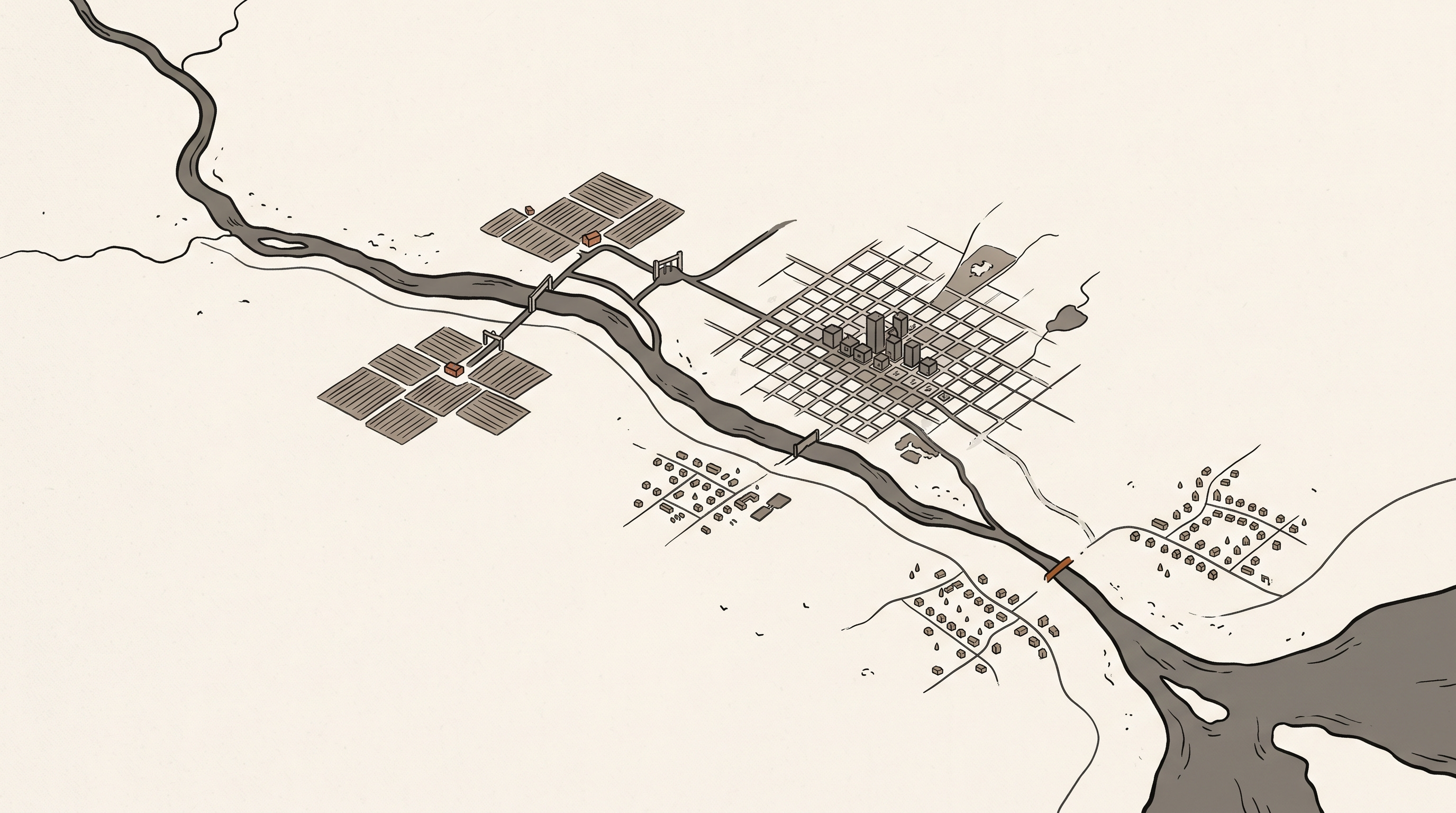
A Right Without Delivery
A legal right to water is not the same as the power to receive it.
The 30 Tribal Nations of the Colorado River Basin understand that distinction better than anyone. Many hold rights older than the cities and irrigation districts around them. Yet a right on paper still requires a settlement, federal authorization, money, pumps, treatment facilities, and pipes.
In March 2026, the U.S. Department of the Interior was still testifying on the [Northeastern Arizona Indian Water Rights Settlement Act](https://www.doi.gov/ocl/indian-water-settlements-0).
The proposal would quantify rights for the Navajo Nation, Hopi Tribe, and San Juan Southern Paiute Tribe and authorize more than $5.1 billion, including a pipeline from Lake Powell. More than 100,000 Tribal members live in the area covered by the settlement.
Their seniority was never the whole question. The harder question was whether institutions would build the means to turn a recognized right into water at a home, school, clinic, or farm.
The same principle applies to infrastructure losses. Mexico City’s own planning indicator estimated that [42 % of its potable water was lost through network leaks in 2022] (https://indicadores.cdmx.gob.mx/dataset/agua-potable-perdida-por-fugas-en-las-redes-de-agua-potable). That water appears in the supply ledger, disappears before delivery, and leaves households to carry the shortage through intermittent service and private expense.
Making the Order Visible
An honest water ledger would show more than reservoir elevations. It would show consumption by crop and sector, the water embedded in trade, the condition of aquifers and pipes, the status of Tribal rights, and the rules that determine who is cut first. It would distinguish a legal allocation from a physical delivery and a temporary saving from a permanent reduction.
Most importantly, it would make power visible.
The Colorado and the Rio Grande/Río Bravo simply carry the water they receive. We are the ones who decided who gets it first, who waits, and who goes without. When the rivers run low, those choices become impossible to hide. You see them in the dry canal, the well that no longer reaches water, the family opening a tap and finding nothing, and the negotiating table where everyone fights over what remains.
The truth is that most of these decisions were made based on completely different ideas of what the future was going to be. The future we live today of less rain, less snow, hotter climate, greater evaporation was never considered in agreements and laws that govern these water bodies and rivers.
Paper III will turn to the institutions that could change this outcome: shared measurement, enforceable conservation, investment that follows vulnerability, and a North American framework capable of treating two shared rivers as common systems.
An honest ledger is only the beginning. We must bring our consumption back within what the rivers can actually provide. That means continentally changing what we grow and where, water protection practices & strategies, repairing and reusing water, investing in water optimization infrastructure, ending growth based on supplies that do not exist, and agreeing now on how shortages will be shared.
If we keep taking water faster than nature can replace it, the arithmetic will eventually make the decisions for us. By then, the cuts will come through dry taps, abandoned farms, migration, and conflict.