
The Roads Are Built. The Standards Aren’t.
Why North America’s next integration project is digital, and why we’re already behind

Column 01 I Versión Español abajo
China’s National Data Administration expects to issue more than 30 new data standards in 2026. Public data, AI agents, data infrastructure, dataset cataloguing. Beijing is building the rulebook other countries will plug into. It tended the fiber, the cables, and the data centers along the Digital Silk Road first, then set the terms.
The country that builds the infrastructure sets the standard. China learned that lesson on physical infrastructure and is now running the same play on the digital layer.
North America hasn’t started.
That’s the gap I want to spend this column, and the next twelve months, arguing matters more than almost anything else on the trade agenda. The reason is simple. The physical integration is already done, and the digital integration that’s supposed to ride on top of it doesn’t exist yet.
Here’s what I mean by “already done.”
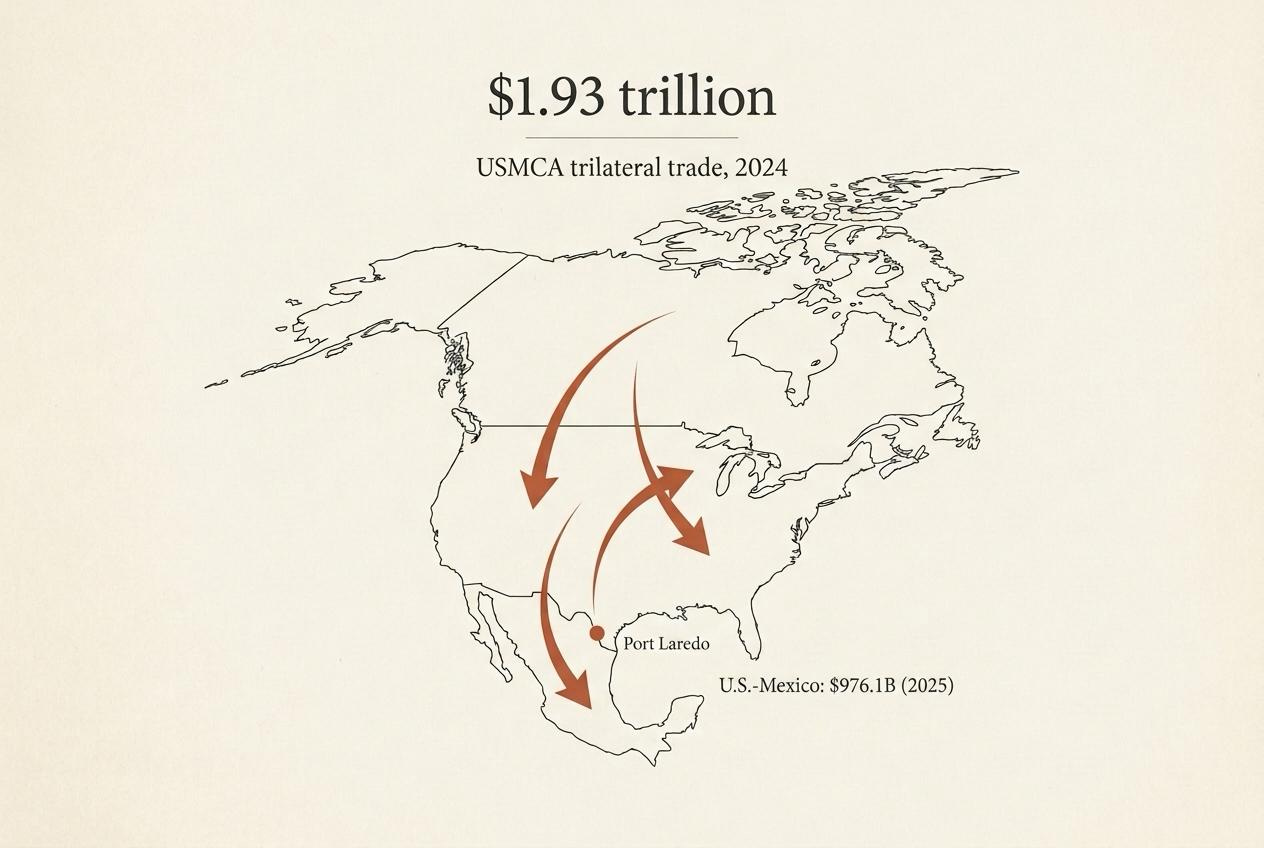
In 2025, total goods and services trade between the United States and Mexico hit $976.1 billion, per the Bureau of Economic Analysis. Trilateral trade across the three USMCA economies ran $1.93 trillion in 2024, the most recent year with a published three-country total. At Port Laredo, the busiest inland crossing on the U.S.-Mexico border, as many as 18,000 commercial trucks move through on the busiest days; the Bureau of Transportation Statistics counted 38.8% of all trucks entering from Mexico crossing here in 2025. The trucks cross. The cargo crosses. The supply chains that build a car across three countries before it’s sold cross, dozens of times, before the vehicle ever reaches a lot.
The trade crosses the border. The institutions don’t. And the digital systems that govern the trade don’t either.
The wall you can’t see
Customs and Border Protection runs one set of systems. Mexico’s customs authority, ANAM, runs another. Canada’s border agency, CBSA, runs a third.
None of them share an operational data platform. There’s no common digital backbone, no interoperable standard for the documentation that moves with every shipment.
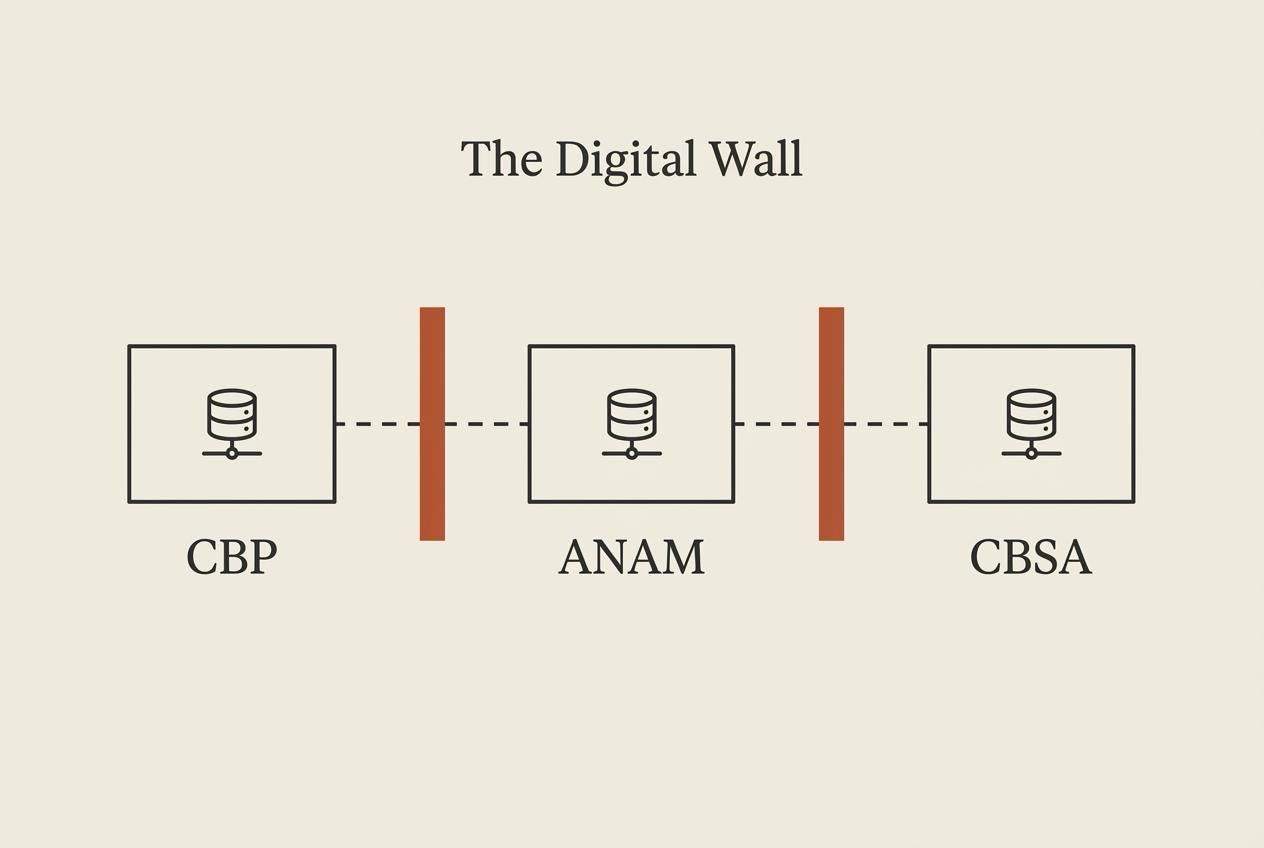
I’ve called this the Digital Wall.
It’s the invisible counterpart to the physical one, and in some ways it’s more expensive.
A truck waits at the bridge for two reasons: inspection capacity, and paperwork that lives in two separate systems never designed to recognize each other.
ECIPE modeled the cost of data localization rules across seven economies in 2014 and found GDP losses as high as 1.7%. For the businesses caught in the middle, the bill is materially higher operating costs.
That’s the tax nobody votes on. It shows up as inventory buffers, redundant filings, and the quiet decision by a mid-sized exporter to not expand because the friction isn’t worth it.
We’ve spent 30 years building physical integration.
We built bridges (the newest, the Gordie Howe between Detroit and Windsor, opens to traffic this month), rail lines, warehouses, and the largest inland port in the hemisphere.
We have not built the digital layer that’s supposed to coordinate it all.
NADICI, in one sentence
The proposal I want to put on the table is the North American Digital Infrastructure Coordination Initiative, or NADICI: shared standards for cybersecurity, data governance, and AI-enabled trade interoperability across the three USMCA borders.
That’s it. A common set of rules for how data moves across the continent, the same way USMCA set common rules for how goods move. It doesn’t add a bureaucracy. And I won’t pretend standards never touch sovereignty: standards are exactly where sovereignty gets contested, which is why Beijing is writing 30 of them. The design answers it this way: each country keeps its own systems, its own data, and its own enforcement. What gets standardized is the plumbing, the rulebook for how those systems recognize each other.
It’s the third piece of a framework I’ve been building with colleagues over the past year. The Binational Customs Agency would handle the operational fusion of customs. The North American Industrial Coordination Council would align industrial policy. NADICI is the digital backbone both would need to run. You can’t operate a binational customs agency on two incompatible IT systems. You can’t coordinate continental industrial policy without agreeing on how cross-border data flows.
The digital layer is load-bearing for the whole agreement. It determines whether the deal still works in an economy where AI designs the product, software runs the logistics, and data is the input that matters most.
The questions USMCA never had to answer
When NAFTA took effect in 1994, the hardest question was a rule of origin: how much of a car had to be made in North America to cross duty-free. We’re about to face a much stranger version of that question.
How does a rule of origin work when an AI system designs the product across three borders at once?
What does “worker protection” mean when the task in question is performed by software, not a person?
Who’s liable when an autonomous truck crosses an international bridge, and the decision to brake was made by a model trained on data from a fourth country?
The 2026 USMCA Joint Review is the moment these questions get asked, whether we’re ready or not. The agreement’s digital trade chapter was written for a world of e-commerce and data flows, not agentic AI.
It’s a 20th-century agreement governing a 21st-century economy, and the gap is widening every quarter.
Why this is the security argument too
I used to keep the technology and security conversations in separate rooms. I don’t anymore.
The United States is racing China for the frontier of artificial intelligence. That’s the defining technological competition of the decade.
But if the U.S. reaches that frontier alone, with Mexico and Canada lagging behind on digital infrastructure, that’s not a North American victory. It’s a continental vulnerability.
A supply chain is only as secure as its least digitized link. A continent that shares nearly $2 trillion in annual trade but can’t share a cybersecurity standard has built a single economy with three different locks on the same door.
Security has become the continent’s new subsidy.
Every dollar kept in North America through secure, digitally coordinated trade reduces global risk and builds regional strength. The digital layer is where that logic either holds or breaks.
What I’ll be writing about here
This is the first of a monthly column for The North American — 77, and the through-line will be Logistechs: the impact exponential technologies have on logistics and on the integration logistics makes possible.
Over the next year, I’ll get specific. The digital border and what a binational customs agency actually requires. AI and the 9.9 million North American jobs the trade relationship touches. What cross-border trade looks like when sensors, autonomous vehicles, and AI converge. Cybersecurity as the integration risk nobody’s pricing.
But it starts here, with the unglamorous foundation. China is writing 30 standards this year. We haven’t written the first one.
The roads are built. The standards aren’t. That’s the work.
Daniel Covarrubias, Ph.D., is Director of the Texas Center for Border Economic and Enterprise Development at Texas A&M International University’s A.R. Sanchez, Jr. School of Business. He writes The Bridge, a data-first Substack on North American trade and exponential technologies.
Versión Español
Las carreteras ya están. Los estándares no.
Por qué el próximo proyecto de integración de Norteamérica es digital, y por qué ya vamos tarde
La Administración Nacional de Datos de China prevé emitir más de 30 nuevos estándares de datos en 2026. Datos públicos, agentes de inteligencia artificial, infraestructura de datos, catalogación de conjuntos de datos. Beijing está construyendo el reglamento al que otros países tendrán que conectarse. Primero tendió la fibra, los cables y los centros de datos de la Ruta de la Seda Digital, y después fijó las condiciones.
El país que construye la infraestructura fija el estándar. China aprendió esa lección con la infraestructura física y hoy la repite en la capa digital.
Norteamérica ni siquiera ha empezado.
Esa es la brecha que quiero defender en esta columna, y durante los próximos doce meses, como una de las cosas que más importan en toda la agenda comercial. La razón es simple. La integración física ya está hecha, y la integración digital que se supone debe ir montada encima todavía no existe.
Déjenme explicar a qué me refiero con “ya está hecha”.
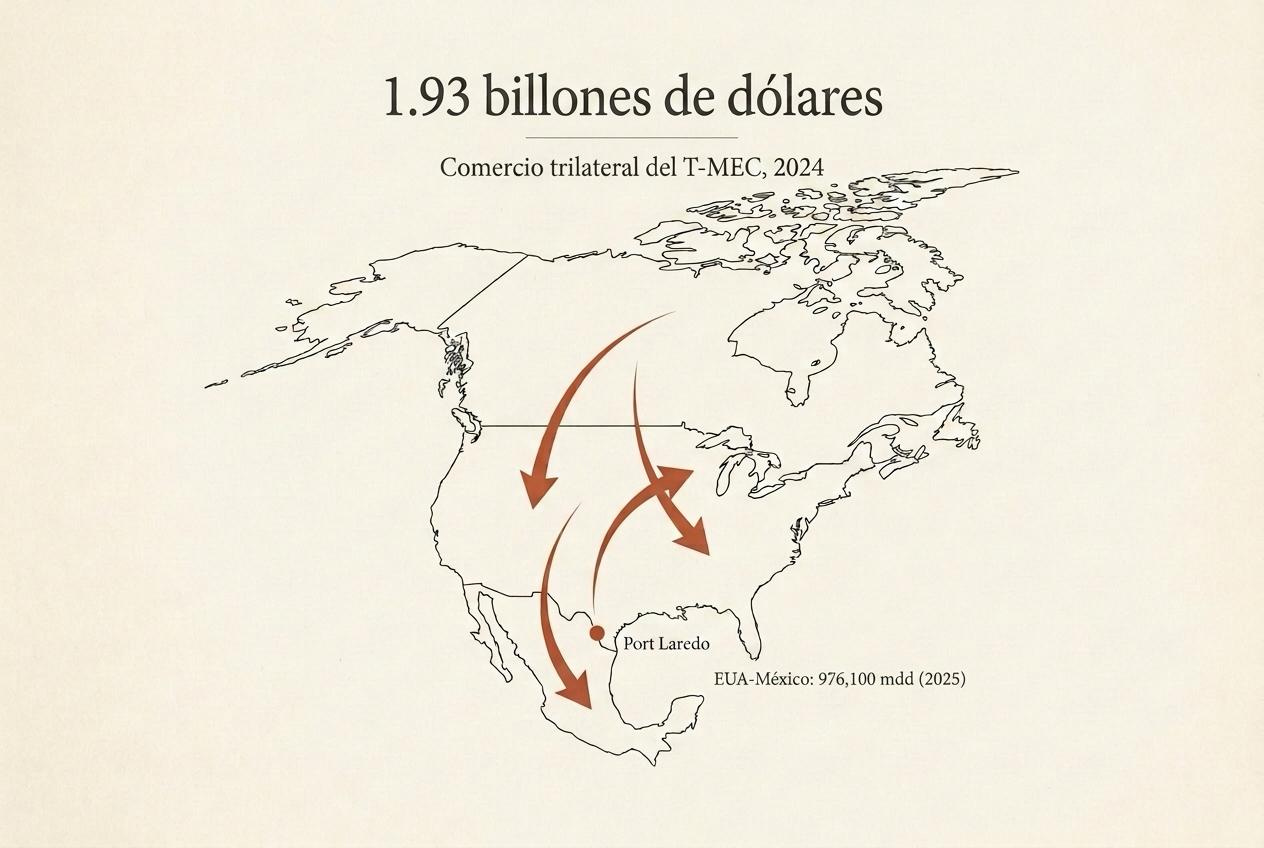
En 2025, el comercio total de bienes y servicios entre Estados Unidos y México alcanzó 976,100 millones de dólares, según el Bureau of Economic Analysis. El comercio trilateral entre las tres economías del T-MEC sumó 1.93 billones de dólares en 2024, el año más reciente con una cifra trilateral publicada.
En el Puerto de Laredo, el cruce interior más activo de la frontera entre Estados Unidos y México, pasan hasta 18,000 camiones comerciales en los días más cargados; el Bureau of Transportation Statistics contó que el 38.8% de todos los camiones que entraron desde México en 2025 cruzaron por aquí.
Cruzan los camiones. Cruza la carga. Cruzan las cadenas de suministro que ensamblan un automóvil entre tres países decenas de veces antes de que el vehículo llegue siquiera a una agencia.
El comercio cruza la frontera. Las instituciones no. Y los sistemas digitales que gobiernan ese comercio tampoco.
El muro que no se ve
La Oficina de Aduanas y Protección Fronteriza de Estados Unidos opera un conjunto de sistemas. La Agencia Nacional de Aduanas de México (ANAM) opera otro. La agencia fronteriza de Canadá, la CBSA, opera un tercero. Ninguno comparte una plataforma de datos operativa. No hay una columna vertebral digital común, ni un estándar interoperable para la documentación que viaja con cada embarque.
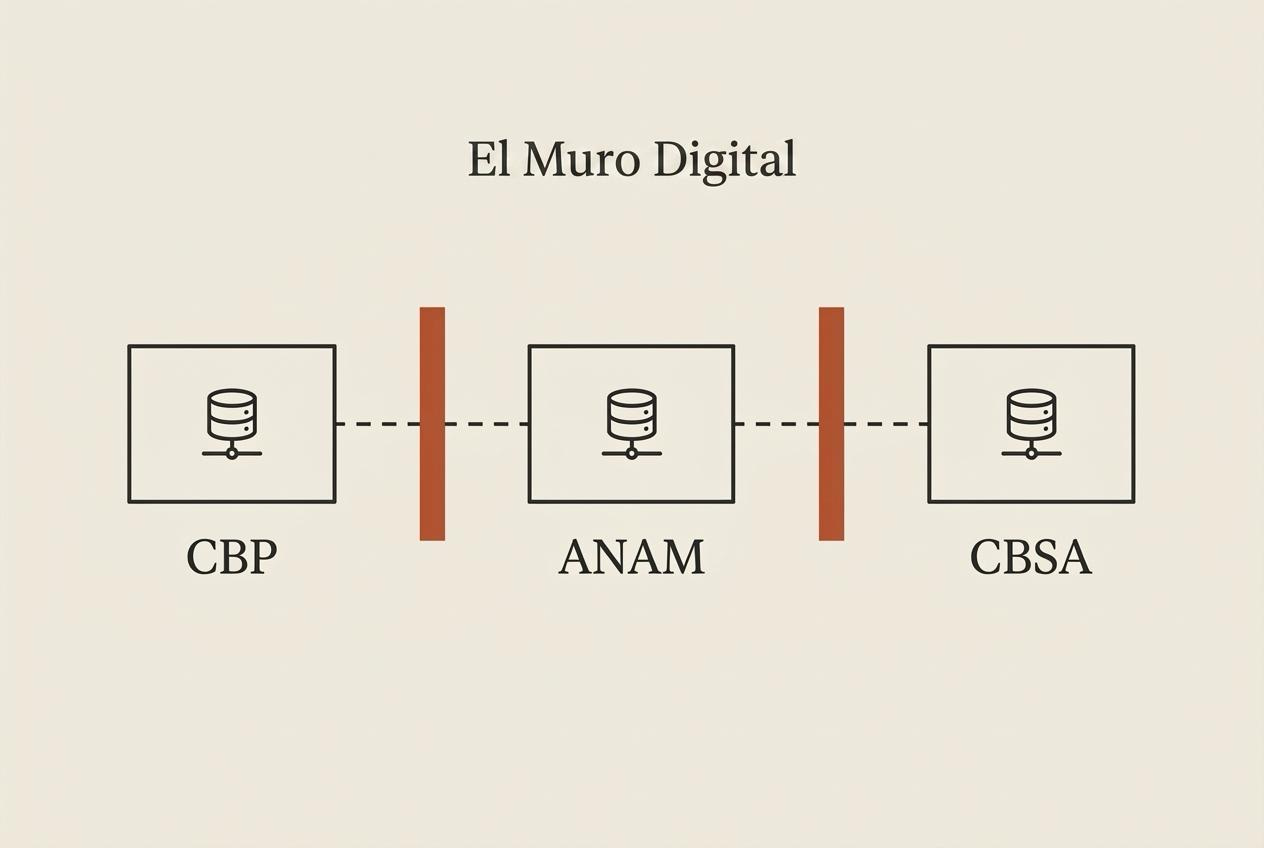
A esto le he llamado el Muro Digital. Es la contraparte invisible del muro físico, y en ciertos aspectos resulta más caro. Un camión espera en el puente por dos razones: la capacidad de inspección física, y los documentos que viven en dos sistemas separados que nunca se diseñaron para reconocerse.
ECIPE modeló en 2014 el costo de las reglas de localización de datos en siete economías y encontró pérdidas de PIB de hasta 1.7%. Para las empresas atrapadas en medio, la factura son costos operativos sustancialmente más altos. Ese es el impuesto por el que nadie vota. Aparece como inventarios de seguridad, trámites duplicados, y la decisión silenciosa de un exportador mediano de no crecer porque la fricción no vale la pena.
Llevamos 30 años construyendo integración física.
Construimos puentes (el más nuevo, el Gordie Howe entre Detroit y Windsor, abre al tráfico este mes), vías férreas, almacenes, el puerto interior más grande del hemisferio.
No hemos construido la capa digital que se supone que debe coordinarlo todo.
NADICI, en una frase
La propuesta que quiero poner sobre la mesa es la North American Digital Infrastructure Coordination Initiative, o NADICI: estándares compartidos de ciberseguridad, gobernanza de datos e interoperabilidad comercial habilitada por la inteligencia artificial en las tres fronteras del T-MEC.
Eso es todo. Es un conjunto común de reglas sobre cómo se mueven los datos en el continente, al igual que el T-MEC fijó reglas comunes sobre cómo se mueven los bienes. No agrega una burocracia. Y no voy a fingir que los estándares nunca tocan la soberanía: los estándares son justo el terreno donde la soberanía se disputa, por eso Beijing está escribiendo 30.
El diseño lo resuelve así: cada país conserva sus propios sistemas, sus propios datos y su propia capacidad de hacer cumplir la ley. Lo que se estandariza es la plomería, el reglamento para que esos sistemas se reconozcan entre sí.
Es la tercera pieza de un marco que he venido construyendo con varios colegas durante el último año. La Agencia Binacional de Aduana resolvería la fusión operativa de las aduanas. El North American Industrial Coordination Council alinearía la política industrial. NADICI es la columna vertebral digital que ambas necesitan para funcionar.
No se puede operar una agencia binacional de aduana con dos sistemas informáticos incompatibles. No se puede coordinar una política industrial continental sin ponerse de acuerdo sobre cómo fluyen los datos a través de las fronteras.
La capa digital es el muro de carga de todo el acuerdo. Define si el acuerdo todavía sirve en una economía donde la inteligencia artificial diseña el producto, el software opera la logística, y los datos son el insumo que más importa.
Las preguntas que el T-MEC nunca tuvo que responder
Cuando el TLCAN entró en vigor en 1994, la pregunta más difícil era la de una regla de origen: cuánto de un automóvil tenía que fabricarse en Norteamérica para cruzar libre de aranceles. Estamos por enfrentar una versión mucho más extraña de esa pregunta.
¿Cómo funciona una regla de origen cuando un sistema de inteligencia artificial diseña el producto en tres fronteras a la vez?
¿Qué significa “protección al trabajador” cuando la tarea la realiza un software y no una persona?
¿Quién responde cuando un camión autónomo cruza un puente internacional y la decisión de frenar la tomó un modelo entrenado con datos de un cuarto país?
La Revisión Conjunta del T-MEC de 2026 es el momento en que estas preguntas se plantean, estemos listos o no. El capítulo de comercio digital del acuerdo se redactó para un mundo de comercio electrónico y de flujos de datos, no para el de la IA agéntica.
Es un acuerdo del siglo XX que gobierna una economía del siglo XXI, y la brecha se ensancha cada trimestre.
Por qué este también es el argumento de seguridad
Antes, mantenía la conversación sobre tecnología y la de seguridad en cuartos separados. Ya no.
Estados Unidos compite con China en la frontera de la inteligencia artificial. Esa es la competencia tecnológica que define la década. Pero si Estados Unidos llega solo a esa frontera, con México y Canadá rezagados en infraestructura digital, eso no es una victoria norteamericana. Es una vulnerabilidad continental.
Una cadena de suministro es tan segura como su eslabón menos digitalizado. Un continente que comparte casi 2 billones de dólares en comercio anual, pero no puede compartir un estándar de ciberseguridad, ha construido una sola economía con tres cerraduras distintas en la misma puerta.
La seguridad se ha vuelto el nuevo subsidio del continente.
Cada dólar que se queda en Norteamérica, a través del comercio seguro y coordinado digitalmente, reduce el riesgo global y construye fuerza regional al mismo tiempo. La capa digital es donde esa lógica se sostiene o se rompe.
Sobre lo que voy a escribir aquí
Esta es la primera de una columna mensual para The North American — 77, y el hilo conductor va a ser los Logistechs: el impacto que las tecnologías exponenciales tienen sobre la logística, y sobre la integración que la logística hace posible.
Durante el próximo año entraré en detalle. La frontera digital y lo que realmente exige una agencia binacional de aduanas. La IA y los 9.9 millones de empleos norteamericanos que la relación comercial toca. Cómo se ve el comercio transfronterizo cuando convergen los sensores, los vehículos autónomos y la inteligencia artificial. La ciberseguridad como el riesgo de integración que nadie está cotizando.
Pero empieza aquí, con el cimiento poco glamoroso.
China va a escribir 30 estándares este año. Nosotros no hemos escrito el primero.
Las carreteras ya están. Los estándares no. Ese es el trabajo.
Daniel Covarrubias, Ph.D., dirige el Texas Center for Border Economic and Enterprise Development en la A.R. Sanchez, Jr. School of Business de Texas A&M International University. Escribe The Bridge, un Substack basado en datos sobre el comercio de Norteamérica y las tecnologías exponenciales.
 | A guest post by
|