
The Cost You Can't Calculate
How trade policy uncertainty (Tariffs) is quietly stalling North American supply chains

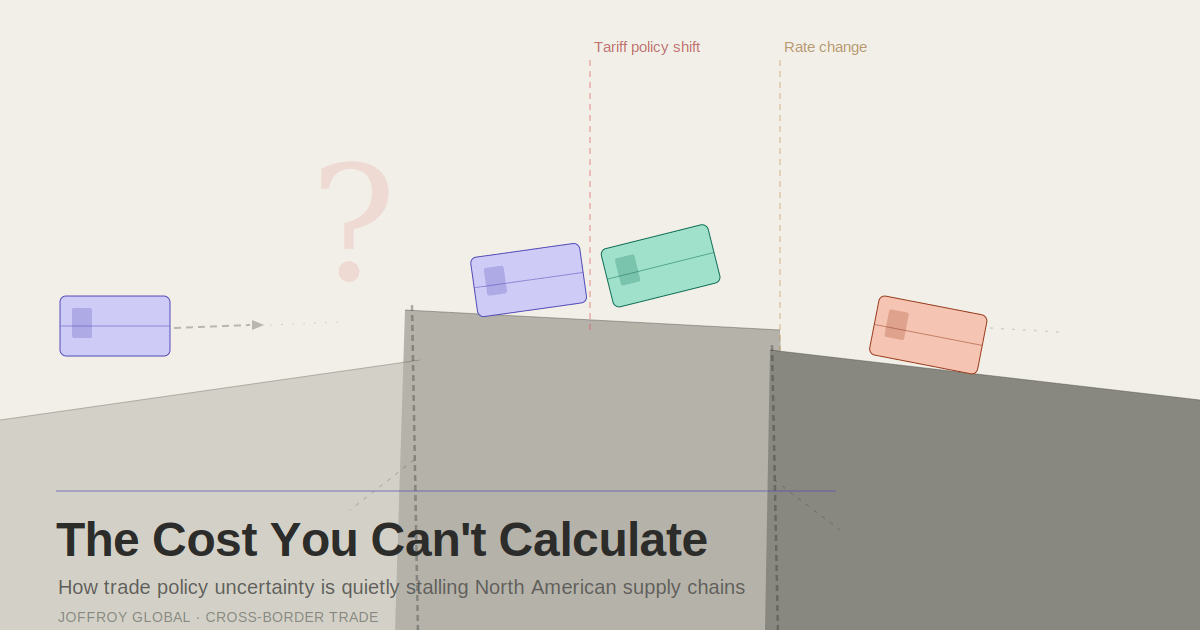
For businesses that move goods across borders, the biggest risk right now is not tariffs. It’s policy uncertainty.
Over the past few weeks, U.S. trade policy has shifted repeatedly, forcing importers, manufacturers, and logistics operators to adjust in real time.
First, the U.S. Supreme Court struck down tariffs that had been imposed using emergency powers.
Almost immediately, the White House replaced them with a new 10% global tariff under a rarely used provision of the Trade Act. Within days, officials signaled the rate could rise to 15%.
In just a few weeks, the legal foundation for tariffs changed entirely.
For companies operating across the U.S.–Mexico border and throughout North American supply chains, that kind of shift matters far more than the political debate around trade deficits.
---
Supply chains are planned years in advance
Contracts are negotiated months ahead.
Freight pricing depends on stable assumptions.
Policy, by contrast, can change in a matter of days.
When those assumptions change overnight, planning becomes far more difficult.
---
The Scale of the Refund Shock
The real jolt came from refunds.
On March 4, a federal judge ordered U.S. Customs and Border Protection to refund all tariffs previously collected under the earlier policy — not only to the companies that filed lawsuits, but to every importer who paid them.
The scale is extraordinary: roughly **$166 billion** across more than **53 million import entries**.
CBP has said processing those refunds manually would require more than 4.4 million labor hours. Enforcement has therefore been paused for roughly 45 days while automated systems are built to handle the process.
In the meantime, companies expecting refunds should ensure their ACE portal is configured for electronic ACH payments, since Customs has stopped issuing paper checks.
---
The Legal Fight Continues
Even as businesses try to understand the refund process, a new legal challenge is already underway.
A coalition of 24 U.S. states has filed suit to block the new tariffs, arguing that the law being used was originally designed for monetary crises decades ago — not modern trade deficits.
Whether that argument succeeds remains to be seen.
For companies operating real supply chains, however, the legal debate is almost beside the point.
---
The Real Damage Is Uncertainty
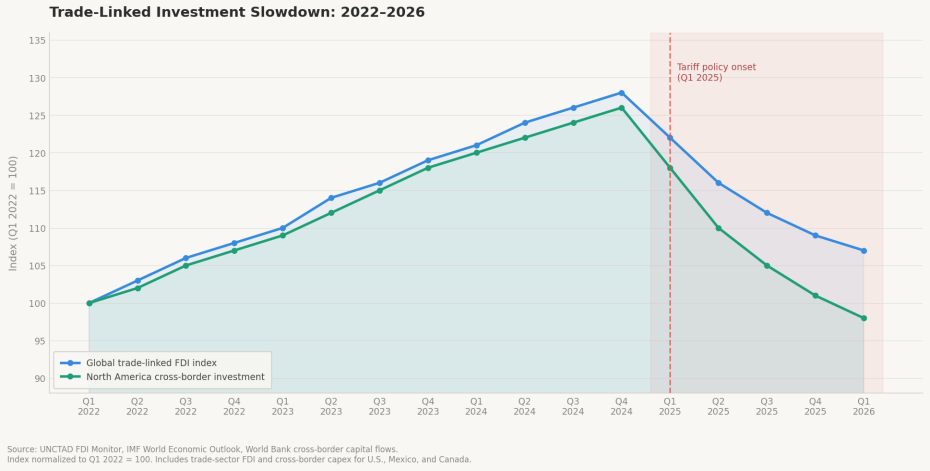
Businesses are trying to price products, plan shipments, negotiate contracts, and make investment decisions while the rules change in real time.
Factories, logistics hubs, ports, and distribution networks require one basic condition to grow: **predictability**.
When policy swings back and forth, the cost is not just the tariff itself.
The cost is hesitation.
Investment decisions get delayed. Contracts become defensive. Expansion slows.
Tariffs can be calculated. Businesses deal with them every day.
What cannot be calculated is uncertainty.
Supply chains can adapt to tariffs.
They cannot adapt to chaos.
Eduardo Joffroy | Creator of Northamerican 77
Building North America’s future by trading old systems for bold new ideas. I believe it is up to us to face today’s challenges and secure a better destiny for all North Americans. Let’s win the 21st century.
Construyendo el futuro de Norteamérica al cambiar viejos sistemas por ideas nuevas y audaces. Creo que nos corresponde a nosotros enfrentar los retos actuales y asegurar un mejor destino para todos los norteamericanos. Ganemos el siglo 21.
Join the mission | Únete a la misión: