NORTHAMERICAN 77
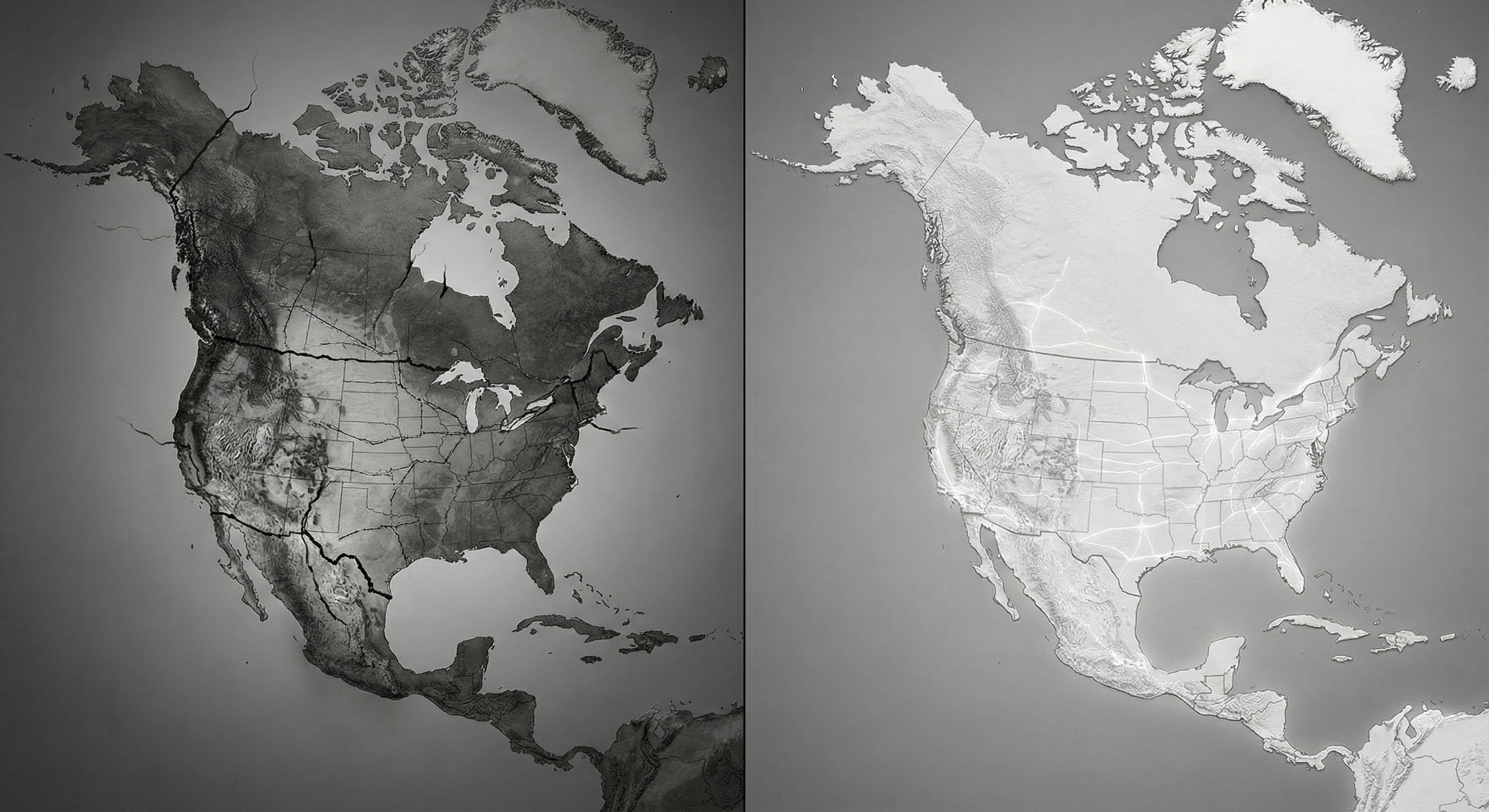
For decades, North America has lived with a convenient illusion. We trade like a block, but we think like three separate countries. We benefit from proximity without accepting the responsibility that proximity demands.
That illusion is ending.
In 2026, the United States, Mexico, and Canada will enter the mandatory six-year review of USMCA. Public debate will focus on trade balances, enforcement disputes, and political leverage.
Those conversations miss the larger point.
Trade volumes already show that the agreement functions. The deeper question is whether North America understands the world it is now operating in.
The World Is Reorganizing
The global economy is consolidating into regional power centers.
Not loose alliances.
Not simple trade deals.
Integrated systems with strategic intent.
Integrated systems cannot afford internal fragmentation.
China’s strength does not come from efficiency alone. It comes from coordination across industry, finance, infrastructure, and long-term state planning. Europe’s renewed defense posture is not driven by aggression, but by the recognition that fragmentation carries strategic risk. The Russia–Ukraine war accelerated that realization.
North America, by contrast, holds extraordinary advantages:
Technology and innovation leadership
Geographic insulation with access to two oceans
Strong consumer markets
Advanced manufacturing capacity
Deep and liquid capital markets
Demographic scale
Labor across the full industrial chain
Energy and natural resource abundance
Food security
Together, the United States, Mexico, and Canada represent nearly 30 percent of global GDP. With genuine strategic alignment, that share can grow and provide greater human centric distribution.
Few regions possess this combination of assets and potential.
On paper, North America is already a superpower.
In practice, it operates without a shared strategic framework.
The Quiet Shift: From Efficiency to Security
The most important change is not rhetorical. It is structural.
Economic integration is no longer primarily about cost optimization. It is about security, continuity, and long-term resilience.
Supply chains are now designed around reliability and political alignment, not just price. Energy is not merely a commodity; it is leverage. Critical minerals, semiconductor capacity, water access, logistics corridors, and workforce development are strategic variables.
A region that cannot coordinate these elements is exposed.
USMCA was negotiated in a period that assumed relative global stability. The 2026 review will take place in a world shaped by digital transformation, industrial policy, strategic competition, migration pressures, climate stress, and contested supply chains.
The agreement can remain a trade framework and risk gradual strategic erosion.
Or it can become the foundation of a continental strategy.
If We Fail to Align
Fragmentation is not neutral.
If North America continues to integrate economically while remaining misaligned institutionally, the pressure points will multiply.
Migration flows will remain reactive instead of managed, straining public trust and political stability across the continent. Organized criminal networks will continue to exploit jurisdictional gaps, moving drugs, weapons, money, and people through three legal systems that do not operate as one.
Critical infrastructure — ports, rail corridors, energy facilities, digital networks — will become more valuable and more vulnerable at the same time. Where governance is uneven, external influence follows.
If institutional strength does not rise alongside economic integration, asymmetry will deepen. Investment decisions are sensitive to stability. Insurance premiums, financing costs, and long-term capital commitments respond quickly to perceived risk.
The danger is not sudden collapse.
It is gradual erosion — of trust, coordination, and strategic leverage.
North America’s advantages are real. But advantages that are not protected eventually become opportunities for others.
Fortress Does Not Mean Isolation
“Fortress North America” is not a call for retreat from the world.
It is a call for internal coherence.
Regions that fail to coordinate and secure their economic and physical borders become arenas where external powers compete for influence, capital, and leverage.
Geography gave North America scale, resources, and insulation.
Strategy will determine whether we use them.
The 2026 review is more than a procedural checkpoint. It is a decision point.
We can continue treating integration as a commercial arrangement.
Or we can recognize that it is already a geopolitical reality and act accordingly.
In the next essay, I will argue something more difficult: the greatest obstacle to a unified North America is not Washington or Ottawa.
It is Mexico.
Part II of this three-part series will examine why Mexico is the pivotal piece of the North American puzzle — and what structural changes are necessary for it to become a fully reliable continental partner.