P. 1 de 3 — MÉXICO: El Vecino que Decidió Ignorar el Orden Global
¿Por qué México no se transformó teniendo todo a su favor?

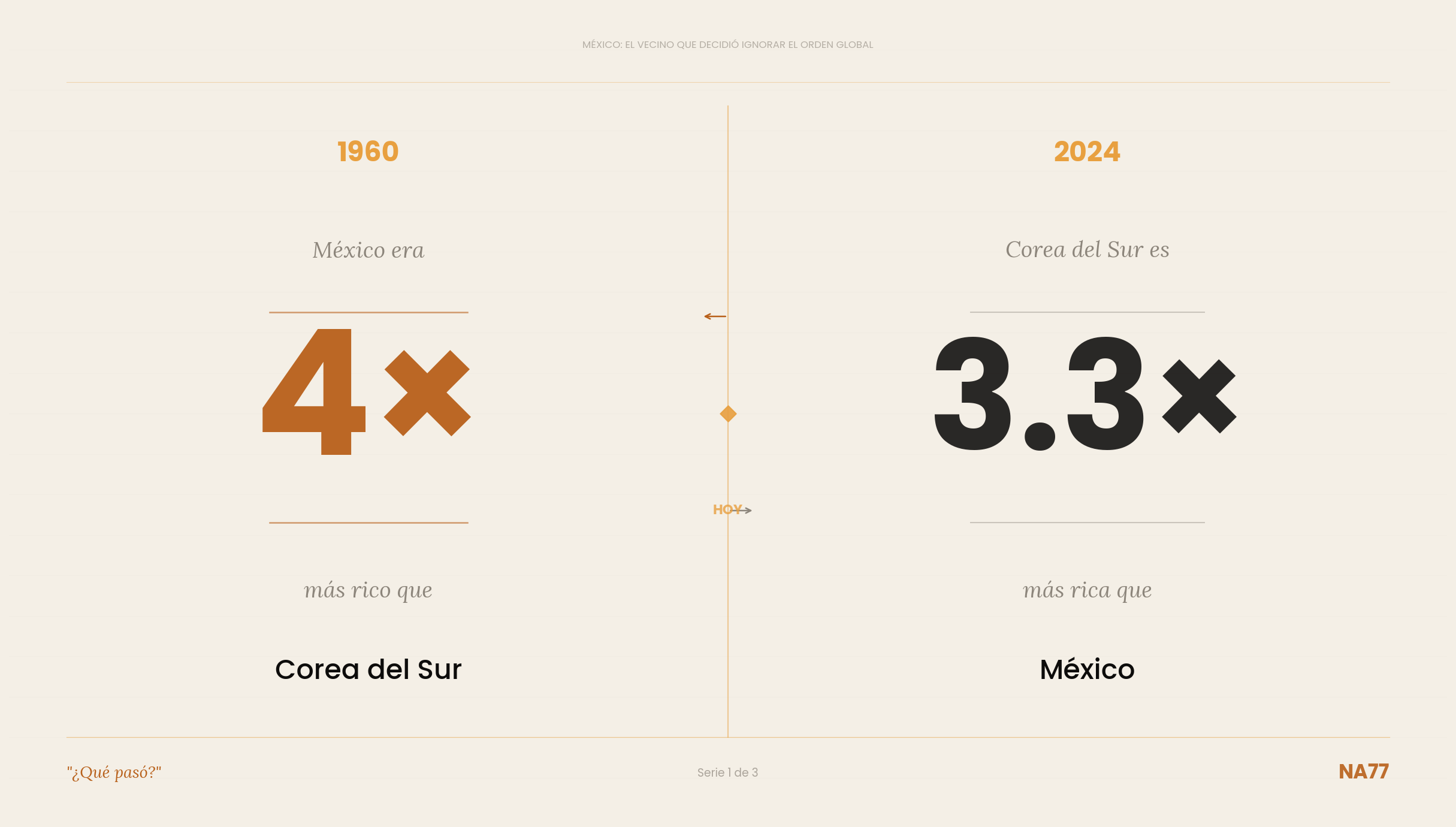
En 1960, el PIB per cápita de México era cuatro veces mayor que el de Corea del Sur.
Cuatro veces.
México tenía petróleo. Tenía frontera directa con la economía más poderosa de la historia. Tenía décadas de relación comercial con Estados Unidos. Tenía una posición geográfica que cualquier país del mundo habría considerado una ventaja irrepetible.
Corea del Sur no tenía nada de eso.
Corea del Sur salía de una guerra civil devastadora. No tenía recursos naturales significativos. No tenía un vecino rico. No tenía acceso privilegiado a ningún mercado.
Hoy, el PIB per cápita de Corea del Sur es 3.3 veces el de México.
¿Qué pasó?
La decisión que definió el siglo
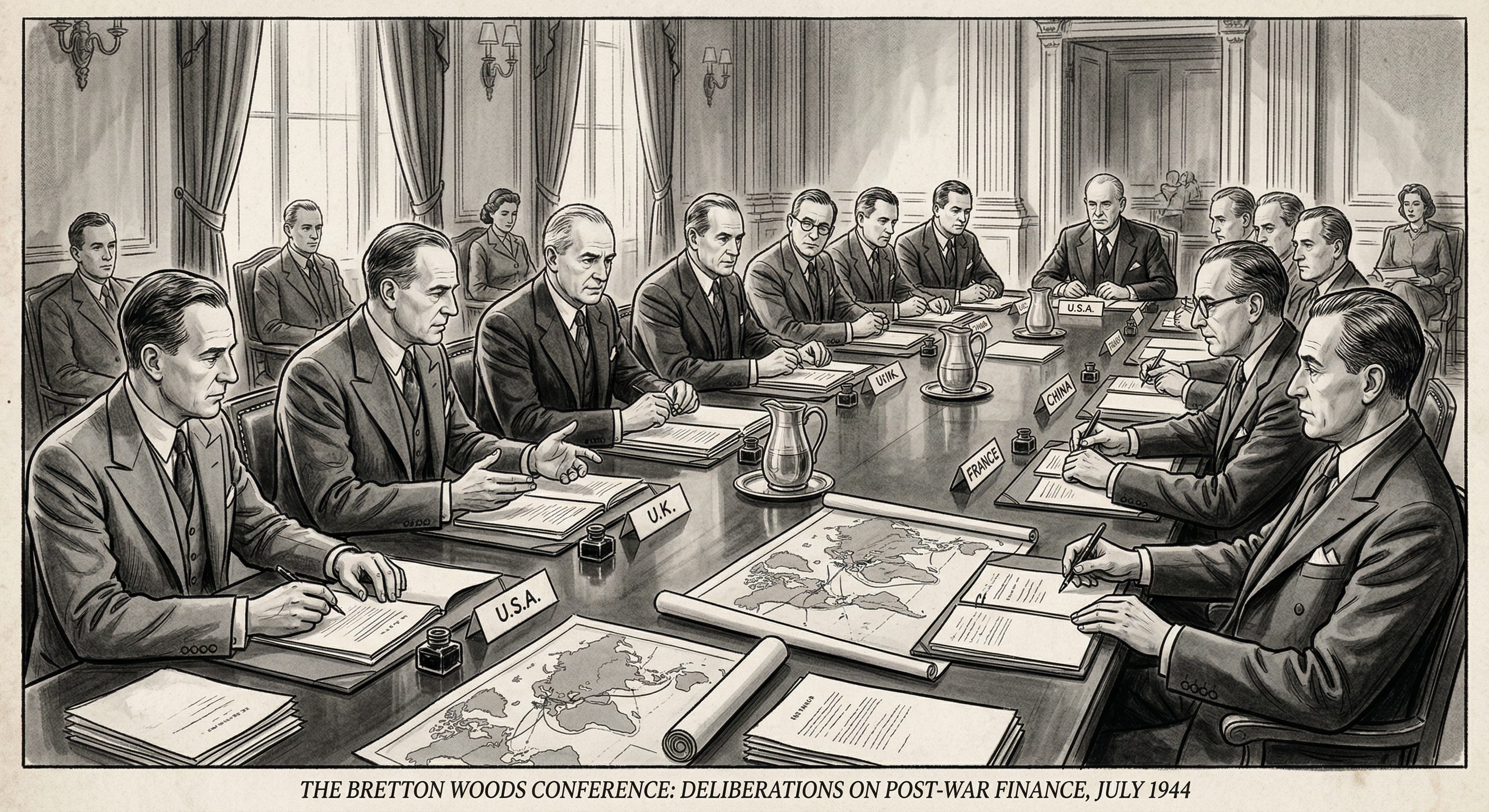
En julio de 1944, representantes de 44 naciones — incluyendo a México — se reunieron en Bretton Woods, New Hampshire.
El objetivo: diseñar un sistema económico global que impidiera que otra guerra mundial fuera posible. De esa conferencia nació la arquitectura que definiría el siglo XX:
el dólar como moneda de reserva
el Fondo Monetario Internacional
el Banco Mundial
y las bases del GATT.
No era un sistema perfecto. Pero era un sistema con reglas. Y las reglas generan previsibilidad. Y la previsibilidad es el cimiento de toda inversión y de todo progreso sostenido.
México estuvo ahí. Su delegación, encabezada por el Secretario de Hacienda Eduardo Suárez y el economista Víctor Urquidi, participó activamente en las negociaciones que dieron origen al FMI y al Banco Mundial. México no fue un observador distante. Fue un actor presente — que eligió no hacer propio lo que ayudó a diseñar.
El México de los años 40: una dirección que ya apuntaba hacia adentro
Para entender por qué México tomó un camino diferente, hay que regresar a la Revolución.
Después del Porfiriato — un período de crecimiento impulsado por inversión extranjera pero con una concentración de riqueza que el pueblo mexicano rechazó profundamente — vino la Revolución Mexicana. Y la Revolución no fue solo un cambio de gobierno. Fue una redefinición completa del modelo.
Un Estado fuerte. Control económico centralizado. Desconfianza institucionalizada hacia el capital externo. Estas no fueron decisiones accidentales — fueron respuestas políticas legítimas a décadas de explotación.
El problema es que cuando el nuevo orden global se consolidaba en 1944, México ya había elegido su dirección. Y esa dirección apuntaba en sentido contrario a los Acuerdos de Bretton Woods.
En 1938, Lázaro Cárdenas nacionalizó el petróleo. Fue un acto de soberanía que todavía se celebra cada 18 de marzo. Pero también fue una señal al mundo: México no iba a jugar con las reglas del sistema global. Iba a jugar con las propias.
Mientras Bretton Woods promovía apertura, competencia e integración, México avanzaba bajo una lógica distinta: protección, control y desarrollo estabilizador — el modelo priísta de crecimiento gestionado desde el Estado. Un modelo que funcionó durante ciertos períodos. Que produjo crecimiento. Que generó estabilidad. Pero que no construyó las bases institucionales necesarias para sostener ese crecimiento, ni para distribuirlo de manera que beneficiara a la mayoría.
Mientras tanto, al otro lado del mundo
Japón, devastado por la guerra, tomó una decisión radical: alinear sus instituciones al sistema global. Invirtió masivamente en educación. Abrió su economía al comercio. Fortaleció el estado de derecho para proteger la inversión. Para 1980, era la segunda economía del mundo.
Alemania hizo lo mismo. De las ruinas literales surgió el Wirtschaftswunder — el milagro económico. No porque Alemania tuviera recursos naturales, sino porque adoptó las reglas del sistema: mercados abiertos, instituciones fuertes, educación universal, previsibilidad legal.
Y Corea del Sur — el caso más devastador para la narrativa mexicana. En 1960, un país más pobre que México por un factor de cuatro. Sin petróleo. Sin un vecino rico. Sin acceso geográfico privilegiado. Pero con una decisión clara: invertir en educación al nivel del primer mundo, abrir la economía al comercio global, y construir instituciones que trascendieran gobiernos.
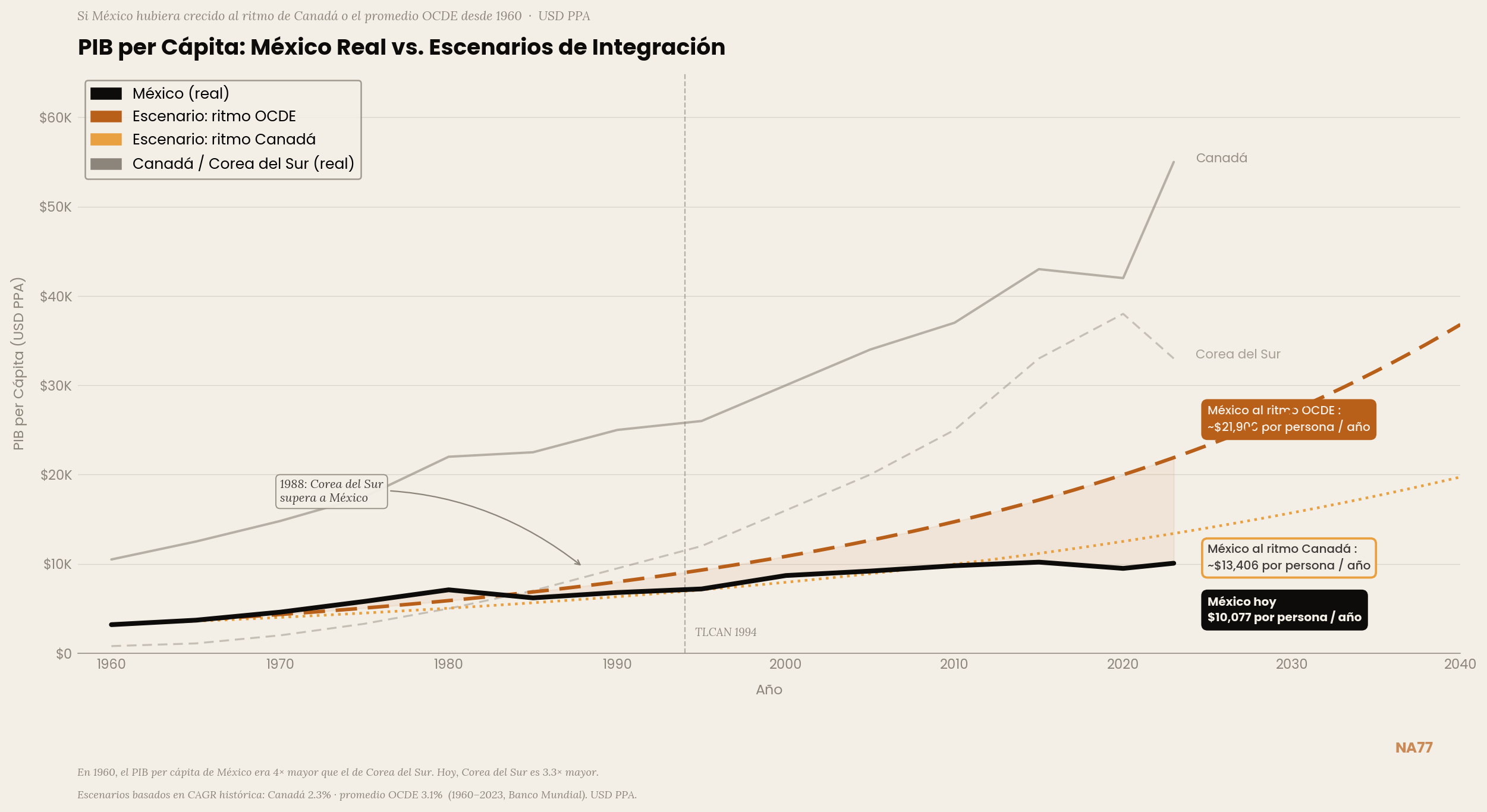
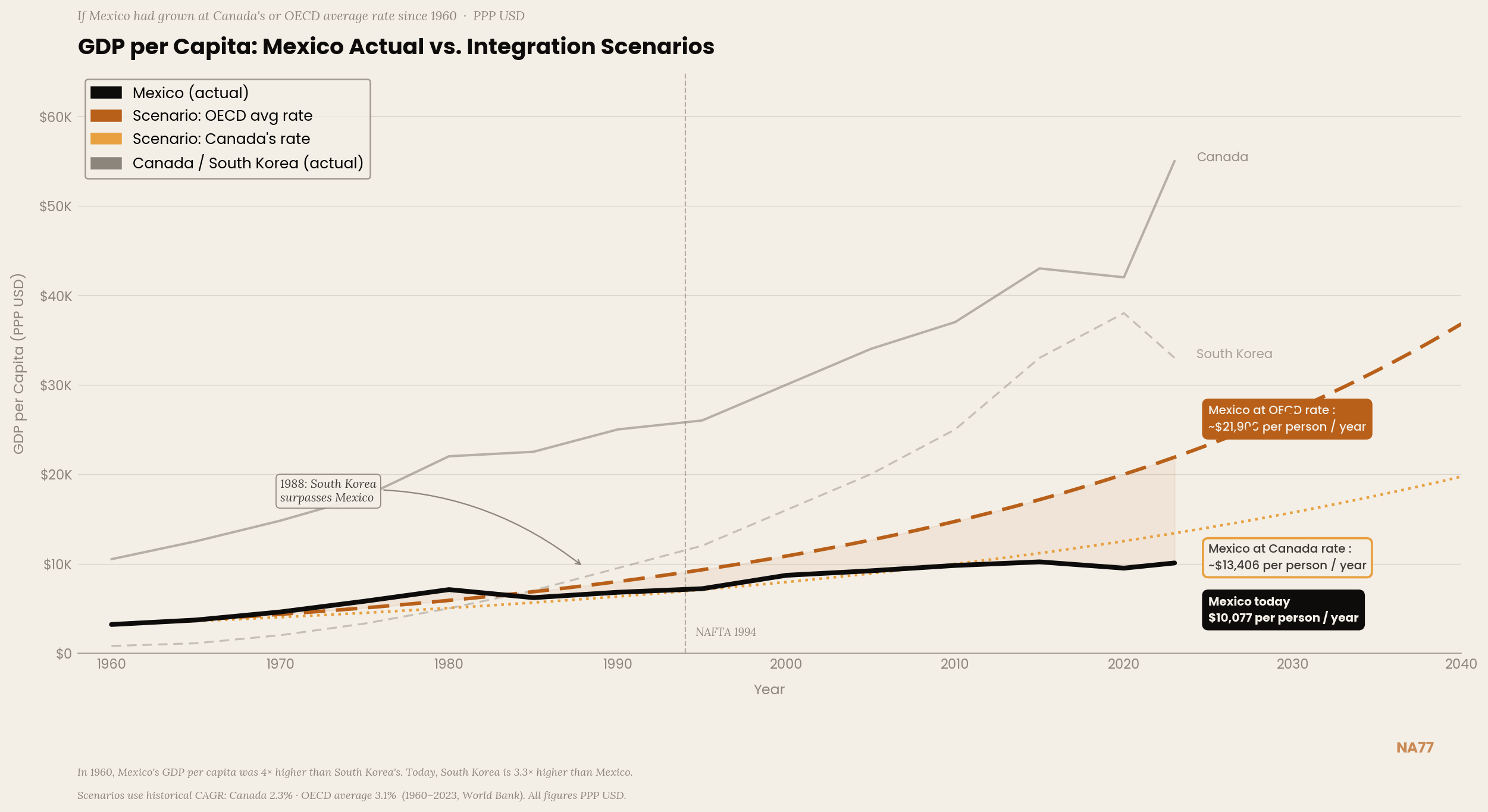
Para 1988, Corea del Sur había superado a México en PIB per cápita. Y nunca volvió a ver hacia atrás.
El costo de esa divergencia no requiere proyecciones imaginarias. Se mide con precisión: en 1960, México era cuatro veces más rico que Corea del Sur. Hoy, Corea del Sur genera 3.3 veces más riqueza por persona que México. Ese cruce — de 4x arriba a 3.3x abajo — representa el costo acumulado de décadas de decisiones.
Lo que México dejó en la mesa
El costo de este camino no es teórico. Es medible.
Si México hubiera crecido al ritmo de Canadá — no de Corea del Sur, solo al ritmo de su socio comercial del norte con quien comparte un tratado desde hace 30 años — cada mexicano produciría $13,406 dólares al año en lugar de $10,077. Si hubiera alcanzado el promedio de crecimiento de los países de la OCDE, esa cifra sería de $21,900 dólares.
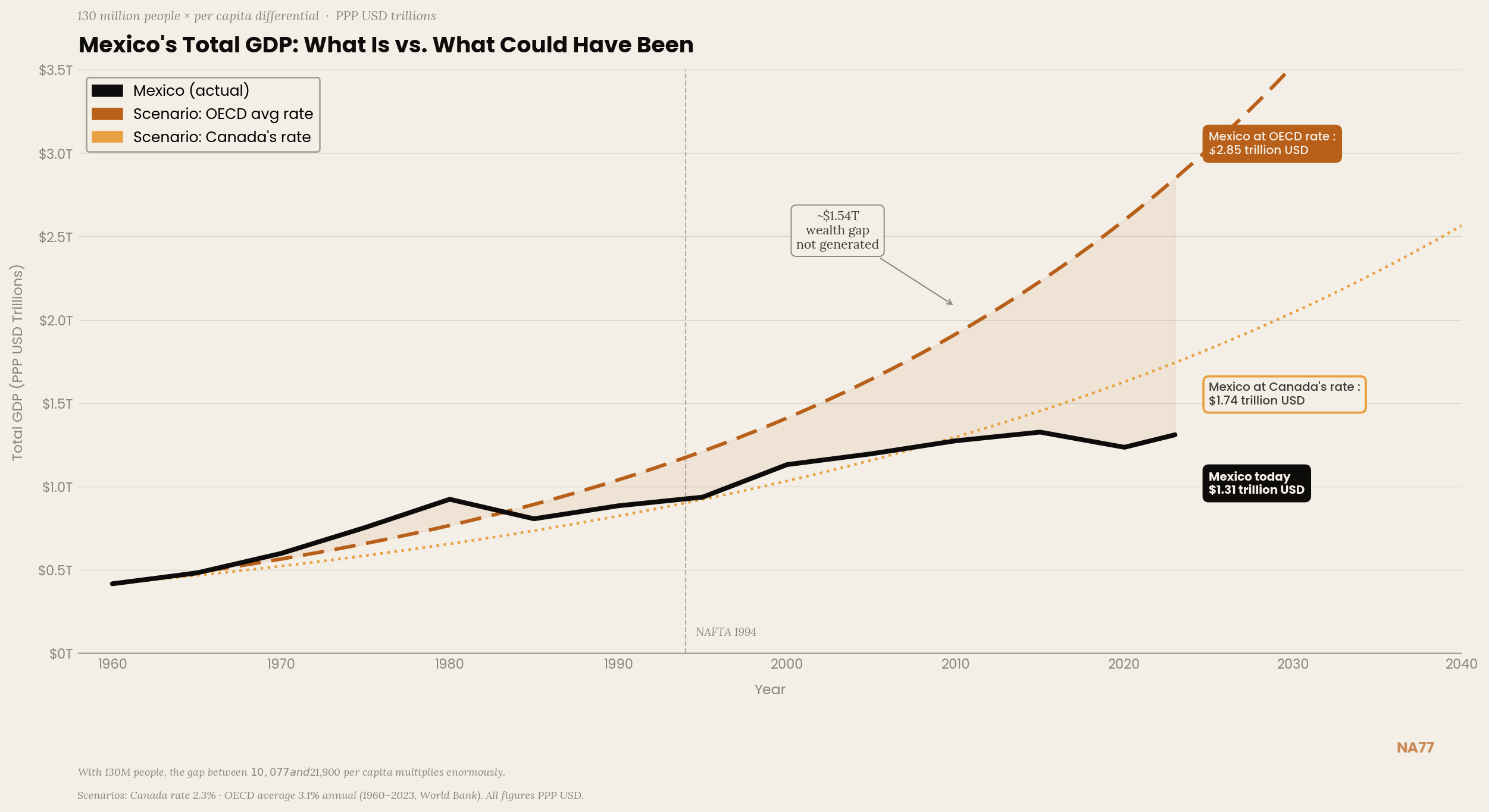
Multiplicado por 130 millones de personas, la brecha acumulada entre lo que México generó y lo que pudo haber generado al ritmo OCDE representa más de $1.5 billones de dólares en riqueza no creada.
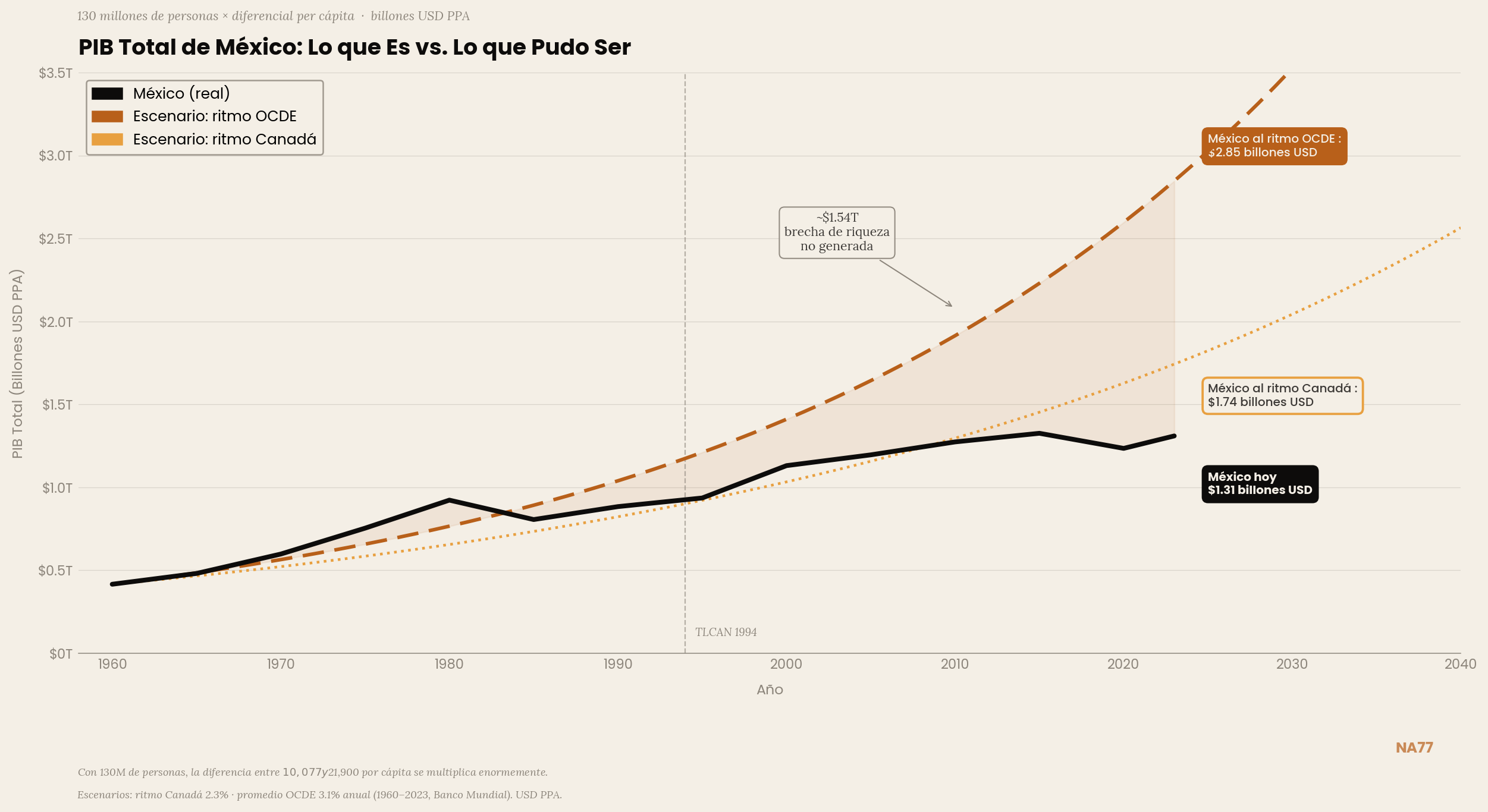
Esto no son puntos porcentuales de PIB. Son generaciones enteras de mexicanos que no pudieron construir patrimonio. Que trabajaron en la informalidad porque el sistema no estaba diseñado para integrarlos. Que buscaron oportunidades afuera porque no las encontraron adentro.
El espejismo del TLCAN
En 1994, México firmó el Tratado de Libre Comercio de América del Norte. Los mercados se abrieron. Las exportaciones se dispararon. La inversión extranjera llegó.
Pero aquí está la trampa: México abrió su comercio sin transformar su sistema.
El comercio se abrió, pero la gobernanza no convergió. Los mercados se conectaron, pero el estado de derecho permaneció inconsistente. La democracia avanzó formalmente, pero las instituciones siguieron siendo débiles. México ganó acceso al mercado más grande del mundo. Pero el acceso sin alineación institucional es solo una puerta entreabierta.
El resultado se ve en un dato que pocos discuten abiertamente: aproximadamente el 66% del valor de las exportaciones manufactureras de México es capturado por empresas extranjeras. Las maquiladoras — que representan el 58% del PIB manufacturero — son en su mayoría propiedad de compañías estadounidenses.
México exporta más de $600 mil millones de dólares al año. Pero solo aproximadamente $200 mil millones de ese valor se queda en México.
Esto no es integración. Es intermediación. México presta su geografía y su mano de obra, pero no captura la riqueza. Es la diferencia entre ser parte del sistema y ser utilizado por el sistema.
Corea del Sur también comenzó con manufactura básica. Pero exigió transferencia tecnológica, invirtió en investigación y desarrollo, creó sus propias marcas globales — Samsung, Hyundai, LG — y transformó a sus trabajadores de mano de obra barata en capital humano de primer nivel.
México creó maquiladoras. Corea del Sur creó Samsung.
¿Por qué el PIB per cápita se estancó?
Los números cuentan la historia completa.
México invierte menos del 1% de su PIB en investigación y desarrollo. Corea del Sur invierte más del 4.5% — el porcentaje más alto del mundo.
Más del 55% de la fuerza laboral mexicana opera en la informalidad, según el INEGI. Eso significa que la mayoría de los mexicanos trabajan sin acceso a crédito, sin protección legal, sin seguridad social, sin la posibilidad real de construir patrimonio.
El sistema educativo mexicano produce resultados consistentemente por debajo del promedio de la OCDE. No porque los mexicanos carezcan de talento. Sino porque el sistema no está diseñado para desarrollarlo.
Estos no son problemas de recursos. Son problemas de diseño institucional. Son el resultado acumulado de décadas de decisiones que priorizaron el control sobre la competencia, la protección sobre la apertura, y la estabilidad política de corto plazo sobre la transformación estructural de largo plazo.
La pregunta que no es histórica
México nunca estuvo fuera del sistema global. Estuvo frente a él. Lo entendió. Se benefició parcialmente de él. Pero nunca tomó la decisión de hacerlo propio.
Esa es la historia de México en el orden global moderno: proximidad sin convergencia.
La pregunta ya no es histórica. La pregunta es: ¿por qué, incluso después de firmar el TLCAN, incluso con acceso directo al mercado más grande del mundo, México sigue sin dar el paso?
¿Qué fuerzas internas bloquearon la transformación? ¿Quién se benefició de que México no cambiara?
Esas preguntas, incómodas como son, las confrontamos en la Parte 2.
ENGLISH VERSION
Part 1 of 3 — MEXICO: The Neighbor that Chose to Ignore the Global Order
Why didn’t Mexico transform itself when it had every advantage?
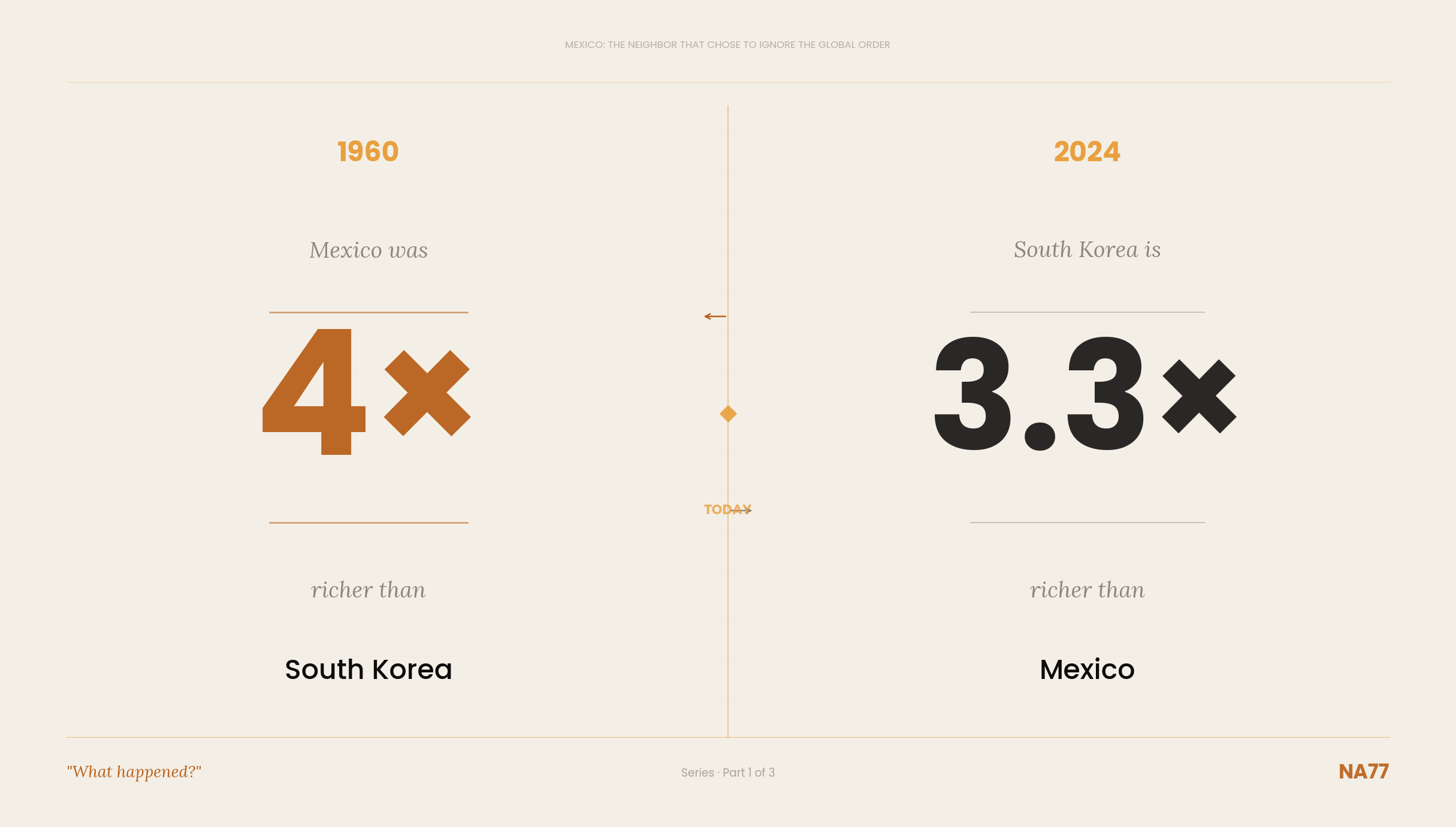
In 1960, Mexico’s GDP per capita was four times that of South Korea.
Four times.
Mexico had oil. It shared a direct border with the most powerful economy in history. It had decades of established trade relations with the United States. It occupied a geographic position that any country in the world would have considered an unrepeatable advantage.
South Korea had none of that.
South Korea was emerging from a devastating civil war. It had no significant natural resources. It had no wealthy neighbor. It had no privileged access to any major market.
Today, South Korea’s GDP per capita is 3.3 times that of Mexico.
What happened?
The decision that defined a century
In July 1944, representatives from 44 nations — including Mexico — gathered in Bretton Woods, New Hampshire.
The objective: design a global economic system that would make another world war impossible. From that conference emerged the architecture that would define the 20th century:
the dollar as the global reserve currency
the International Monetary Fund
the World Bank
and the foundations of what would become the GATT.
It was not a perfect system. But it was a system with rules. And rules generate predictability. And predictability is the foundation of every investment and every form of sustained progress.
Mexico was there. Its delegation, led by Finance Minister Eduardo Suárez and economist Víctor Urquidi, played an active role in the negotiations that gave rise to the IMF and the World Bank. Mexico was not a distant observer. It was a present actor — one that chose not to make its own what it had helped design.
Mexico in the 1940s: a direction already pointing inward
To understand why Mexico took a different path, you have to go back to the Revolution.
After the Porfiriato — a period of economic growth driven by foreign investment, but with a concentration of wealth that the Mexican people deeply rejected — came the Mexican Revolution. And the Revolution was not simply a change of government. It was a complete redefinition of the model.
A strong state. Centralized economic control. Institutionalized distrust of external capital. These were not accidental decisions — they were legitimate political responses to decades of exploitation.
The problem is that by the time the new global order was consolidating in 1944, Mexico had already chosen its direction. And that direction pointed away from Bretton Woods.
In 1938, Lázaro Cárdenas nationalized the oil industry. It was an act of sovereignty still celebrated every March 18th. But it was also a signal to the world: Mexico was not going to play by the rules of the global system. It was going to play by its own.
While Bretton Woods promoted openness, competition, and integration, Mexico advanced under a different logic: protection, control, and state-managed growth — the PRI’s model of stability from above. A model that worked during certain periods. That produced growth. That generated stability. But one that did not build the institutional foundations necessary to sustain that growth, or to distribute it in a way that benefited the majority.
Meanwhile, on the other side of the world
Japan, devastated by war, made a radical decision: align its institutions with the global system. It invested massively in education. It opened its economy to trade. It strengthened the rule of law to protect investment. By 1980, it was the second-largest economy in the world.
Germany did the same. From literal ruins emerged the Wirtschaftswunder — the economic miracle. Not because Germany had natural resources, but because it adopted the rules of the system: open markets, strong institutions, universal education, legal predictability.
And South Korea — the most devastating case for Mexico’s narrative. In 1960, a country poorer than Mexico by a factor of four. No oil. No wealthy neighbor. No privileged geographic access. But one clear decision: invest in education at first-world levels, open the economy to global trade, and build institutions that would outlast governments.
By 1988, South Korea had surpassed Mexico in GDP per capita. And it never looked back.
The cost of that divergence requires no imaginary projections. It is measurable: in 1960, Mexico was four times richer than South Korea. Today, South Korea generates 3.3 times more wealth per person than Mexico. That reversal — from 4x above to 3.3x below — represents the accumulated cost of decades of decisions.
What Mexico left on the table
The cost of this path is measurable, not theoretical.
If Mexico had grown at Canada’s rate — not South Korea’s, just its northern trading partner’s, with whom it has shared a trade agreement for 30 years — each Mexican would produce $13,406 per year instead of $10,077. At the OECD average growth rate, that figure would be $21,900.
Multiplied across 130 million people, the accumulated gap between what Mexico generated and what it could have generated at OECD rates represents more than $1.5 trillion dollars in wealth not created.
These are not GDP percentage points. They are entire generations of Mexicans who could not build lasting wealth. Who worked in informality because the system was not designed to integrate them. Who sought opportunity abroad because they could not find it at home.
The NAFTA mirage
In 1994, Mexico signed the North American Free Trade Agreement. Markets opened. Exports surged. Foreign investment arrived.
But here is the trap: Mexico opened its trade without transforming its system.
Trade opened, but governance did not converge. Markets connected, but the rule of law remained inconsistent. Democracy advanced formally, but institutions stayed weak. Mexico gained access to the largest market in the world. But access without institutional alignment is nothing more than a half-open door.
The result shows in a figure that few discuss openly: approximately 66% of the value of Mexico’s manufactured exports is captured by foreign companies. The maquiladoras — representing 58% of manufacturing GDP — are majority-owned by American companies.
Mexico exports more than $600 billion dollars per year. But only approximately $200 billion of that value stays in Mexico.
This is not integration. It is intermediation. Mexico lends its geography and its labor, but does not capture the wealth. It is the difference between being part of the system and being used by the system.
South Korea also started with basic manufacturing. But it demanded technology transfer, invested in research and development, created its own global brands — Samsung, Hyundai, LG — and transformed its workers from cheap labor into world-class human capital.
Mexico created maquiladoras. South Korea created Samsung.
Why has GDP per capita stagnated?
The numbers tell the full story.
Mexico invests less than 1% of its GDP in research and development. South Korea invests more than 4.5% — the highest percentage in the world.
More than 55% of Mexico’s labor force operates in the informal economy, according to INEGI. That means the majority of Mexicans work without access to credit, without legal protection, without social security, without any real possibility of building lasting wealth.
Mexico’s education system produces results consistently below the OECD average. Not because Mexicans lack talent. But because the system is not designed to develop it.
These are not problems of resources. They are problems of institutional design. They are the accumulated result of decades of decisions that prioritized control over competition, protection over openness, and short-term political stability over long-term structural transformation.
The question that is no longer historical
Mexico was never outside the global system. It stood in front of it. It understood it. It partially benefited from it. But it never made the decision to fully adopt it as its own.
That is Mexico’s story in the modern global order: proximity without convergence.
The question is no longer historical. The question is: why, even after signing NAFTA, even with direct access to the largest market in the world, has Mexico still not taken the step?
What internal forces blocked the transformation? Who benefited from Mexico not changing?
Those questions, uncomfortable as they are, we confront in Part 2.
And the answer is going to make more than a few people uncomfortable.