
NA77 Weekly Affairs — Sunday Brief · May 10, 2026
The North American — 77 | ONE FUTURE. THREE NATIONS. · Weekly Intelligence Digest

Format: The Sunday Brief covers the five stories that moved North America in the past seven days, and the events and signals to watch in the week ahead. Published every Sunday.
Sources this week: NPR / Trade Court Ruling (May 7), The Hill / PBS News / Al Jazeera (Carney-Trump, May 6), White & Case (Mexico tariff decree / May 2026), BNN Bloomberg / Mexico Business News (USMCA bilateral track), Colorado Sun / WyoFile / EnviroLink (Colorado River, May 2026), TrendForce / Data Center Knowledge / CNN Business (AI infrastructure, May 2026), FreightWaves / Kearney (FDI), CSIS / Brookings / Baker Institute (USMCA analysis).
If someone shared this with you — welcome.
The North American — 77 is digital media platform for operators, builders, and thinkers who believe North America's best chapter is still ahead. → Subscribe here and join the conversation.
🔴 THE WEEK THAT WAS — Five Stories That Moved the Continent
1. Legal Shock: The Court That Reshuffled the Table
The week's most consequential event did not happen in a negotiating room. It happened in a courthouse.
On May 7, the U.S. Court of International Trade struck down the Trump administration's second round of replacement tariffs — issued after the Supreme Court ruled in February that the original emergency tariffs exceeded presidential authority. The court found that the balance-of-payments statute used does not apply: no qualifying deficit condition exists. The ruling is a direct blow to Washington's primary trade leverage instrument.
The practical consequence is immediate: the U.S. government must refund more than $166 billion in tariff collections. First payments begin this week. For importers across the continent, it is a material reversal. For the USMCA negotiation, it scrambles the pressure calculus.
Key numbers:
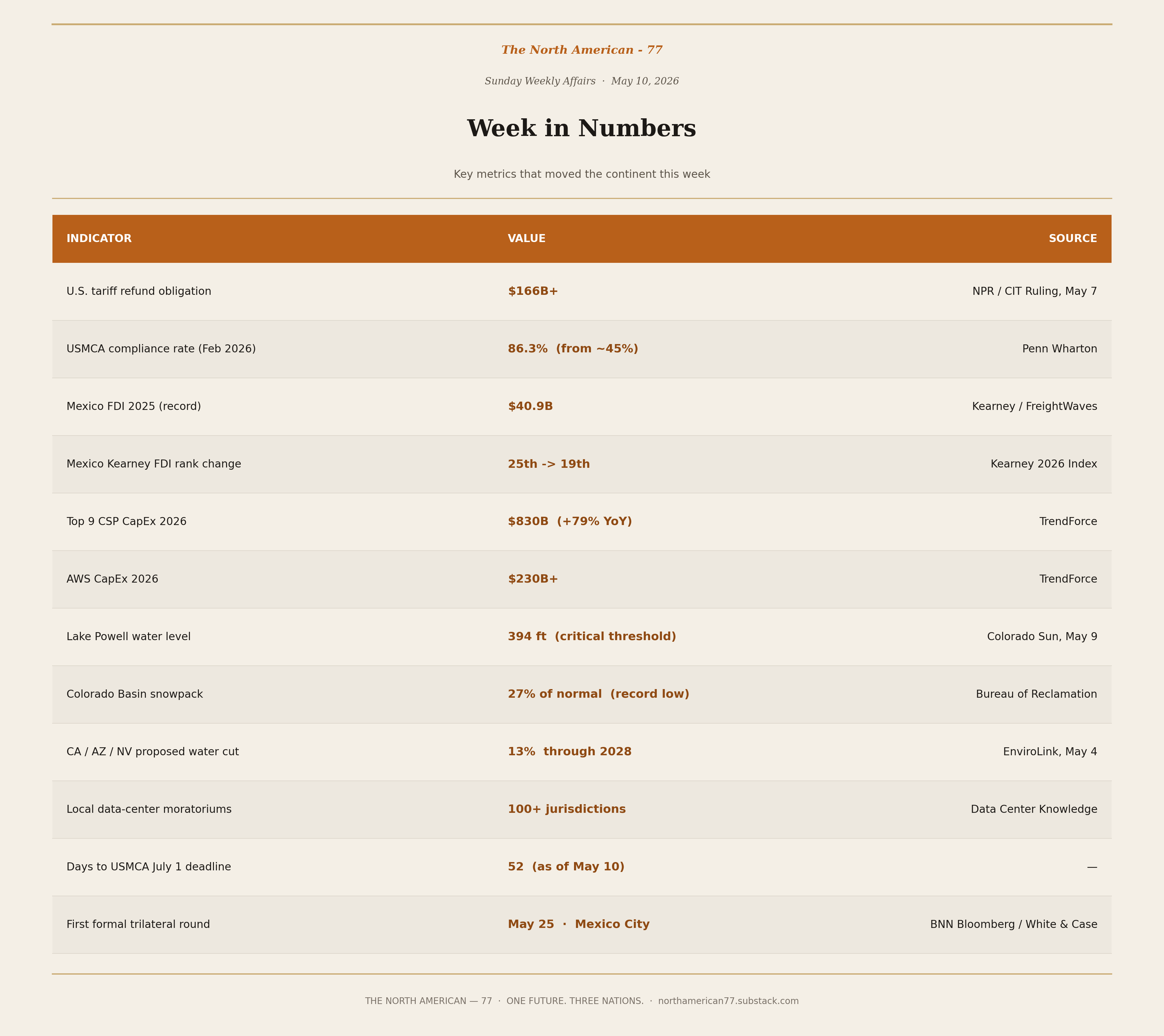
$166B+ — refund obligation from struck-down tariffs
2 — tariff rounds struck down by courts in 2026
May 7 — ruling date; first refunds expected week of May 11
July 1 — USMCA decision window; negotiating leverage now in legal limbo
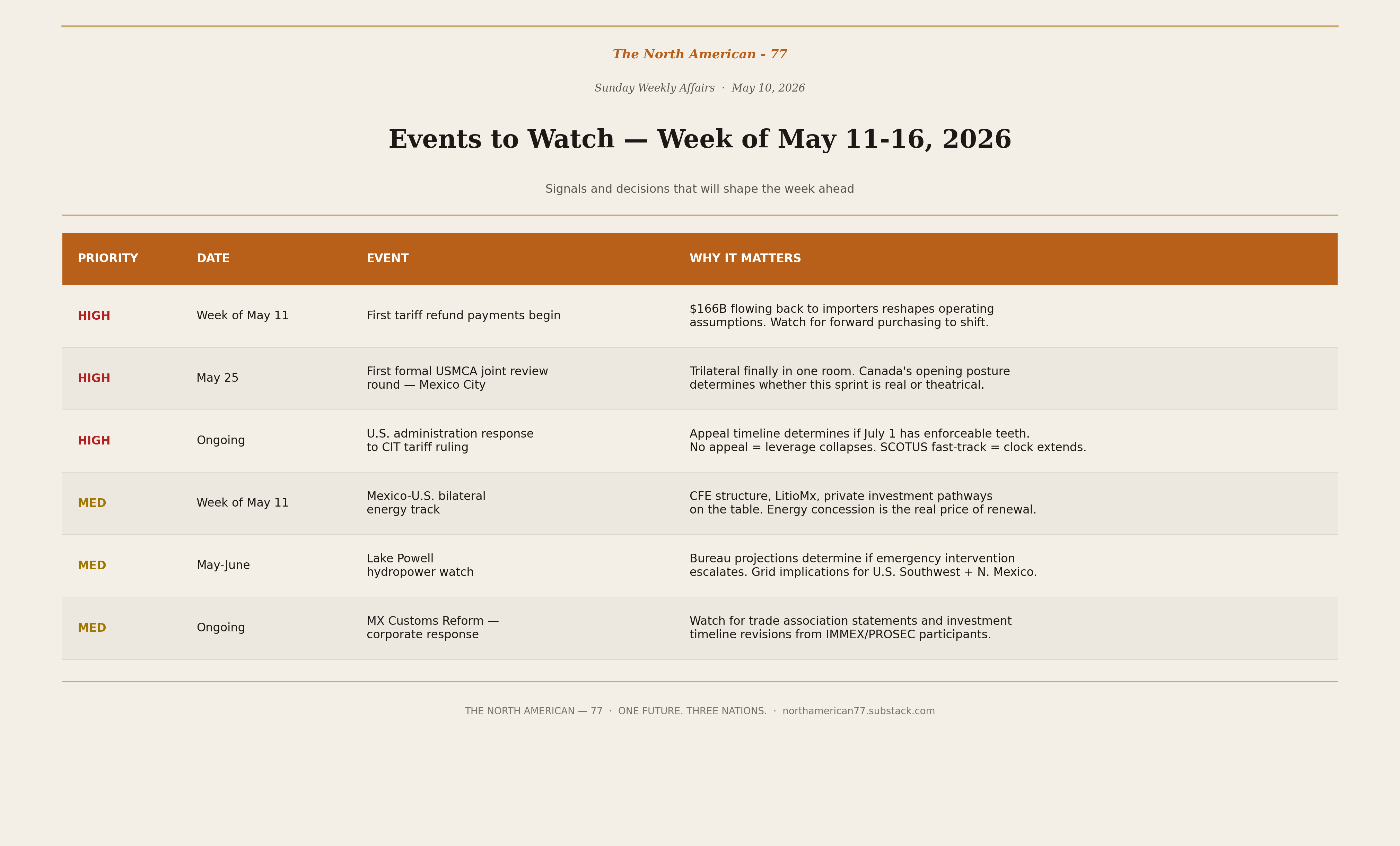
What to watch: Whether the administration appeals to the Supreme Court, and how fast. The answer determines whether the July 1 deadline retains its bite.
2. Canada Is Back in the Room
For six weeks, the working assumption was that USMCA was being renegotiated as a US-Mexico bilateral while Canada diversified. That framing changed this week.
On May 6, Prime Minister Carney sat across from President Trump in the Oval Office — the first formal bilateral of his tenure as PM. When Trump raised Canadian sovereignty, Carney replied: "It's not for sale. Won't be for sale, ever." Trump replied: "Never say never." Neither backed down. Both kept talking.
More consequentially: Canada named Janice Charette, the former head of Canada's public service, as its chief CUSMA negotiator. And the first formal trilateral negotiating round was confirmed for May 25 in Mexico City.
What to watch: Canada's opening posture at the May 25 Mexico City trilateral. The gap between "cannot dictate" and "step change in defense" is where the deal gets made — or doesn't.
3. Mexico Plays the Rules-Based Card
On April 23, President Sheinbaum published a tariff decree imposing 5%–35% duties on 185 tariff lines — chemicals, textiles, steel, aluminum, auto parts, electrical materials — targeting non-FTA-country imports. This follows the January 2026 decree imposing 50% tariffs on 1,000+ Chinese and Indian goods.
Mexico arrives at May 25 with receipts: 86.3% USMCA compliance (from ~45% a year ago), record $40.9B FDI in 2025, Kearney 25→19 jump, and $5.8B in January 2026 investment announcements.
The energy bottleneck remains unresolved. CFE's grid constraints throttle industrial execution across the two primary maquila corridors: Northern Mexico from Tijuana to Monterrey, and Central Mexico from San Luis Potosí to Puebla. Private capital exists — what is missing is the regulatory pathway.
And a quieter but growing concern: Mexico's 2025 Customs Reform. Throughout U.S. and Canadian corporate offices, there is rising unease about new compliance burdens, steep fines, bureaucratic complexity, and the cloud over the IMMEX and PROSEC programs. Mexico's reform is moving in the opposite direction from trade facilitation — adding friction at exactly the wrong moment.
4. Water: The River That Will Not Wait for July
Lake Powell sits at 394 feet as of early May — so low that hydropower generation through Glen Canyon Dam could halt as soon as September 2026. Snowpack in the Colorado Basin is at 27% of normal, the lowest on record.
California, Arizona, and Nevada responded with a joint proposal to cut total Colorado River usage by 13% through 2028. Emergency releases from the Flaming Gorge Reservoir in Wyoming are already underway.
The Colorado system supplies water to seven U.S. states, two Mexican states, 30 tribal nations, and roughly 40 million people. AI data centers are now drawing from the same diminishing pool — an infrastructure collision this continent has no institutional mechanism to manage.
5. Compute: $830 Billion, No Continental Conversation
The top nine cloud service providers will spend an estimated $830 billion on AI infrastructure in 2026 — a 79% increase over 2025. Microsoft: $190B. AWS: $230B+. Google: $180–190B. Data center racks are now designed for hundreds of kilowatts — approaching megawatt scale.
Power, not compute, is the binding constraint. More than 100 local jurisdictions have enacted moratoriums. More than 300 state data-center bills were filed in the first six weeks of 2026.
The North American AI compute corridor is a continental story. The states that can support this buildout form a corridor running deep into Mexico: Baja California, Sonora, Chihuahua, Coahuila, Nuevo León, San Luis Potosí, Guanajuato, Querétaro, Jalisco — and beyond. This is the conversation President Sheinbaum needs to be having. In a global competition where the U.S., China, and Europe race to claim the compute layer of the next economy, a coordinated North American AI strategy is better for the continent than three uncoordinated national ones.
🟠 QUICK SIGNALS — Also on the Radar
Legal cascade: With the trade court striking down replacement tariffs, a Supreme Court appeal appears likely. If taken, the tariff landscape remains in legal suspension through the fall — precisely when USMCA July 1 outcomes need enforceability.
Logistics reality: Supply Chain Brain (May 5): a chaotic front-loading year for imports has left Laredo and Houston processing outsized volumes; West Coast ports distorted as importers reroute away from China-origin goods.
Canadian resource leverage: Uranium price spike (+41%) holding. BC lithium refinery — first in North America — coming online. Canada is converting its resource base from passive export income into active geopolitical instrument.
Mexico's demographic window: Median age ~29–30; 67.4% working-age; unemployment at 2.6%. The labor math that makes nearshoring work has a clock — Mexico's median age reaches 42 by 2050. The window is roughly two decades, not indefinite.
Defense dimension: Carney committed to 2% of GDP defense spending by March 2026, 5% by 2035. The U.S.-Canada military relationship is being restructured in parallel with trade talks.
MX Customs Reform — growing boardroom concern: Throughout U.S. and Canadian corporate offices, there is rising unease about Mexico's 2025 Customs Reform — tough fines, bureaucratic complexity, and growing uncertainty around the IMMEX and PROSEC programs. Companies are watching. Some are already reconsidering timelines.
🎙️ THIS WEEK AT NA77 — On the Record with Dr. Daniel Covarrubias
This week, The North American — 77 sat down with Dr. Daniel Covarrubias for our first official collaboration conversation — one of the most meaningful conversations in NA77's short history.
Daniel and Eddie first met in Monterrey more than 25 years ago. His path has been quintessentially Ambos: from computer systems to business, from business to the border, from the border to a doctorate and a career at Texas A&M International University in Laredo — where he now directs the Texas Center for Border Economic and Enterprise Development and teaches the next generation of supply chain leaders.
Along the way, he coined the framework Logistechs — born, he'll tell you without hesitation, in the shower — to describe how exponential technologies are reshaping cross-border trade, logistics, and supply chains in real time. Today his work reaches PBS, the Wall Street Journal, TEDx, and Washington briefing rooms. His book on the future of crossborder trade is available at Amazon Books.
We are proud to announce that he is joining NA77 as a monthly writing collaborator, focused on the digital integration of North America. We have much to share. Full profile coming soon.
→ Follow Dr. Daniel Covarrubias · LinkedIn · @jdanielcova on X
You're reading The North American — 77. We publish every Sunday — and every Monday for subscribers who want the week's lead story first. If this brief is part of your Sunday morning, make it official. → Subscribe — it's free.
📚 FROM THE NA77 ARCHIVE — Recent Papers Worth Your Time
Each week we point back to the work that holds up. These pieces form the foundation of everything we cover.
The Announcement Is Not the Investment
April 22, 2026 · Long View
Mexico has become extraordinarily competent at the ceremony of investment. The ribbon-cutting, the presidential decree, the rendering of the industrial park. What has not kept pace is the physical infrastructure — the megawatts, the transmission lines, the regulatory pathways for private capital. "The continent is at capacity for announcements. What it needs now is megawatts."
We Have the Treaty. We Do Not Have the Table.
April 20, 2026 · Long View
The morning USTR Greer flew to Mexico City and Canada was not in the room. On the Hardware vs. Software problem of North American integration — and why a permanent North American Industrial Coordination Council is the piece the 1994 architecture never included.
86.3%. The Number the Politicians Aren't Talking About.
April 25, 2026 · Sunday Brief
While governments debated tariffs, the corridor filed paperwork. How North American manufacturers voted with their supply chains — and what 86.3% USMCA compliance actually means for the continent's future.
$100 Billion in Compute Leases. No Continental Conversation.
April 17, 2026 · Long View
The largest capital reallocation in North American industrial history is happening without a name. On the Infrastructure Terms for the Next Decade — and why they're being written right now, in private contracts.
📊 WEEK IN NUMBERS
🔵 EVENTS TO WATCH — Week of May 11–16, 2026
⚪ THE LONG VIEW — By Eduardo Joffroy G
The People Who Actually Take the Risks Should Have a Seat
The energy deficit, the customs reform complexity, and the infrastructure gaps in Mexico's supply chain are not abstractions. They are the daily math of every industrial developer holding permits in Monterrey, every manufacturer calculating whether the next facility goes in Querétaro or somewhere else entirely. Nearshoring continues — but capital follows long-term stability. It follows clear rules, reliable energy, rule of law, available water, and infrastructure that is ready before the announcement, not years after it. When those conditions are in doubt, investment does not disappear. It relocates.
What is remarkable is how much of this continent's integration has happened not because of political decisions, but in spite of political cycles. The operators, the builders, the logistics teams, the engineers — they did not wait for July 1. They voted with their supply chains, their compliance filings, their capital. They built the hardware of North American integration while the institutional conversations struggled to keep pace.
That is exactly why the USMCA review, as currently structured, is an incomplete conversation. The $1.3 trillion in annual trade flowing across these three borders is not an abstraction in a negotiating room — it is the daily reality of companies that have committed capital, built facilities, hired workers, and bet their futures on a functioning continental system. Those companies are not at the table. They should be.
Not to replace the diplomats. Not to shortcut the process. But because the people with real skin in the game — the ones who cannot walk away from a poorly designed agreement — tend to find solutions that political cycles, by design, cannot afford to reach.
NA77 was built for this moment. Not to watch the negotiations from the outside. To push the narrative of integration further than any trade agreement can carry it alone — beyond tariff schedules, beyond political mandates, toward the continent this shared work has already made possible.
We are not crossing our fingers. We are building the case, one issue at a time, until the table is wider.
— Eduardo Joffroy G · Founder, The North American — 77 · May 10, 2026
— versión en español (Solo Long View)—
⚪ THE LONG VIEW — By Eduardo Joffroy G
Los que Realmente Arriesgan Merecen un Lugar en la Mesa
El déficit energético, la complejidad de la reforma aduanera y las brechas de infraestructura en la cadena de suministro de México no son abstracciones. Son la matemática cotidiana de cada desarrollador industrial que retiene permisos en Monterrey, de cada fabricante que calcula si la próxima instalación va en Querétaro o en algún otro lugar. El nearshoring continúa — pero el capital sigue la estabilidad a largo plazo. Sigue las reglas claras, la energía confiable, el estado de derecho, el agua disponible y la infraestructura que está lista antes del anuncio, no años después. Cuando esas condiciones se vuelven inciertas, la inversión no desaparece. Se reubica.
Lo que resulta notable es cuánta de la integración de este continente ha ocurrido no gracias a las decisiones políticas, sino a pesar de los ciclos políticos. Los operadores, los constructores, los equipos de logística, los ingenieros — no esperaron el 1 de julio. Votaron con sus cadenas de suministro, sus declaraciones de cumplimiento, su capital. Construyeron el hardware de la integración norteamericana mientras las conversaciones institucionales luchaban por seguir el ritmo.
Por eso la revisión del T-MEC, tal como está estructurada, es una conversación incompleta. El billón trescientos mil millones de dólares en comercio anual que fluye a través de estas tres fronteras no es una abstracción — es la realidad diaria de empresas que han comprometido capital, construido instalaciones, contratado trabajadores y apostado su futuro a un sistema continental que funcione. Esas empresas no están en la mesa. Deberían estarlo.
No para reemplazar a los diplomáticos. No para saltarse el proceso. Sino porque las personas con algo genuinamente en juego — las que no pueden alejarse de un acuerdo mal diseñado — tienden a encontrar soluciones que los ciclos políticos, por su naturaleza, no pueden permitirse alcanzar.
NA77 fue diseñado para este momento. No para observar las negociaciones desde afuera. Para empujar la narrativa de la integración más lejos de lo que cualquier acuerdo comercial puede llevarla por sí solo — más allá de los aranceles, hacia el continente que este trabajo compartido ya ha hecho posible.
No estamos cruzando los dedos. Estamos construyendo el argumento, un tema a la vez, hasta que la mesa sea más amplia.
— Eduardo Joffroy G · Fundador, The North American — 77 · 10 de mayo de 2026
ONE FUTURE. THREE NATIONS. The North American — 77 publishes every Sunday — intelligence, analysis, and the long view on the continent that is still becoming itself. Forward this to one person who needs to be reading it. → Subscribe free at northamerican77.substack.com