
MEXICO — The Forgotten Piece of the North American Puzzle (Part 2 of 3)
Why Mexico’s institutional “software” is now a $1 Trillion security risk for the entire continent.


Mexico is already essential to North America. In manufacturing, it is embedded. In labor, it is operationally central. In geography, it is irreplaceable. In being a trade partner, it has the data to back up its relevance—even with a GDP per capita dramatically lower than the US & Canada.
But essential is not the same as a reliable or trusted partner. And in a continental bloc, reliability and trust are the currency of power.
The $1 Trillion Reality
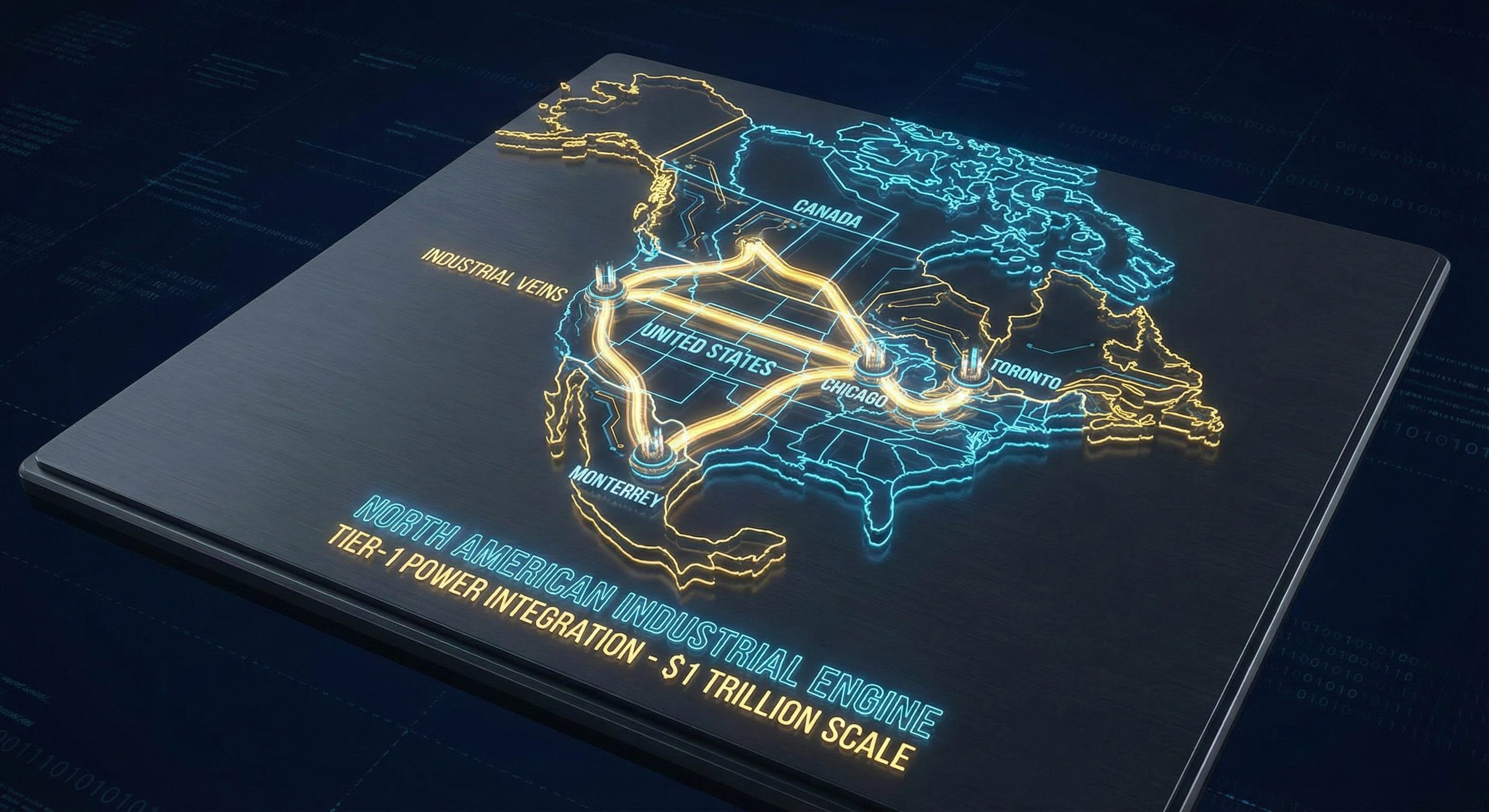
Let’s begin with scale. In 2025, Mexico made history. For the first time, it surpassed Canada not just as the largest supplier to the United States, but as the largest buyer of American exports in the world. With goods trade surpassing $872 billion and services adding roughly another $100 billion, the U.S. and Mexico today officially operate a true one-trillion-dollar annual economic exchange.
This is not symbolic integration. It is structural.
When integration reaches this depth, responsibility changes. When supply chains are fused, risk is shared. When productivity rises in one member, it compounds across the others. When institutional weakness appears in one node, it transmits through the entire system.
This is not simply finished goods crossing borders. It is shared production. For every 1 U.S. dollar in manufactured goods Mexico exports to the United States, roughly 30 cents represents U.S. content embedded in that product.
North America is not three economies trading at the margins. It is a single industrial platform operating across three sovereign systems. Mexico is already a central pillar of the North American architecture. That is precisely why Mexico’s institutional condition is no longer a domestic matter alone. It has continental consequences.
The Institutional Asymmetry: Hardware vs. Software
Mexico does not lack talent. It does not lack work ethic. It does not lack industrial capacity. What we have is institutional asymmetry. Our industrial base operates at world-class levels. Our legal and security frameworks do not consistently match that standard. That gap creates friction—and friction inside an integrated system becomes expensive.
The European Union harmonized institutions before fully integrating markets. North America did the reverse. We executed a masterclass in integrating the hardware of the continent—our supply chains, tariff schedules, and logistics grids. But we assumed that shared economic gravity would magically create shared institutions.
It didn’t. We completely ignored the software.
Today, we are trying to run a 21st-century continental superpower on three incompatible operating systems. North America lacks a shared vocabulary of governance.
In the U.S. and Canada, a “capitalistic system” theoretically means free enterprise protected by blind, predictable justice.
In Mexico, it is too often twisted into cronyism protected by political favor.
We cannot achieve Tier-1 integration without shared governance standards. On the World Justice Project’s 2025 Rule of Law Index, Mexico ranks 121 out of 143 countries. The homicide rate remains an outlier within the OECD.
These are not reputational statistics; they function as a Continental Risk Premium. When contracts are inconsistently enforced, when judicial outcomes are unpredictable, or when security costs spike due to violence, that risk doesn’t stop at the border. If a plant in Tennessee depends on inputs from the Bajío and that supply chain is legally fragile, the Tennessee asset carries embedded risk.
The Security Contagion
Furthermore, integration is a two-way street. It moves prosperity, but it also moves vulnerability. We can no longer pretend that a security vacuum in Mexico is just a “domestic issue.”
In an integrated geography, an insecure logistics hub in central Mexico is a homeland security threat in Chicago. A compromised airport protocol in the South is a direct physical vulnerability for a flight landing in Toronto. When local governance and law enforcement are subverted by parallel shadow economies, it is not merely a local tragedy—it is a Continental Security Breach.
You cannot run a multi-trillion-dollar North American supply chain on top of an illicit economy. The unchecked flow of illegal arms moving South, and the tragic trafficking of humans and narcotics moving North, are symptoms of systemic institutional porosity.
As someone who operates ports in both Mexico and the United States, I see the difference in mindset daily. In the U.S., CBP operates largely with a facilitation culture—an understanding that delays ripple through the economy. In Mexico, customs often prioritizes punitive enforcement over facilitation. The system becomes defensive and slow.
When trade becomes harder than it needs to be, companies hesitate. When companies hesitate, exports slow. When exports slow, growth underperforms. This is not an argument against Mexico; it is an argument for modernization.
Convergence and the Human Capital Crisis
Mexico’s GDP per capita in 2024 was approximately $14,186. The United States stood near $85,810. The issue is not poverty; it is underperformance relative to integration.
In every successful economic bloc, the lower-income member eventually converges upward. South Korea did it in Asia. Poland did it in Europe. Convergence is not charity. It is compounding.
If Mexico moves to $25,000 GDP per capita over the next 15 to 25 years, that implies an economy of roughly $3.3 trillion—an expansion of about $1.4 trillion. That expansion would drive sustained demand for U.S. and Canadian capital, advanced technology, energy systems, and high-value inputs.
But convergence is not just about GDP; it is about Human Capital. Right now, Mexico risks bleeding its greatest asset: its youth.
When an economy fails to provide world-class education and access to capital, it leaves a vacuum. In Mexico, that vacuum is quickly filled by illicit networks. An uneducated young man without a formal future does not just disappear; he is recruited. He becomes a halcón—a lookout in a shadow economy that actively undermines the continent.
Extreme poverty functions as a direct recruitment subsidy for transnational crime.
If we want a Tier-1 North America, we need a Tier-1 Mexican workforce. We must build global leaders who share a common operational language—English—and a common set of Western, democratic, free-market values.
We must break a more than 100 year negative cycle in Mexico and we need everyone`s (Mexico - US - Canada) help for this huge endeavor.
The Vanguard of the Americas
There is a larger game playing out, and Mexico is the linchpin.
Latin America is at a historical inflection point. The recent collapse of the Venezuelan dictatorship is the death rattle of a failed ideology. An ideological vacuum is opening from Caracas to Buenos Aires.
Mexico faces a binary choice:
Allow our institutions to be dragged backward by the centralized, victimhood-driven politics of the “old” Latin America.
Firmly anchor ourselves to the North American project and become the undisputed blueprint for the hemisphere’s future.
A thriving, capitalist, rule-of-law Mexico is the ultimate antidote to authoritarian populism. By stepping up as a Tier-1 partner, Mexico proves to the rest of the Americas that true sovereignty and wealth come from institutional reliability, not isolationism.
What “Tier-1” Actually Means
Scale is not our problem. Coherence is. In 2024, the combined GDP of North America was roughly $32.9 trillion. The EU stood at $19.5 trillion; China around $18.7 trillion.
Integration without institutional convergence creates structural fragility. Tier-1 does not mean imitation; it means predictability. It means an investor or a logistics manager can expect comparable reliability in Monterrey, Memphis, or Montreal.
That requires:
Contract enforcement insulated from political volatility.
A judiciary that signals independence and continuity.
Security policy that guarantees the uninterrupted flow of goods.
Energy and infrastructure planning measured in decades, not electoral cycles.
Mutual Sustainability systems and natural and essential resources North American planning that is strategic and fair to all 3 nations.
Becoming Fully Ourselves
Mexico does not need to become another country. It needs to complete its institutional evolution. We have proven that we can integrate economically. Now we must prove that we can anchor strategically.
The next phase of North American integration will not be defined by tariff schedules. It will be defined by trust, enforcement capacity, and institutional maturity.
Mexico stands at a decision point: Remain indispensable but strategically constrained—or become a fully reliable Tier-1 partner inside the most powerful economic bloc in modern history.
Part III will turn the mirror toward the United States and Canada. Because a Tier-1 Mexico cannot exist inside a North America that tolerates protectionism or complacency.