
Llegó el Momento de Decisión a los Mexicanos
Edición 3 de 3 · El Vecino que Decidió Ignorar el Nuevo Orden Global hace 82 años

I. La Ventana
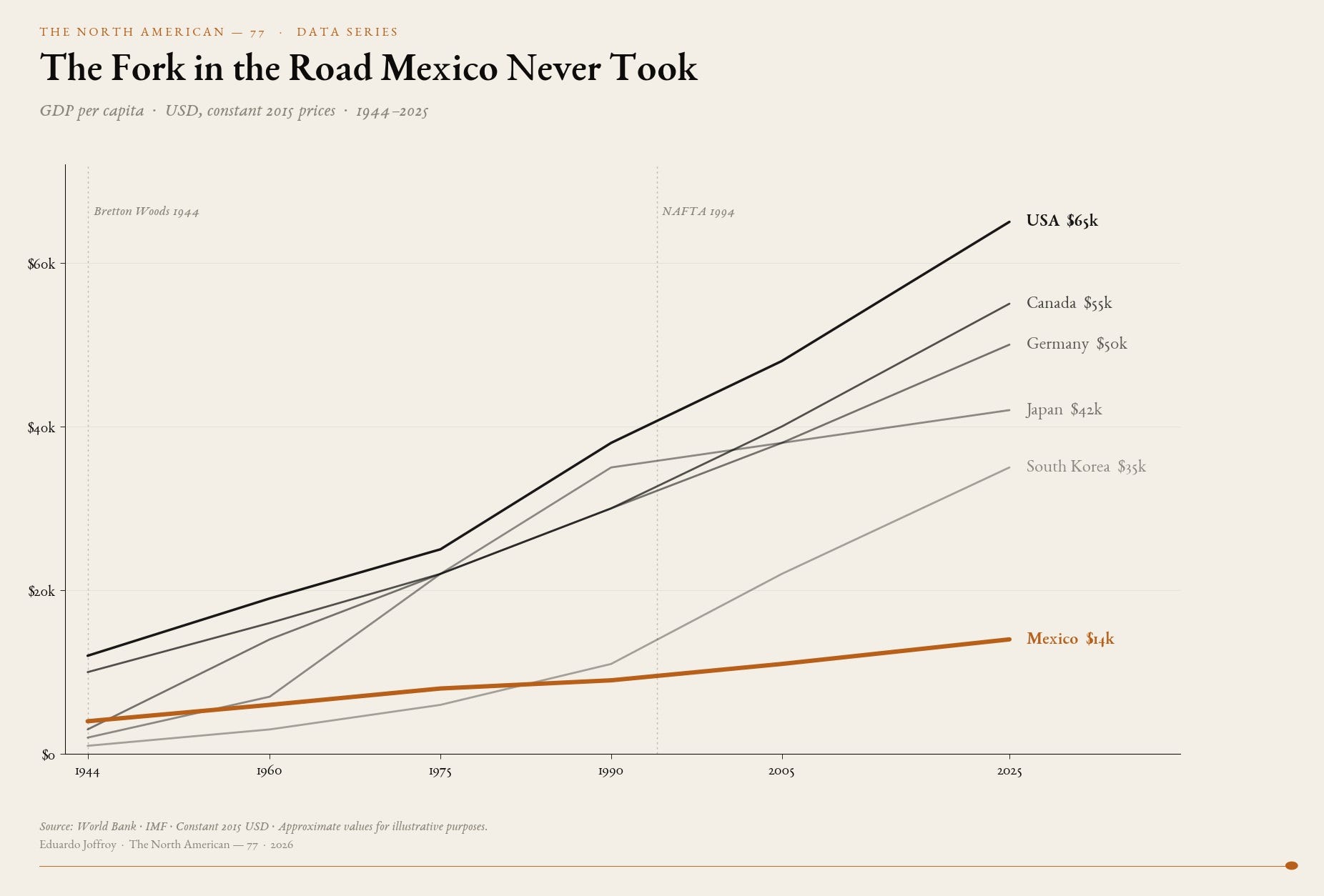
En 1944, el mundo construyó un nuevo orden. Instituciones multilaterales, reglas de comercio, arquitectura financiera — un sistema que, con todas sus imperfecciones, ha sostenido la mayor expansión de prosperidad en la historia moderna.
México no estuvo fuera de ese sistema. Pero tampoco decidió integrarse completamente a él.
Ochenta y dos años después, seguimos en esa posición intermedia — participando, beneficiándonos parcialmente, sin alinear nuestras instituciones a la lógica que sostiene el crecimiento.
Hoy, Norteamérica necesita a un México diferente. Uno de confianza.
Y la ventana para construirlo está abierta — pero no por mucho tiempo.
II. El Patrón
México no falló por falta de recursos. Falló por consistencia.
Manuel E. Familiar escribió en el ensayo que abre esta serie una frase que no he podido sacarme de la cabeza:
“México recibió su pago. Lo que ocurrió con él se disolvió en la maquinaria fiscal y militar de un régimen que no construyó nada permanente con ese capital.”
Con esto se refiere a la compra de territorio que realizó Estados Unidos a México de territorio, fondos los cuales Santa Anna en 1853 pudo haber dejado algo de valor e institucional para México.
¿Que hizo México con esos recursos?
¿Que beneficios nos ha dejado Pemex, la CFE o la venta de Telmex?
NINGUNO.
No es mala suerte. Es un patrón. Y un patrón puede romperse — si primero se reconoce por lo que es: un problema de diseño institucional, no de carácter.
III. La Regla
El ejemplo ideal para este patrón tiene una cara: Pemex.
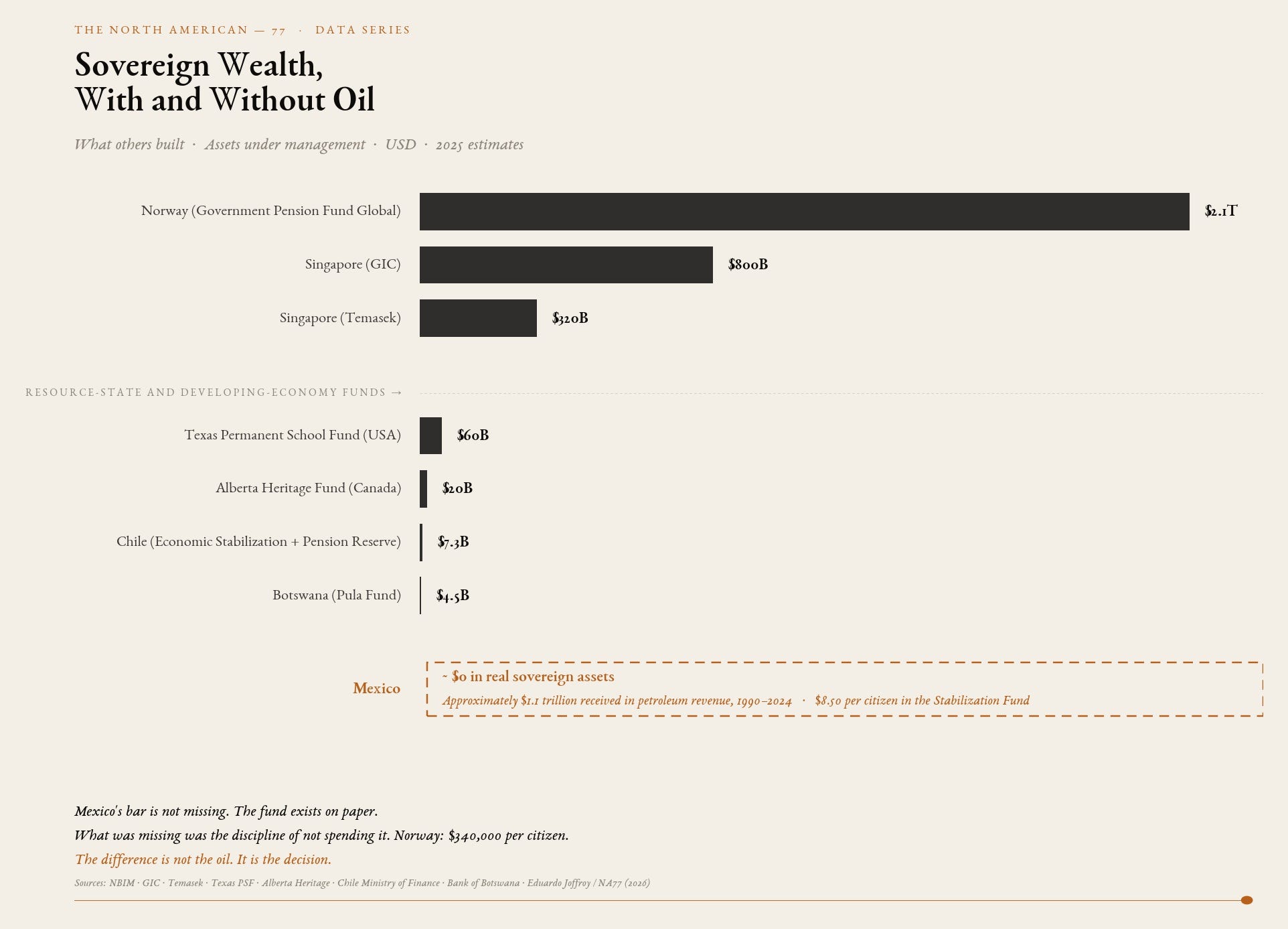
Una empresa del Estado, operando en un sector históricamente rentable, acumula hoy más de $100 mil millones de dólares en deuda. En 2020, el fondo soberano noruego — el administrador fiduciario más disciplinado del mundo — desinvirtió públicamente de Pemex y dejó por escrito el motivo: riesgo inaceptable de corrupción.
Cuando el capital más disciplinado del planeta te saca de su cartera y publica la carta explicándolo, el problema ya no es opinable. Está documentado.
Evidencia de porqué Noruega salió de Pemex en 2024
De ahí sale la regla que articula todo lo que sigue:
Ninguna empresa del Estado puede ser, estructuralmente, perdedora de valor. Mucho menos si opera como monopolio. Si no entrega orden, eficiencia, transparencia y competitividad, la operación pasa a gestión independiente bajo un consejo con mandato fiduciario hacia los ciudadanos — no hacia el gobierno en turno.
El Estado puede ser dueño; el Estado puede ser beneficiario; el Estado no tiene que ser operador.
IV. México ya lo ha hecho
Antes de mirar afuera, vale la pena mirar adentro.
El patrón no es absoluto. México ya ha demostrado, en contextos específicos, que puede construir sistemas que funcionan.
Coahuila y Chihuahua redujeron la violencia con coordinación real.
Querétaro y Guanajuato construyeron clusters aeroespaciales de clase mundial.
Nuevo León y Coahuila consolidaron la manufactura automotriz continental. Las Afores acumularon activos por más del 15% del PIB bajo reglas estables.
FEMSA, CEMEX, Bimbo, Arca, Chedraui y Maseca operan globalmente con disciplina corporativa de primer nivel.
Los casos comparten tres elementos: reglas claras, coordinación institucional, continuidad en el tiempo.
El problema no es capacidad. Es consistencia a escala nacional.
V. Por Qué Ahora
Tres fuerzas convergen de una manera que no volverá a alinearse en una generación.
La energética. La inteligencia artificial va a duplicar el consumo eléctrico global antes de 2030. México tiene el corredor solar más competitivo del hemisferio norte. Amazon, Microsoft y Tesla buscan esa energía aquí — no la encuentran, porque las subastas fueron canceladas y la electricidad industrial cuesta significativamente más que en Texas.
La logística. Los cruces fronterizos procesan más de $800 mil millones en comercio bilateral al año — la relación comercial más grande en la historia entre dos naciones. Y las comunidades que la hacen posible están sistemáticamente subinvertidas.
La demográfica. El bono demográfico se cierra hacia 2030. Los estudiantes en las aulas hoy son la última generación para la que una transformación educativa completa todavía llega a tiempo.
Lo que México decida en los próximos cuatro a seis años determina las próximas cuatro a seis décadas.
VI. La Arquitectura — Cinco Pilares
Esto no es un programa político. Es una arquitectura. Cinco pilares, cada uno bajo la regla, cada uno con una primera señal medible.
Consejo de Seguridad de Norteamérica. Un pacto trilateral con Estados Unidos y Canadá — mando conjunto de interdicción, inteligencia financiera compartida, cooperación judicial. Lo que OTAN es al Atlántico, lo que Five Eyes es a la inteligencia anglosajona. Coahuila y Chihuahua demostraron que el componente mexicano funciona. Falta la capa continental.
Energía 2.0. Reactivar las subastas de energía limpia bajo certeza jurídica constitucional. Posicionar a México, para 2032, como exportador de electricidad limpia a los data centers de Texas, Arizona y California. Bajo la regla: CFE y Pemex entregan, o la operación pasa a gestión independiente.
Educación IA y retorno del talento. Tutores de inteligencia artificial para el 40% más rezagado, con capacitación previa de maestros al modelo Estonia. Y un programa estructurado de retorno: México tiene 37 millones de connacionales y mexicoamericanos en el extranjero — ingenieros, médicos, financieros, investigadores construyendo empresas, hospitales y laboratorios para otros países. Taiwán, Israel, India e Irlanda convirtieron a su diáspora en motor de su transformación. México no lo ha intentado.
Infraestructura y ciudades puerto. México tiene tres tipos de ciudades puerto — fronterizas, marítimas y aeroportuarias — y las tres están subinvertidas. Fondo mixto público–privado con gobernanza independiente, y un mandato que ningún plan mexicano ha pedido: un porcentaje fijo de las rentas regresa a las comunidades que hacen posible el flujo. Porque un ciudadano portuario tiene que poder mirar a su puerto y entender que es bueno para su presente y su futuro.
Infraestructura narrativa. El único pilar que ningún gobierno puede construir, y el que hace políticamente posibles los otros cuatro. Toda transformación nacional exitosa de los últimos cincuenta años fue precedida por un cambio de narrativa, no por uno de ley. Colombia 2003–2016. Corea del Sur 1988–2000. Irlanda en los noventa.
VII. La Inversión Más Importante
La inversión más importante no es la extranjera.
Es la inversión en los mexicanos.
Educación funcional
Inclusión financiera
Simplificación fiscal
Seguridad
Estado de derecho
Transparencia & Apertura.
No como discurso. Como sistema.
Porque recibir inversión no es lo mismo que generar riqueza. Una parte significativa del valor que hoy se produce en México no se queda en México — se captura en otros eslabones: diseño, capital, propiedad intelectual, distribución. Eso no es un problema de capacidad.
Es un problema de arquitectura.
VIII. Dejar de Ignorar
En 1944, México ignoró el orden global que se estaba construyendo. Ochenta y dos años después, ese orden produjo la era de mayor progreso humano de la historia:
revoluciones industriales, avances médicos que duplicaron la expectativa de vida, el período de paz más largo que ha conocido la humanidad —
aun contando Vietnam, Iraq, Ucrania, Palestina e Irán.
México lo ignoró. Y ese orden nos sigue esperando.
No podemos seguir creyendo nuestras propias mentiras. Los datos están publicados. El fondo soberano más disciplinado del mundo sacó sus inversiones de Pemex por corrupción. Nuestra electricidad industrial cuesta más que la de nuestro principal competidor. Nuestros jóvenes más brillantes construyen para otros países. Nuestras ciudades puerto están sub-invertidas mientras sostienen la relación comercial más grande de la historia.
Ignorar esto ya no es una postura política. Es una decisión que le cuesta al futuro de cada mexicano.
La ventana está abierta. Los activos están puestos. La geopolítica empuja. Y México ya ha demostrado que cuando hay reglas claras y coordinación sostenida, los resultados llegan.
Como Manuel E. Familiar escribió al cerrar su ensayo: “La pregunta ya no es si México puede. Lo que queda es la decisión. Solo la decisión.”
Mexicanos — dejemos de ignorar.
Decidamos construir.
Esto concluye la 3a parte de una serie llamada:
MÉXICO: El Vecino que Decidió Ignorar el Nuevo Orden Global
Final - Español I Beginning - English
Mexicans Must Stop Ignoring
Paper 3 of 3 · The Neighbor that Deciced to Ignore the New World Order 82 years ago
I. The Window
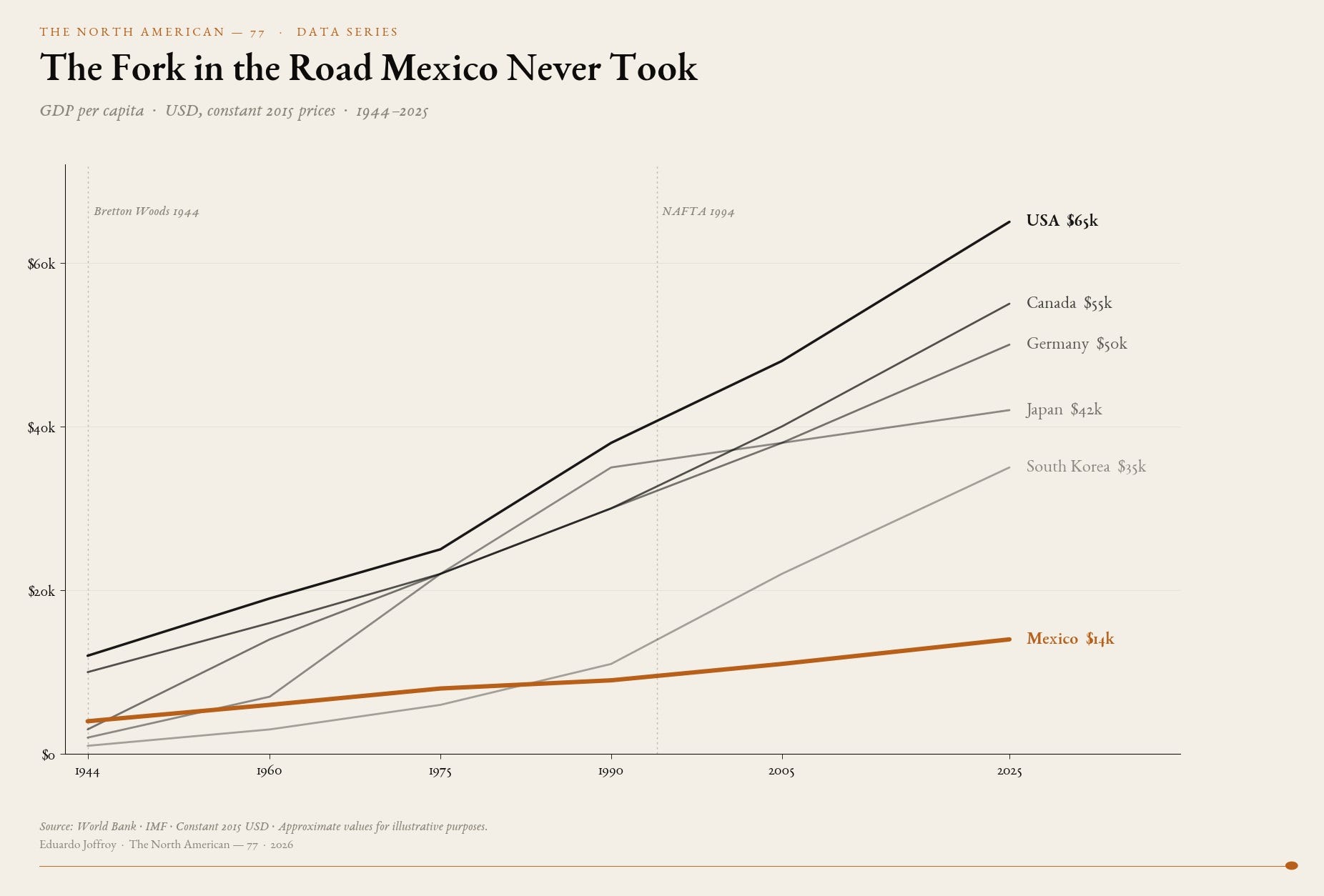
In 1944, the world built a new order. Multilateral institutions, trade rules, a financial architecture — a system that, for all its imperfections, has sustained the greatest expansion of prosperity in modern history.
Mexico was not outside that system. But it never fully decided to integrate into it either.
Eighty-two years later, we remain in that middle posture — participating, benefiting partially, never aligning our institutions to the logic that sustains real growth.
Today, North America needs a different Mexico. One it can trust.
And the window to build that Mexico is open — but not for long.
II. The Pattern
Mexico did not fail for lack of resources. It failed for lack of consistency.
Manuel E. Familiar wrote a line in the essay that opens this series that I have not been able to get out of my head:
“Mexico received its payment. What happened to it dissolved into the fiscal and military machinery of a regime that built nothing permanent with that capital.”
He was writing about the Gadsden Purchase of 1853 — the sale of Mexican territory to the United States, whose proceeds Santa Anna could have turned into something lasting, institutional, permanent. He did not.
The same applies to state owned and monopolies: Telmex, CFE, and Pemex.
What have they done to improve the lives of mexicans?
NOTHING.
This is not bad luck. It is a pattern. And a pattern can be broken — if first it is recognized for what it is: a problem of institutional design, not of character.
III. The Rule
The clearest example of the pattern has a face. It is called Pemex. A state-owned company operating in a historically profitable sector now carries more than $100 billion USD in debt.
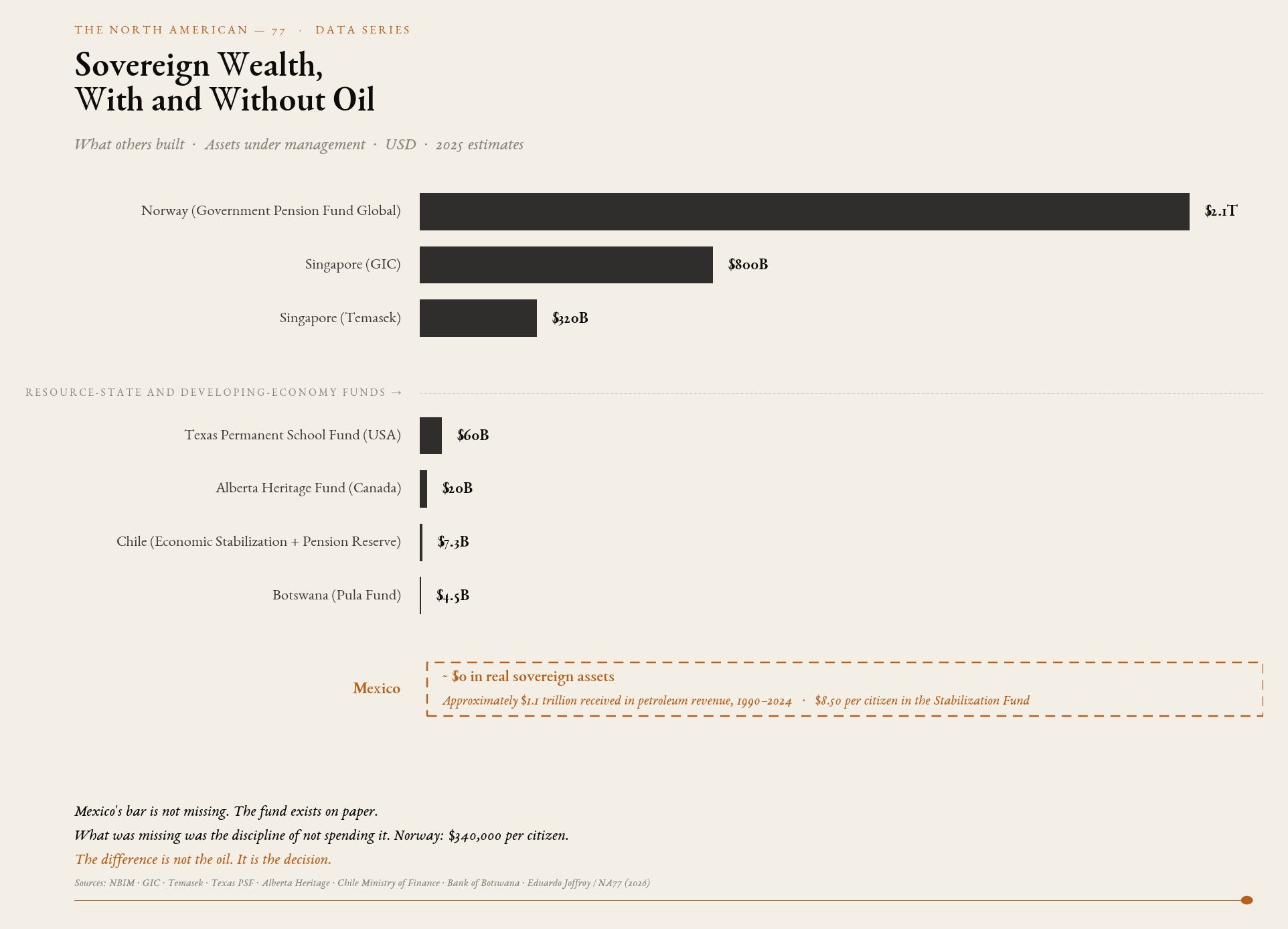
In 2020, Norway’s sovereign wealth fund — the most disciplined fiduciary manager in the world — publicly divested from Pemex and put the reason on record: unacceptable risk of corruption.
Evidence of Norwegian Fund Exiting Pemex 2024
When the most disciplined capital on the planet pulls you from its portfolio and publishes the letter explaining why, the problem is no longer debatable. It is documented.
From that comes the rule that articulates everything that follows:
No state-owned enterprise can be, structurally, a destroyer of value. Least of all if it operates as a monopoly. If it does not deliver order, efficiency, transparency, and competitiveness, the operation transfers to independent management — under a board with a fiduciary mandate to the citizens, not to the government of the day.
This is not the privatization Mexico lived through in the nineties. That transfer moved state monopolies into private monopolies without competition or supervision, and citizens paid twice.
The rule I propose is different: the State can be owner; the State can be beneficiary; the State does not have to be operator.
IV. Mexico Has Already Done It
Before looking abroad, it is worth looking inward.
The pattern is not absolute. Mexico has already proven, in specific contexts, that it can build systems that work.
Coahuila and Chihuahua reduced violence through real coordination between private sector, state and federal forces.
Querétaro and Guanajuato built world-class aerospace and manufacturing clusters. Nuevo León and Coahuila consolidated the continental automotive supply chain.
The Afores system accumulated assets worth more than 15% of GDP under relatively stable rules.
FEMSA, CEMEX, Bimbo, Arca, Chedraui, and Maseca operate globally under corporate discipline of the highest level.
The cases share three elements: clear rules, institutional coordination, continuity over time.
The problem is not capacity. It is consistency at national scale.
V. Why Now
Three forces are converging in a way that will not align again in a generation.
Energy. Artificial intelligence will double global electricity consumption before 2030. Mexico has one of the most competitive solar corridors in the northern hemisphere. Amazon, Microsoft, and Tesla are looking for that energy here — and not finding the infrastructure to supply it. Not because the sun doesn’t shine. Because the auctions were canceled. Industrial electricity in Mexico today costs significantly more than in Texas — strangling the very manufacturers that nearshoring is supposed to attract.
Logistics. Mexico’s border crossings process more than $800 billion in bilateral trade per year — the largest commercial relationship in history between two nations. And the communities that make that flow possible are systematically underinvested.
Demography. Mexico’s demographic dividend closes around 2030. The students in classrooms today are the last generation for whom a full educational transformation still arrives on time.
What Mexico decides in the next four to six years determines the next four to six decades.
VI. The Architecture — Five Pillars
This is not a political program. It is an architecture. Five pillars, each under the rule, each with a measurable first signal.
A North American Security Council. A trilateral compact with the United States and Canada — joint interdiction command, shared financial intelligence, judicial cooperation under clear evidentiary rules. What NATO is to the Atlantic, what Five Eyes is to Anglo intelligence — a continental pact between allies that have been operating separately for too long. Coahuila and Chihuahua proved the Mexican component works. What is missing is the continental layer.
Energy 2.0. Reactivate clean energy auctions under constitutional legal certainty — not merely statutory, because statutory contracts get modified every six-year term. Position Mexico, by 2032, as an exporter of clean electricity to the data centers of Texas, Arizona, and California. Under the rule: CFE and Pemex deliver efficiency, transparency, and competitiveness — or generation passes to independent management.
AI-Driven Education and Talent Return. Deploy AI tutors for the 40% most academically behind students in the public system, with teachers trained first on the Estonia model. And a second, less-discussed piece: Mexico has roughly 37 million nationals and Mexican-Americans living abroad — engineers, doctors, financiers, researchers building companies, hospitals, and laboratories for other countries. Taiwan, Israel, India, and Ireland turned their diaspora into the engine of their transformation. Mexico has never tried.
Infrastructure and Port Cities. Mexico has three kinds of port cities — border, maritime, and airport — and all three are underinvested. A mixed public–private fund with independent governance, and a mandate no Mexican plan has proposed before: a fixed percentage of trade and traffic revenues returns to the communities that make the flow possible. Because a port-city citizen — at the border, on the coast, or at an airport — must be able to look at their port and understand that it is good for their present and their future.
Narrative Infrastructure. The one pillar no government can build, and the one that makes the other four politically possible. Every successful national transformation of the last fifty years was preceded by a change in narrative, not a change in law. Colombia 2003–2016. South Korea 1988–2000. Ireland in the nineties.
VII. The Most Important Investment
The most important investment is not the foreign one.
It is the investment in Mexicans.
Functional education. Financial inclusion. Fiscal simplification. Security. Rule of law. Transparency and openness.
Not as rhetoric. As system.
Because receiving investment is not the same as generating wealth. A significant share of the value produced in Mexico today does not stay in Mexico — it is captured further down the chain: design, capital, intellectual property, distribution. That is not a problem of capacity.
It is a problem of architecture.
VIII. To Stop Ignoring
In 1944, Mexico ignored the global order that was being built. Eighty-two years later, that order produced the era of greatest human progress in history: industrial revolutions, medical advances that doubled life expectancy, the longest period of peace humankind has ever known — even counting Vietnam, Iraq, Ukraine, Palestine, and Iran.
Mexico ignored it. And that order is still waiting for us.
We can no longer keep believing our own lies. The data is published. The most disciplined sovereign fund in the world pulled its money from Pemex for corruption. Our industrial electricity costs more than our main competitor’s. Our brightest young people are building for other countries. Our port cities are underinvested while sustaining the largest commercial relationship in human history.
Ignoring this is no longer a political posture. It is a decision that costs every Mexican their future.
The window is open. The assets are in place. Geopolitics is pushing. And Mexico has already shown that when the rules are clear and coordination is sustained, the results arrive.
As Manuel E. Familiar wrote at the close of his essay: “The question is no longer whether Mexico can. What remains is the decision. Only the decision.”
Mexicans — let us stop ignoring.
Let us choose to build.
This concludes the 3rd and final essay in the series titled:
MÉXICO: The Neighbor that Decided to Ignore the New World Order
The North American — 77 · northamerican77.com
Hola Eduardo, cómo puedo colaborar contigo?