

La historia que nos falta.
Una nueva narrativa para un continente que la merece.
No llegamos tarde. Llegamos cuando teníamos que llegar, con más historia, más claridad y más razones que nunca para elegir diferente.
Por Manuel E. Familiar · Colaborador NA77
(Please find ENGLISH VERSION below)
Nací en Monterrey, pero mi historia comienza en dos países a la vez.
No como metáfora. Como hecho.
Hay pioneros en mi familia que fundaron ciudades en Iowa. Hay un empresario y sobreviviente de la Guerra Civil estadounidense, el Col. Joseph Andrew Robertson, que llegó a Monterrey a tender la vía del ferrocarril al Golfo de México y terminó participando en la fundación de la Cervecería Cuauhtémoc, estableciendo lo que hoy es Lamosa, introduciendo las primeras naranjas Valencia a Montemorelos, trayendo el béisbol a México y publicando el primer periódico bilingüe en esta ciudad. Hay un cónsul general estadounidense, Philip C. Hanna, a quien su familia llamaba “Uncle Phil”, cuyo trabajo en Monterrey tendió puentes entre dos naciones, y cuya vida, sin proponérselo, tendió el puente que me trajo a mí. Todo eso ocurrió aquí, en esta frontera invisible que siempre fue más umbral que muro.
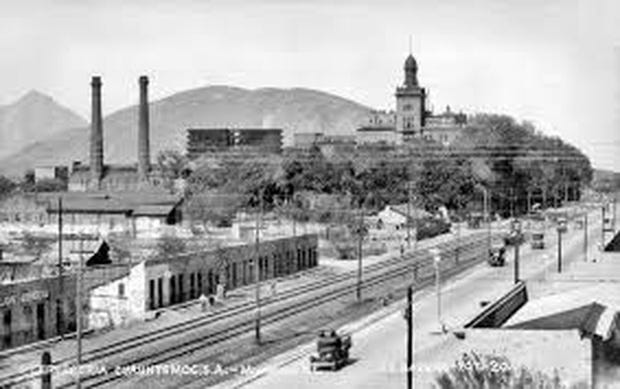
Cervecería Cuauhtémoc, Monterrey — principios del siglo XX.
Las vías del ferrocarril en primer plano: el mismo que el Col. Robertson tendió al Golfo de México.
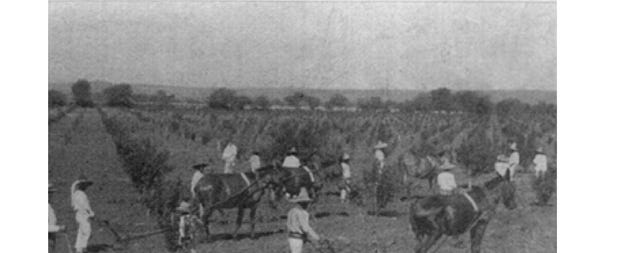
Huerta La Eugenia, Montemorelos, Nuevo León, ca. 1894 — la primera plantación comercial de naranjos Valencia en México.
León Stuart dirigiendo la plantación · Colección: Reforma Siglo XXI, vol. 91 (2017) · José de Jesús Martínez Perales
Del lado de mi padre, una línea familiar que conecta con Octavio Paz, primo hermano de mi abuela, quien dedicó su vida entera a descifrar lo que significa ser mexicano, y una línea de emprendedores regiomontanos que construyeron en esta ciudad cuando construir aquí requería una fe que los números todavía no podían justificar.
Crecí sin lograr reclamar la nacionalidad que técnicamente me correspondía. Pero nunca crecí sin saber que pertenecía a ambos lados, y que esa pertenencia doble no era una contradicción. Era, aunque tardé años en entenderlo, una perspectiva.
Pasé una década en CEMEX durante los años en que la empresa decidió dejar de ser una cementera mexicana para convertirse en una institución global. Lo viví desde adentro: en España, en los Estados Unidos, en Panamá, en Singapur, Indonesia, Bangladesh, Myanmar y China, en los años en que todo eso todavía requería ser construido a mano, decisión por decisión. Viví cinco años en Singapur, sede de mi familia mientras yo operaba en los países vecinos, y fui testigo directo de lo que le ocurre a una sociedad cuando decide, con disciplina, construirse a la altura de sus propias aspiraciones.
Lo más importante que aprendí no fue sobre cemento, ni sobre fusiones, ni sobre mercados emergentes.
Fue esto: la diferencia entre una empresa que opera en el mundo y una empresa que pertenece al mundo no es tecnológica ni financiera. Es institucional.
Es la decisión, tomada conscientemente, de construirse a la altura de las expectativas del entorno al que quieres pertenecer. Antes de que ese entorno te lo exija.
México ha producido empresas que tomaron esa decisión. Yo tuve el privilegio de vivir una de ellas desde adentro. La pregunta que no me abandonó después de CEMEX, y que no me ha abandonado desde entonces, es por qué no lo hemos hecho como país.
En 1848, México perdió la mitad de su territorio. Esa herida nunca se cerró del todo. Y hay quienes, en ambos lados de la frontera, han encontrado en mantenerla abierta una utilidad que no requiere ser nombrada para ser entendida.
Pero en esa misma época, y en esta misma ciudad, ocurría otra cosa. Empresarios americanos y familias regiomontanas construían juntos lo que ninguno hubiera podido construir solo: una cervecería que se convertiría en uno de los conglomerados más importantes de América Latina, una red ferroviaria que conectó el norte de México con sus mercados, una industria citrícola que transformó la economía de una región entera. Para 1910, Monterrey producía el 13.5% de la producción industrial de México. Más que la Ciudad de México. Lo construyeron juntos.
Eso no es historia sentimental. Es historia económica. Es la demostración de que siempre existió otra manera.
Durante la Segunda Guerra Mundial, mientras mi tío abuelo Treadwell, nacido en Monterrey, hijo de Treadwell Ayres Robertson y Eugenia Hanna, servía como médico en el ejército de los Estados Unidos, México y Estados Unidos firmaban el Programa Bracero. Agosto de 1942. Más de cuatro millones de trabajadores mexicanos cruzaron la frontera legalmente para sostener la agricultura y los ferrocarriles americanos mientras sus hombres combatían en Europa y el Pacífico. Dos naciones que se necesitaban mutuamente, ayudándose mutuamente. Por acuerdo oficial de gobierno, en el peor momento del siglo.
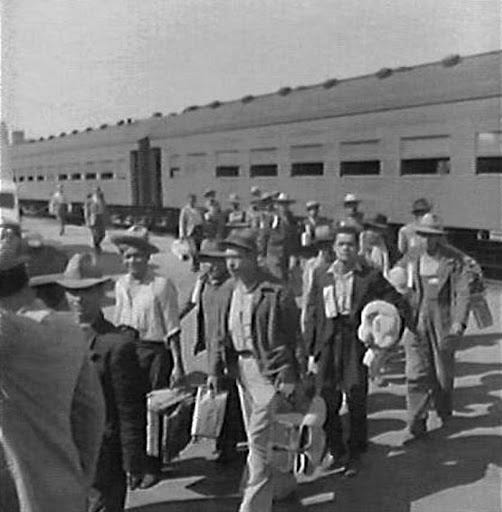
Braceros llegando en tren a California, agosto 1942.
Primeros trabajadores del Programa Bracero · Dominio público, University of California Davis Special Collections
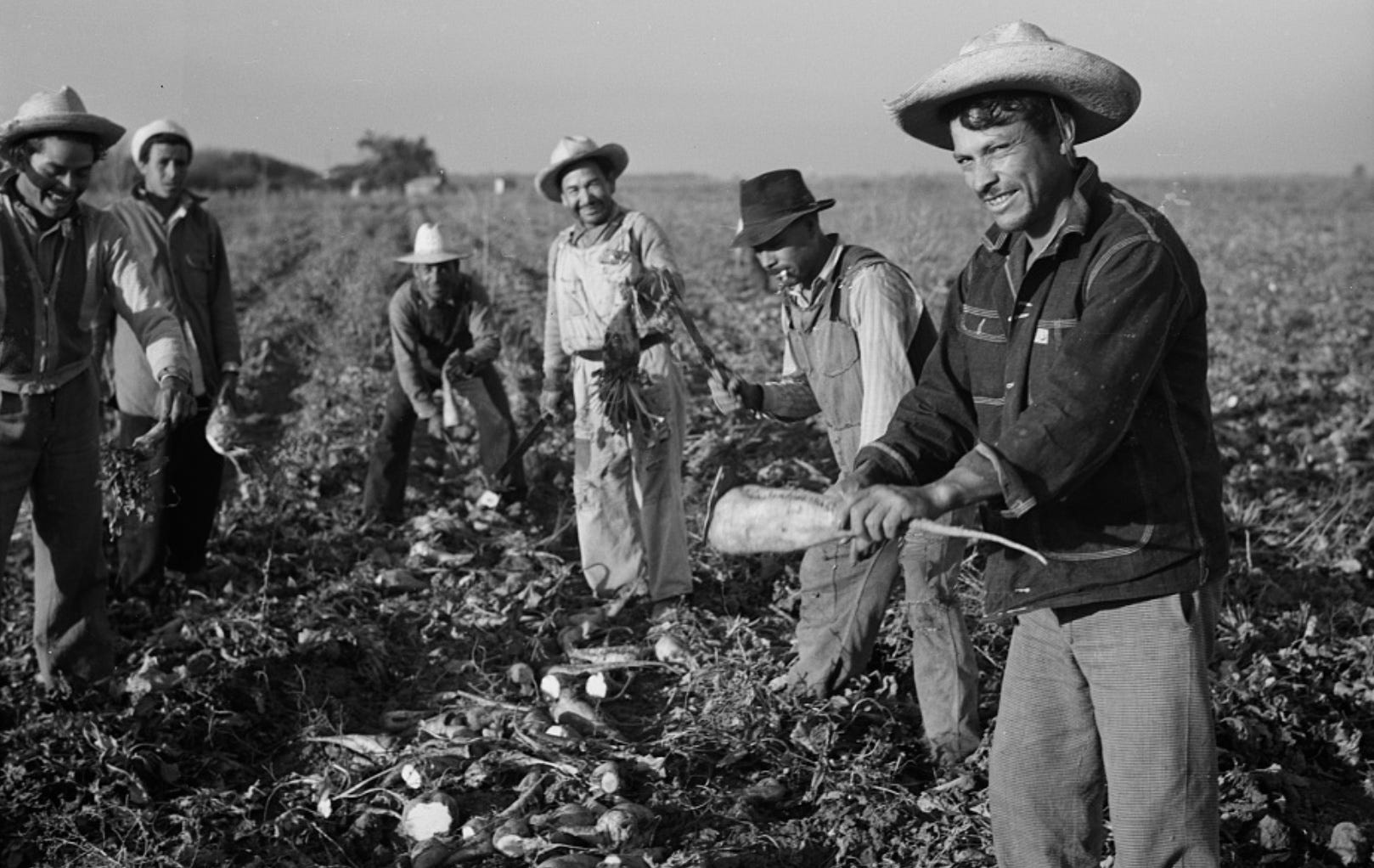
Braceros cosechando betabel en California, 1943.
Fotografía: Marjory Collins · Library of Congress Prints and Photographs Division · Dominio público
Hoy, Estados Unidos y México son los mayores socios comerciales el uno del otro. El intercambio bilateral supera el billón de dólares anuales. Las cadenas de suministro están tan integradas que separarlas no es una opción política. Es una amputación económica. Y sin embargo, la narrativa dominante en ambos países sigue siendo la del adversario, la del muro, la del otro como amenaza.
Algo no cuadra. Lo que no cuadra es la narrativa. Y llevo toda la vida viviendo la evidencia de que existe otra.
Mientras Japón, Corea del Sur, Alemania, Singapur y Taiwan reconstruían sus economías devastadas y elegían pertenecer al orden global como constructores, exigiendo transferencia tecnológica, invirtiendo en educación como infraestructura, edificando instituciones que sobrevivieran a sus gobiernos, México eligió otra cosa. No por falta de talento. No por falta de recursos ni de geografía. Elegimos ser el proveedor. La mano de obra. La maquiladora. El bracero institucionalizado. Y esa elección, repetida durante décadas, tiene beneficiarios concretos en ambos lados de la frontera. Aunque no sean los trabajadores ni los empresarios mexicanos.
Esa es la pregunta que nadie termina de hacer con la precisión que merece. No por qué fallamos. Sino por qué, teniendo todo, elegimos quedarnos donde estábamos. Y si esa elección, porque fue una elección, puede deshacerse.
Escribo esto en un momento en que la narrativa de la división alcanza volúmenes que no habíamos escuchado en décadas. Las políticas de deportación masiva, la retórica del otro como amenaza, el miedo institucionalizado como instrumento de gobierno. Conozco personas que comparten mi misma sangre, mi mismo árbol genealógico, mi misma historia de dos mundos, y que hoy hablan de los americanos con una rabia completamente justificada por lo que están viendo. No los culpo. La provocación es real. El daño es real.
Pero aquí está lo que también es real: cada arancel impuesto, cada cadena de suministro interrumpida, cada trabajador deportado que dejó atrás una empresa, una familia, una vida construida, es una demostración en tiempo real del costo de ignorar lo que ya construimos juntos. El dolor de la separación es, paradójicamente, el argumento más convincente para la integración. No necesitamos convencer a nadie de que Norteamérica funciona mejor unida. El mercado lo está demostrando solo, en tiempo real, cada vez que alguien intenta desarmarla.
Las energías renovables no se adoptaron porque el mundo decidió ser virtuoso. Se adoptaron cuando tuvieron sentido económico. La integración norteamericana no se realizará porque sea la decisión correcta moralmente, aunque lo sea. Se realizará cuando sea imposible ignorar que es la decisión correcta económicamente. Y ese momento, aunque cueste creerlo hoy, está más cerca que nunca. Porque nunca antes había sido tan visible lo que cuesta no tomarla.
Y hay un argumento más que no puede ignorarse: la seguridad. Las amenazas que de verdad ponen en riesgo a los ciudadanos de los tres países, el crimen organizado, el tráfico de personas, el fentanilo, no se detienen con muros. Se detienen con sistemas. Con inteligencia compartida, con aduanas coordinadas, con una frontera que funcione como lo que siempre debió ser: un umbral administrado con disciplina, no un campo de batalla administrado con miedo. Un frente norteamericano común no es una concesión de soberanía. Es el ejercicio más serio de ella. Porque la soberanía real no se mide por la altura del muro. Se mide por la capacidad de proteger a tus ciudadanos de las amenazas que sí existen, con las herramientas que sí funcionan.
No escribo desde aquí porque conozca la respuesta. Escribo porque llevo décadas acumulando las piezas de una pregunta que este continente lleva demasiado tiempo haciéndose en voz baja, y porque creo, con la certeza de quien lo ha visto funcionar en otros lugares y en otras épocas, que la respuesta ya existe. No en un modelo económico ni en una política pública. Existe en personas. En empresas. En historias que suceden todos los días a lo largo y ancho de este continente y que nadie ha tenido la paciencia de encontrar, documentar y elevar a la escala que merecen.
Eso es lo que North American 77 viene a hacer.
No a lamentarse por lo que no fue. A documentar lo que ya está siendo construido: por los que adaptaron sin perder su esencia, los que cruzaron fronteras de ida y de vuelta y emergieron más fuertes, los que eligieron pertenecer al mundo sin dejar de ser lo que son. Sus historias no son excepciones a la narrativa dominante. Son la evidencia de que esa narrativa siempre estuvo equivocada.
Norteamérica no necesita reinventarse. Necesitamos reconocerla.
No llegamos tarde. Llegamos cuando teníamos que llegar, con más historia, más claridad y más razones que nunca para elegir diferente. El umbral sigue ahí. Siempre estuvo ahí. Esta vez, crucémoslo juntos.
────────────────────────────────────
ENGLISH VERSION
The Missing Story.
A new narrative for a continent that deserves one.
We are not late. We arrive when we were meant to arrive, with more history, more clarity, and more reasons than ever to choose differently.
By Manuel E. Familiar · NA77 Contributor
I was born in Monterrey, in the industrial north of Mexico, a city that has always known it had one foot on each side of the border. But my story begins in two countries at once.
Not as metaphor. As fact.
There are pioneers in my family who founded cities in Iowa. There is an entrepreneur and Civil War survivor, Col. Joseph Andrew Robertson, who arrived in Monterrey to build the railroad to the Gulf of Mexico and ended up helping found the Cuauhtémoc Brewery, establishing what is today Lamosa, introducing the first Valencia oranges to Montemorelos, bringing baseball to Mexico, and publishing the first bilingual newspaper in this city. There is an American consul general, Philip C. Hanna, known to his family as “Uncle Phil”, whose work in Monterrey built bridges between two nations, and whose life, without intending to, built the bridge that brought me here. All of it happened here, on this invisible border that was always more threshold than wall.
Cervecería Cuauhtémoc, Monterrey — early twentieth century.
The railroad tracks in the foreground: the same line Col. Robertson built to the Gulf of Mexico.
Huerta La Eugenia, Montemorelos, Nuevo León, ca. 1894 — the first commercial Valencia orange plantation in Mexico.
León Stuart directing the planting · Collection: Reforma Siglo XXI, vol. 91 (2017) · José de Jesús Martínez Perales
On my father’s side, a family line that connects to Octavio Paz, my grandmother’s first cousin, who dedicated his entire life to deciphering what it means to be Mexican, and a line of entrepreneurs from Monterrey who built in this city when building here required a faith that the numbers could not yet justify.
I grew up unable to claim the nationality that was technically mine. But I never grew up without knowing I belonged to both sides, and that belonging to both was not a contradiction. It was, though it took me years to understand it, a perspective.
I spent a decade at CEMEX during the years the company decided to stop being a Mexican cement producer and become a global institution. I lived it from the inside: in Spain, in the United States, in Panama, in Singapore, Indonesia, Bangladesh, Myanmar, and China, in the years when all of that still had to be built by hand, decision by decision. I lived five years in Singapore, home base for my family while I operated across the neighboring countries, and witnessed firsthand what happens to a society when it decides, with discipline, to build itself to the level of its own aspirations.
The most important thing I learned had nothing to do with cement, or mergers, or emerging markets.
It was this: the difference between a company that operates in the world and a company that belongs to the world is not technological or financial. It is institutional.
It is the conscious decision to build yourself to the level of expectations of the world you want to belong to. Before that world demands it of you.
Mexico has produced companies that made that decision. I had the privilege of living inside one of them. The question that never left me after CEMEX, and has never left me since, is why we haven’t done it as a country.
In 1848, Mexico lost half of its territory. That wound never fully closed. And there are those, on both sides of the border, who have found in keeping it open a convenience that doesn’t need to be named to be understood.
But in that same era, and in this same city, something else was happening. American entrepreneurs and Monterrey families were building together what neither could have built alone: a brewery that would become one of the most important conglomerates in Latin America, a railroad network that connected northern Mexico to its markets, a brick company that still operates today, a citrus industry that transformed the economy of an entire region. By 1910, Monterrey produced 13.5% of Mexico’s industrial output. More than Mexico City. They built it together.
That is not sentimental history. It is economic history. It is proof that another way always existed.
During World War II, my grandmother’s brother Treadwell, born in Monterrey, son of Treadwell Ayres Robertson and Eugenia Hanna, served as a doctor in the United States Army. At the same time, Mexico and the United States signed one of the largest bilateral agreements in their shared history. The Bracero Program. August 1942. More than four million Mexican workers crossed the border legally to sustain American agriculture and railroads while American men fought in Europe and the Pacific. Two nations that needed each other, helping each other. By official government agreement, at the worst moment of the century.
Braceros arriving by train in California, August 1942.
First workers of the Bracero Program · Public domain, University of California Davis Special Collections
Braceros harvesting sugar beets in California, 1943.
Photograph: Marjory Collins · Library of Congress Prints and Photographs Division · Public domain
Today, the United States and Mexico are each other’s largest trading partners. Bilateral trade exceeds one trillion dollars annually. Supply chains are so deeply integrated that separating them is not a political option. It is an economic amputation. And yet the dominant narrative in both countries remains the same: adversary, wall, the other as threat.
Something doesn’t add up. What doesn’t add up is the narrative. And I have spent my whole life living the evidence that another one exists.
While Japan, South Korea, Germany, Singapore, and Taiwan rebuilt their devastated economies and chose to belong to the postwar global order as builders, demanding technology transfer, investing in education as infrastructure, constructing institutions designed to outlast their governments, Mexico chose something else. Not for lack of talent. Not for lack of resources or geography. We chose to be the supplier. The labor force. The maquiladora. The institutionalized bracero. And that choice, repeated across decades, has concrete beneficiaries on both sides of the border. Just not the Mexican worker or the Mexican entrepreneur.
That is the question nobody has finished asking with the precision it deserves. Not why we failed. But why, having everything, we chose to stay where we were. And whether that choice, because it was a choice, can be undone.
I write this at a moment when the narrative of division has reached volumes we haven’t heard in decades. Mass deportation policies, the rhetoric of the other as threat, institutionalized fear as an instrument of government. I know people who share my exact blood, my exact family tree, my exact history of two worlds, who today speak of Americans with a rage completely justified by what they are witnessing. I don’t blame them. The provocation is real. The damage is real.
But here is what is also real: every tariff imposed, every supply chain disrupted, every deported worker who left behind a business, a family, a life built from nothing, is a live demonstration of what it costs to ignore what we already built together. The pain of separation is, paradoxically, the most convincing argument for integration. We don’t need to convince anyone that North America works better united. The market is proving it on its own, in real time, every time someone tries to take it apart.
Renewable energy was not adopted because the world decided to be virtuous. It was adopted when it made economic sense. North American integration will not happen because it is the morally right decision, though it is. It will happen when it becomes impossible to ignore that it is the economically right decision. And that moment, hard as it is to believe today, is closer than it has ever been. Because never before has it been so visible what it costs not to make it.
And there is one more argument that cannot be ignored: security. The threats that genuinely endanger citizens across all three countries, organized crime, human trafficking, fentanyl, are not stopped by walls. They are stopped by systems. By shared intelligence, coordinated customs, a border that functions as what it always should have been: a threshold managed with discipline, not a battlefield managed with fear. A united North American front is not a concession of sovereignty. It is the most serious exercise of it. Because real sovereignty is not measured by the height of the wall. It is measured by the capacity to protect your citizens from the threats that actually exist, with the tools that actually work.
I don’t write from here because I have the answer. I write because I have spent decades assembling the pieces of a question that this continent has been asking itself in a whisper for too long, and because I believe, with the certainty of someone who has seen it work in other places and other eras, that the answer already exists. Not in an economic model or a public policy. It exists in people. In companies. In stories happening every day across this continent that nobody has had the patience to find, document, and elevate to the scale they deserve.
That is what North American is here to do.
Not to mourn what wasn’t. To document what is already being built: by those who adapted without losing their essence, who crossed borders in both directions and emerged stronger, who chose to belong to the world without ceasing to be what they are. Their stories are not exceptions to the dominant narrative. They are proof that the narrative was always wrong.
North America doesn’t need to reinvent itself. We need to recognize what’s already there.
We are not late. We arrive when we were meant to arrive, with more history, more clarity, and more reasons than ever to choose differently. The threshold is still there. It always was. This time, let’s cross it together.