
Enrique Perret - Profile No. 2
Camaleón de Norteamérica: twenty years holding the U.S.–Mexico relationship together.

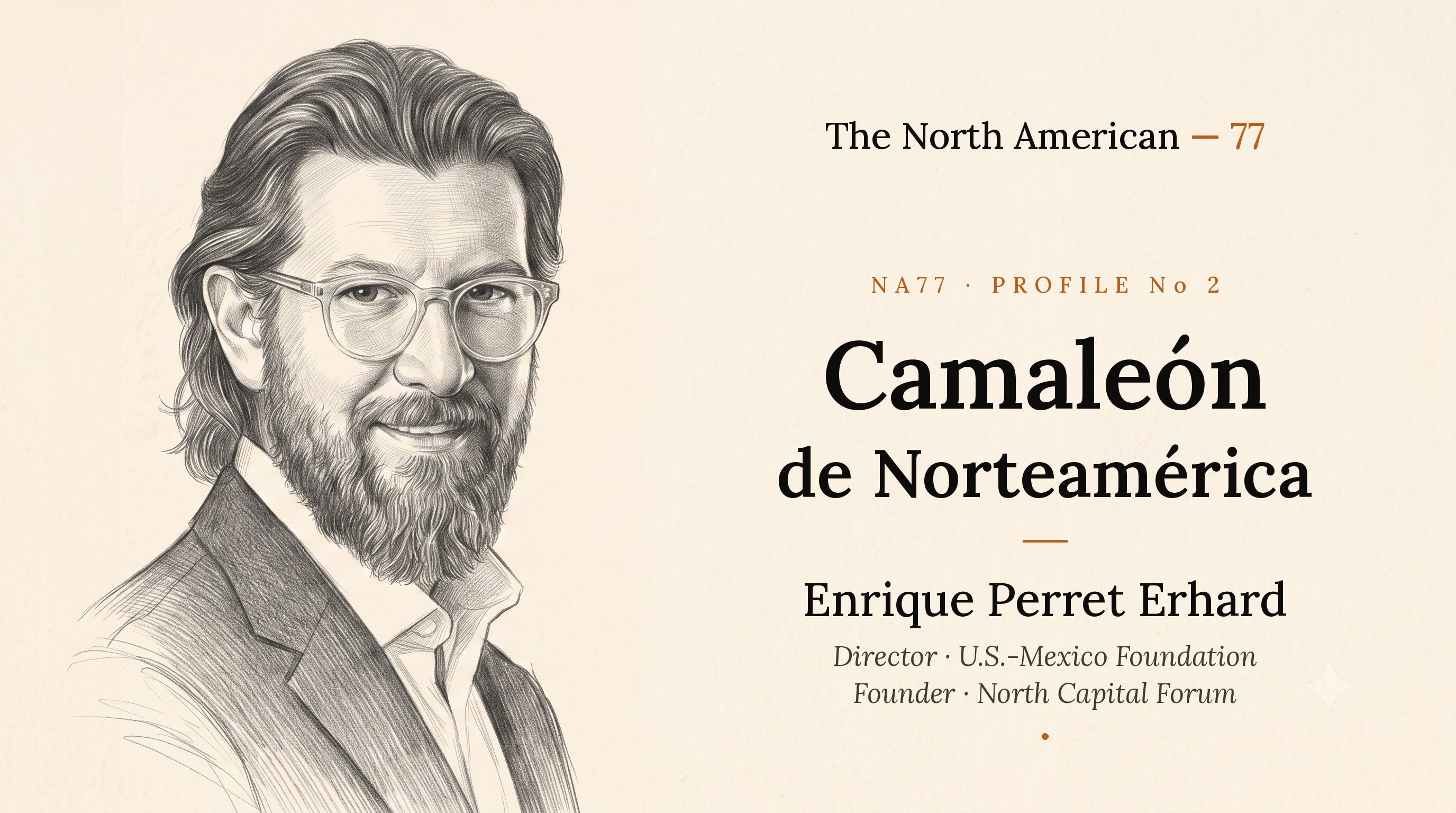
Versión español (English see below)
0 — Intro
Hay un oficio que no aparece en ningún catálogo de carreras: sostener la relación entre dos países cuando cambian los presidentes, cambian los partidos y desaparecen las instituciones.
Enrique Perret Erhard lleva más de 20 años haciendo esto. Lo ha hecho desde la frontera, la Ciudad de México, Chicago y hoy desde Washington, D.C. Durante estos 20 años, el logotipo de la organización ha cambiado pero su misión sigue siendo la misma.
Este es el año en que Enrique y sus organizaciones son pilares de todo lo que está pasando en Norteamérica. The U.S.-Mexico Foundation y North Capital Forum son plataformas que reúnen a los líderes más influyentes de Norteamérica y sin duda tendrán impacto en nuestro continente.
Por eso el Profile №02 de The North American le pertenece a Enrique Perret Erhard.
1 — El Inicio
Enrique nació en Piedras Negras, Coahuila, frontera con Eagle Pass, Texas, donde vivió sus primeros 18 años. Nació y creció del lado mexicano junto con sus padres y sus dos hermanos. Confiesa que pudo haber nacido en EUA pero las cosas eran diferentes en la frontera en esos tiempos, y la verdad es que le creo porque yo viví lo mismo.
En sus palabras: “Hace 50 años, en la frontera, nadie sentía urgencia de nacer americano; del lado mexicano se veían más beneficios.”
Creció cruzando. “Los que somos de la frontera, pues hay muchas cosas que es bien difícil explicar”, ha contado. “El haber cruzado a veces hasta tres veces en el día”: al McDonald’s del otro lado, a cargar gasolina del otro lado, a la escuela. Su pasaporte de niño era la mica con fotografía de bebé que traíamos todos los que crecimos en la línea, cuidada en la cartera durante años.
Tenía 14 años cuando se firmó el Tratado de Libre Comercio, y él mismo marca ahí el origen de su vocación: la relación México–Estados Unidos como interés de vida. Su hermano mayor estudió comercio internacional, la carrera de moda de la generación del TLCAN, y Enrique llegó al Tec de Monterrey a los 18 a estudiar lo mismo. Desde ese primer día en Monterrey hizo algo que pocos muchachos de 18 años hacen a propósito: buscar mentores.
Los que encontró entonces, dice, siguen moldeando quién es.
2 — La Identidad
A Eagle Pass le dice “Igle Pass”, y su esposa se burla de él por eso. O simplemente “el otro lado”, como decimos todos los de la línea. Esa naturalidad es la credencial que ningún posgrado otorga.
Por muchos años, Perret vio como desventaja no haber nacido del lado americano. Hoy lo lee al revés: de haber nacido allá, no habría estudiado en Monterrey, no habría sido diplomático mexicano y no viviría en Washington. La vida que tiene existe por la decisión de su madre.
Lo que parecía carencia se volvió su ventaja competitiva.
Enrique habla el idioma de la frontera y el idioma de Washington, D.C. sin traducirse a sí mismo. Yo crecí igual, en Ambos Nogales, cruzando a diario para ir a la escuela. Los que venimos de la línea nos reconocemos rápido. Es un verdadero orgullo ver a talento que viene de la frontera, como Enrique, en los escenarios más relevantes de Norteamérica y del mundo, representando muy bien nuestros intereses.
3 — El Oficio del Puente
Enrique trabajó 12 años en el gobierno mexicano, todo el sexenio de Calderón y todo el de Peña Nieto, casi siempre en promoción económica. Pasó por ProMéxico y por la Secretaría de Economía como secretario técnico de competitividad, donde coordinó el B20 durante la presidencia mexicana del G20 y el encuentro del World Economic Forum para América Latina en 2012.
Fue consejero comercial de México en Chicago, jefe de gabinete del presidente de la CNBV, y en diciembre de 2014 se mudó a Washington para dirigir las 15 oficinas de ProMéxico en Norteamérica.
Ahí le tocó la primera administración de Trump y la renegociación del tratado que terminó en el USMCA. Y ahí, en la transición de 2018, el nuevo gobierno mexicano decidió eliminar ProMéxico. La agencia fue extinguida por decreto en 2019, y México quedó como el único país de la OCDE sin agencia especializada de promoción de comercio exterior.
Enrique había llegado a Washington, D.C. con un contrato de dos años. Cuando el vehículo desapareció, enfrentó lo que él ha llamado su gran tema: “la gran decisión era: me quedo o me voy. Esa decisión era una decisión de vida.”
La consultó con la gente que quiere y en la que confía, y la respuesta fue consistente: tienes un expertise muy particular, aprovéchalo.
Él lo resume sin adorno: “la vida me fue llevando a tener un expertise muy particular, a conocer a la gente correcta en Washington, en México, para poder ser ese puente que se necesita hoy.”
Se quedó; y en diciembre de 2018 tomó la dirección de la U.S.-Mexico Foundation.
No cambió de causa; cambió de vehículo.
4 — La Obra
La U.S.-Mexico Foundation es una organización binacional, sin fines de lucro y no partidista, fundada en 2001 para fomentar el entendimiento y la colaboración entre México y Estados Unidos.
Bajo la dirección de Enrique giró hacia el advocacy y construyó músculo propio: programas de inmersión como US Mexico 360, que desde el 2018 han llevado a más de 1000 tomadores de decisión de Washington a conocer México a profundidad, y delegaciones mexicanas en sentido inverso, porque como él dice, “hay una brecha todavía de conocimiento de cómo funciona esta ciudad de Washington, de cuáles son las palancas que hay que mover.”
En 2022 fundó el North Capital Forum, el foro anual de la fundación en Ciudad de México que reúne a gobierno, sector privado, academia y sociedad civil de los tres países. Creció de 700 participantes en 2022 a más de 1,100 en 2024, con nivel real de decisión: embajadores del T-MEC, gobernadores, fondos, corporativos. Robert F. Smith, fundador de Vista Equity Partners, fue co-chair de la edición 2025.
La quinta edición será del 27 al 29 de septiembre de 2026 en Ciudad de México. En abril de este año, la fundación convocó además, junto con el Meridian International Center, un foro de diplomacia en Washington con delegados de los tres países.
Y hay un lado creativo que pocos en el mundo del policy conocen: Enrique es productor ejecutivo de Pati’s Mexican Table, la serie de Pati Jinich que acumula premios James Beard, y de La Frontera en PBS, para la cual ha recorrido decenas de cruces fronterizos contando la frontera desde adentro.
Desde 2024 es Senior Fellow del Milken Institute, escribe la columna Negocios desde Washington en Milenio, y ha presidido o acompañado consejos que van de Enseña por México a COMEXUS y el patronato del Museo del Palacio de Bellas Artes.
5 — La Visión Norteamericana
La tesis de Enrique cabe en una frase que dijo en Border Masters en 2025:
“La relación entre México y Estados Unidos no puede estar basada solo en la amistad; tiene que estar basada en una alianza estratégica.”
La geografía ya regaló la proximidad; la confianza hay que construirla. Y la confianza, para él, se construye con instituciones:
“Necesitamos construir más instituciones y mejores instituciones. Necesitamos invertir más en la relación entre México y Estados Unidos, pues no podemos dejarla en piloto automático.”
Sobre la relocalización no vende humo. El nearshoring llegó para quedarse, sostiene, pero “el gran ganador de la relocalización ha sido Estados Unidos, que es más un reshoring.”
El matiz importa: la oportunidad mexicana sigue abierta, no está ganada. Su carta más fuerte es el talento: México gradúa 130 mil ingenieros al año, y en sus palabras el mejor factor de México ante Estados Unidos es ese, talento más proximidad más el concepto de aliado.
Sobre el bloque no se hace ilusiones y tampoco se disculpa: las asimetrías entre México y sus socios se conocían desde el primer TLC, y aun así los tres países, dice, “deben considerarse como el bloque más competitivo del mundo.”
De cara al T-MEC, su lectura desde Washington aún ante una falta de una renovación es de mantener ánimo positivo de que Norteamérica es un bloque de competencia global que se necesita más de lo que dejan aparentar. Y su pregunta de fondo para 2026 es la que más me resuena: cómo empatar la visión de Estados Unidos, la de México y la de Canadá en una sola reinvención norteamericana.
6 — El Camaleón del Desierto
En la frontera le decimos camaleón, aunque los biólogos insistan en que no lo es. El Phrynosoma platyrhinos es la lagartija cornuda de nuestro desierto: un animalito gordito, de cuernos, que parece prehistórico y es completamente inofensivo.
Vive en los dos lados de la línea sin pedirle permiso a nadie, porque su territorio existía millones de años antes de que existiera la frontera. Su piel toma el color del suelo donde nace, arena en un valle, piedra en otro. Cuando el peligro pasa cerca no corre: se queda quieto, rompe su silueta con los cuernos, se entierra en la arena si hace falta, y aguanta.
Vive de hormigas. Sobrevive a punta de paciencia.
De ese animal sacamos el filtro editorial de esta casa. La pregunta Camaleón se le aplica a cada persona, empresa o idea que quiere entrar a NA77:
¿Se adaptó a través de fronteras, culturas o sistemas, y salió más fuerte sin perder su naturaleza esencial?
Las características son las del bicho: no tener fronteras, ser altamente adaptable, ser resiliente, y nunca perder la esencia.
Enrique Perret las cumple todas: nacido en frontera, cruzó la frontera todos los días hasta sus 18 años, se preparó en el Tec de Monterrey, alto funcionario federal en México, promotor comercial en Chicago, jefe de gabinete regulatorio, director regional en Washington, líder de una fundación binacional, productor de televisión, senior fellow de un think tank: cada muda conservó el mismo núcleo, ser puente entre dos países que conoce desde el nacimiento.
Cuando su propio gobierno eliminó la institución que él representaba, su causa solo se reforzó.
Eso es exactamente lo que el camaleón del desierto sabe hacer: cambiar de forma sin cambiar de naturaleza.
Por eso The North American — 77 le otorga a Enrique Perret Erhard nuestro reconocimiento de Camaleón de Norteamérica, el segundo en la historia de esta plataforma. Es un reconocimiento a la continuidad: a sostener el mismo puente a través de tres andamiajes institucionales distintos, dos países y todos los cambios de gobierno que le tocaron encima.
7 — En Su Voz
“Últimamente he reflexionado mucho que como país nos conviene, hoy, ser aliados que otra cosa.” — Sobre México ante Estados Unidos · Forbes México, febrero 2025.
“Necesitamos construir más instituciones y mejores instituciones. Necesitamos invertir más en la relación entre México y Estados Unidos, pues no podemos dejarla en piloto automático.” — Sobre el trabajo que no se ve · Forbes México, febrero 2025.
“La relación entre México y Estados Unidos no puede estar basada solo en la amistad; tiene que estar basada en una alianza estratégica.” — Sobre amistad y alianza · Border Masters / Olas Media, junio 2025.
“La vida me fue llevando a tener un expertise muy particular, a conocer a la gente correcta en Washington, en México, para poder ser ese puente que se necesita hoy.” — Sobre su oficio · La Revolución de la Riqueza, marzo 2025.
“La pregunta es cómo México puede ser parte de esa reinvención norteamericana en múltiples productos, industrias, plataformas, tecnologías; cómo empatamos esa visión de Estados Unidos, de México, de Canadá en una visión norteamericana.” — Sobre 2026 · Negocios W / W Radio, enero 2026.
7.5 — La Pregunta Abierta
ProMéxico fue creada por decreto en 2007 y extinguida por decreto en 2019. Todo lo que Enrique construyó dentro del gobierno dependía, al final, de la firma de un presidente.
Lo que construye hoy depende de donantes y patrocinadores. Su respuesta de fondo es que el USMCA es en sí mismo una institución, una base de reglas que da certidumbre, y que defenderlo es defender la continuidad misma.
La pregunta que queda abierta apunta hacia adentro de México: si un país que desarma sus instituciones cada seis años puede sostener una causa de Estado que exige décadas. La U.S.-Mexico Foundation lleva 25 años, siete con Enrique al frente.
Esa continuidad, hoy, la está dando una fundación privada y no el Estado mexicano. Ahí hay una lección que el gobierno mexicano todavía no recoge.
8 — Lo Que Sigue
El North Capital Forum llega a su quinta edición del 27 al 29 de septiembre en Ciudad de México, con la ambición de siempre: que los tres países se sienten a la misma mesa como bloque y no como tres vecinos con agendas paralelas.
Y La Frontera sigue contando, plato a plato y cruce a cruce, la historia que las noticias no cuentan: Pati Jinich anda presentando su nuevo libro, Food from la Frontera, con paradas en Arizona. La diplomacia también se hace en la cocina, y Perret lo entendió antes que casi todos en su gremio.
9 — El Puesto de Escucha
Dónde seguirlo
U.S.-Mexico Foundation · North Capital Forum — NCF26: 27–29 de septiembre, CDMX · Columna Negocios desde Washington — Milenio · Milken Institute — perfil de Senior Fellow · LinkedIn
Para escucharlo largo
La Revolución de la Riqueza (marzo 2025) — su conversación más personal: infancia, mentores, la decisión de quedarse en Washington
Border Masters / Olas Media (junio 2025) — la frontera como motor y el programa US-MX Trust 60
The Supply & Demand Show (agosto 2024, en inglés) — talento, confianza y narrativa
Negocios W / W Radio (enero 2026) — la visión 2026 y la revisión del T-MEC
Nota del Editor
Conozco el trabajo de Enrique desde hace unos años: tuve el honor de invitarlo múltiples veces al Trade Hub Summit que organizamos junto con CAAAREM en tres ediciones, he vivido el North Capital Forum como asistente y formó parte de un comité dentro de The U.S.-Mexico Foundation.
Lo que me impresiona de él no es el acceso ni los títulos: cambiaron los presidentes, desapareció por decreto la institución que representaba, tuvo que decidir en qué país construir su vida, y siguió tendiendo el mismo puente. Los que venimos de la línea sabemos lo que eso exige.
The North American — 77 se creó para amplificar a personas como Enrique Perret: esenciales para el futuro de un mejor Norteamérica.
Camaleón de Norteamérica, №02. Bien ganado.
Si encuentras valor en NA77, te invitamos a suscribirte y a correr la voz con tus contactos.
English Version
ENRIQUE PERRET
The man who keeps the bridge standing.
Profile №02 · Piedras Negras → Washington, D.C. · August 2026
The North American - [77]
0 — Intro
There is a trade no career catalog lists: keeping the relationship between two countries standing while presidents change, parties change, and institutions disappear.
Enrique Perret Erhard has worked that trade for more than 20 years. He has done it from the border, from Mexico City, from Chicago, and today from Washington, D.C. Over those 20 years the logo on the organization has changed, but the mission has stayed the same.
This is the year Enrique and his organizations stand as pillars of everything moving in North America. The U.S.-Mexico Foundation and the North Capital Forum are platforms that convene the most influential leaders of North America, and they will leave a mark on our continent.
That is why Profile №02 of The North American belongs to Enrique Perret Erhard.
1 — The Beginning
Enrique was born in Piedras Negras, Coahuila, across the border from Eagle Pass, Texas, where he lived his first 18 years. He was born and raised on the Mexican side with his parents and his two brothers. He admits he could have been born in the U.S., but the border was a different world in those days, and I believe him because I lived the same thing.
In his words: “Fifty years ago on the border, nobody felt any urgency to be born American; the Mexican side looked like the better deal.”
He grew up crossing. Those of us from the border, he has said, carry things that are hard to explain: crossing as many as three times in a single day, to the McDonald’s on the other side, to buy gas on the other side, to school. His childhood passport was the laminated border-crossing card with a baby photo, “the mica” all of us who grew up on the line carried and guarded in our wallets for years.
He was 14 when NAFTA was signed, and he traces his vocation to that moment: the U.S.–Mexico relationship as a life’s interest. His older brother studied international trade, the fashionable degree of the NAFTA generation, and Enrique arrived at Tec de Monterrey at 18 to study the same. From that first day in Monterrey he did something few 18-year-olds do on purpose: he went looking for mentors.
The ones he found then, he says, still shape who he is.
2 — The Identity
He calls Eagle Pass “Igle Pass,” and his wife teases him for it. Or simply “el otro lado,” the other side, the way all of us from the line say it. That ease is a credential no graduate school grants.
For many years Perret saw it as a disadvantage that he had not been born on the American side. Today he reads it the other way: born over there, he would have studied in San Antonio instead of Monterrey, he could never have served as a Mexican diplomat, and he would not live in Washington today. The life he has exists because of his mother’s decision.
What looked like a deficit became his competitive advantage.
Enrique speaks the language of the border and the language of Washington, D.C. without translating himself. I grew up the same way, in Ambos Nogales, crossing daily to go to school. Those of us who come from the line recognize each other fast. It is a real point of pride to see talent from the border, like Enrique, on the most relevant stages of North America and the world, representing our interests well.
3 — The Bridge Trade
Enrique spent 12 years in the Mexican government, the full Calderón and Peña Nieto administrations, almost always in economic promotion. He served at ProMéxico and at the Ministry of Economy as technical secretary for competitiveness, where he coordinated the B20 during Mexico’s G20 presidency and the World Economic Forum’s Latin America meeting in 2012.
He was Mexico’s trade commissioner in Chicago, chief of staff to the president of the national banking regulator, and in December 2014 he moved to Washington to run ProMéxico’s 15 offices across North America.
There he worked through the first Trump administration and the renegotiation that produced the USMCA. And there, in the 2018 transition, the incoming Mexican government decided to eliminate ProMéxico. The agency was extinguished by decree in 2019, leaving Mexico as the only OECD country without a specialized trade-promotion agency.
Enrique had arrived in Washington, D.C. on a two-year contract. When the vehicle disappeared, he faced what he has called his defining question: “the big decision was: do I stay or do I go. That decision was a life decision.”
He took it to the people he loves and trusts, and the answer was consistent: you have a very particular expertise, use it.
His own summary carries no varnish: “life kept leading me toward a very particular expertise, toward knowing the right people in Washington and in Mexico, to be the bridge that is needed today.”
He stayed; and in December 2018 he took over the U.S.-Mexico Foundation.
He did not change causes; he changed vehicles.
4 — The Work
The U.S.-Mexico Foundation is a binational, nonprofit, nonpartisan organization founded in 2001 to build understanding and cooperation between the two countries.
Under Enrique it turned toward advocacy and built muscle of its own: immersion programs like US Mexico 360, that since 2018 has taken more than 1000 Washington decision makers to Mexico to understand the country in depth, and Mexican delegations in the opposite direction, because, as he puts it, “there is still a knowledge gap about how this city of Washington works, about which levers have to move.”
In 2022 he founded the North Capital Forum, the foundation’s annual gathering in Mexico City that brings together government, business, academia, and civil society from all three countries. It grew from 700 participants in 2022 to more than 1,100 in 2024, at genuine decision-maker level: USMCA ambassadors, governors, funds, corporations. Robert F. Smith, founder of Vista Equity Partners, served as U.S. co-chair in 2025.
The fifth edition runs September 27–29, 2026, in Mexico City. This past April the foundation also convened, with the Meridian International Center, a diplomacy forum in Washington with delegates from all three countries.
And there is a creative side few people in the policy world know: Enrique is executive producer of Pati’s Mexican Table, Pati Jinich’s James Beard Award-winning series, and of La Frontera on PBS, for which he has traveled dozens of border crossings telling the border’s story from the inside.
Since 2024 he is a Senior Fellow at the Milken Institute, he writes the column Negocios desde Washington in Milenio, and he has chaired or served on boards from Enseña por México to COMEXUS and the trustees of the Palacio de Bellas Artes museum.
5 — The North American Lens
Enrique’s thesis fits in one sentence he delivered on Border Masters in 2025:
“The relationship between Mexico and the United States cannot be based on friendship alone; it has to be based on a strategic alliance.”
Geography already provided the proximity; the trust has to be built. And trust, for him, is built with institutions:
“We need to build more institutions and better institutions. We need to invest more in the relationship between Mexico and the United States, because we cannot leave it on autopilot.”
On relocation he refuses to oversell. Nearshoring is here to stay, he argues, but “the big winner of relocation has been the United States, which is living something closer to reshoring.”
The nuance matters: Mexico’s opportunity remains open, not won. His strongest card is talent: Mexico graduates 130,000 engineers a year, and in his words Mexico’s best factor before the United States is exactly that, talent plus proximity plus the ally concept.
On the bloc itself he holds no illusions and offers no apologies: the asymmetries between Mexico and its partners were known when the first NAFTA was signed, and even so the three countries, he argues, “should regard themselves as the most competitive bloc in the world.”
On USMCA, his read from Washington, even with no renewal yet on the table, is to stay positive: North America is a bloc for global competition that needs itself more than the parties let on.
And his underlying question for 2026 is the one that resonates most with me: how to align the vision of the United States, Mexico, and Canada into a single North American reinvention.
6 — The Desert Camaleón
On the border we call it a camaleón, even though biologists insist it is not one. The Phrynosoma platyrhinos is the horned lizard of our desert: a chubby, horned little animal that looks prehistoric and is completely harmless.
It lives on both sides of the line without asking anyone’s permission, because its territory existed millions of years before the border did. Its skin takes the color of the ground where it is born, sand in one valley, stone in another. When danger passes close it does not run: it holds still, breaks its outline with its horns, buries itself in the sand if it must, and endures.
It lives on ants. It survives on patience.
From that animal we took the editorial filter of this house. The Camaleón question is applied to every person, company, or idea that wants to enter NA77:
Did they adapt across borders, cultures, or systems, and come out stronger without losing their essential nature?
The traits are the animal’s: no borders, highly adaptable, resilient, and never losing the essence.
Enrique Perret meets every one of them:
born on the border, crossing it daily until he was 18, trained at Tec de Monterrey, senior federal official in Mexico, trade promoter in Chicago, regulatory chief of staff, regional director in Washington, head of a binational foundation, television producer, think-tank senior fellow: through every molt he kept the same core, being a bridge between two countries he has known since birth.
When his own government eliminated the institution he represented, his cause only grew stronger.
That is exactly what the desert camaleón knows how to do: change form without changing nature.
For all of this, The North American — 77 grants Enrique Perret Erhard our recognition as Camaleón de Norteamérica, the second in the history of this platform. It is a recognition of continuity: holding the same bridge across three different institutional scaffoldings, two countries, and every change of government that landed on top of him.
7 — In His Voice
“Lately I have reflected a great deal that, as a country, what suits us today is to be allies more than anything else.” — On Mexico before the United States · Forbes México, February 2025. Translated from Spanish.
“We need to build more institutions and better institutions. We need to invest more in the relationship between Mexico and the United States, because we cannot leave it on autopilot.” — On the work nobody sees · Forbes México, February 2025. Translated from Spanish.
“The relationship between Mexico and the United States cannot be based on friendship alone; it has to be based on a strategic alliance.” — On friendship and alliance · Border Masters / Olas Media, June 2025. Translated from Spanish.
“If it’s only a friend and a neighbor, proximity is your best factor. But if you’re an ally, it is not only proximity: there is a lot of trust in you.” — On what an alliance adds · The Supply & Demand Show, August 2024.
“Talent is the best factor. 130,000 engineers graduated every year from Mexico. Mexico can be a tremendous factor on talent, proximity, and then the third is this ally concept.” — On Mexico’s strongest card · The Supply & Demand Show, August 2024.
7.5 — The Open Question
ProMéxico was created by decree in 2007 and extinguished by decree in 2019. Everything Enrique built inside government depended, in the end, on a president’s signature.
What he builds today depends on donors and sponsors. His deeper answer is that the USMCA is itself an institution, a base of rules that produces certainty, and that defending it is defending continuity itself.
The question that stays open points inward, at Mexico: whether a country that dismantles its institutions every six years can sustain a cause of state that demands decades. The U.S.-Mexico Foundation is 25 years old, seven of them with Enrique at the helm.
That continuity, today, is being provided by a private foundation and not by the Mexican state. There is a lesson there the Mexican government has yet to collect.
8 — What’s Next
The North Capital Forum reaches its fifth edition September 27–29 in Mexico City, with the same ambition as always: getting the three countries to sit at one table as a bloc instead of three neighbors with parallel agendas.
And La Frontera keeps telling, dish by dish and crossing by crossing, the story the news does not: Pati Jinich is presenting her new book, Food from la Frontera, with stops in Arizona. Diplomacy also happens in the kitchen, and Perret understood that before almost anyone in his field.
9 — The Listening Post
Where to follow him
U.S.-Mexico Foundation · North Capital Forum — NCF26: September 27–29, Mexico City · Negocios desde Washington column — Milenio · Milken Institute — Senior Fellow profile · LinkedIn
To hear him at length
La Revolución de la Riqueza (March 2025, in Spanish) — his most personal conversation: childhood, mentors, the decision to stay in Washington
Border Masters / Olas Media (June 2025) — the border as an engine, and the US-MX Trust 60 program
The Supply & Demand Show (August 2024, in English) — talent, trust, and narrative
Negocios W / W Radio (January 2026, in Spanish) — the 2026 outlook and the USMCA review
Editor’s Note
I have known Enrique’s work for some years now: I had the honor of inviting him multiple times to the Trade Hub Summit we organized with CAAAREM across three editions, I have lived the North Capital Forum as an attendee, and I serve on a committee within The U.S.-Mexico Foundation.
What impresses me about him is neither the access nor the titles: presidents changed, the institution he represented was erased by decree, he had to decide in which country to build his life, and he kept building the same bridge. Those of us who come from the line know what that demands.
The North American — 77 was created to amplify people like Enrique Perret: essential to the future of a better North America.
Camaleón de Norteamérica, №02. Well earned.
If you find value in NA77, please subscribe and help us spread the word.