
El Umbral del Continente Está sin Terminar
Infraestructura fronteriza: la decisión que define a Norteamérica

El umbral pendiente
Infraestructura fronteriza: la decisión que define a Norteamérica
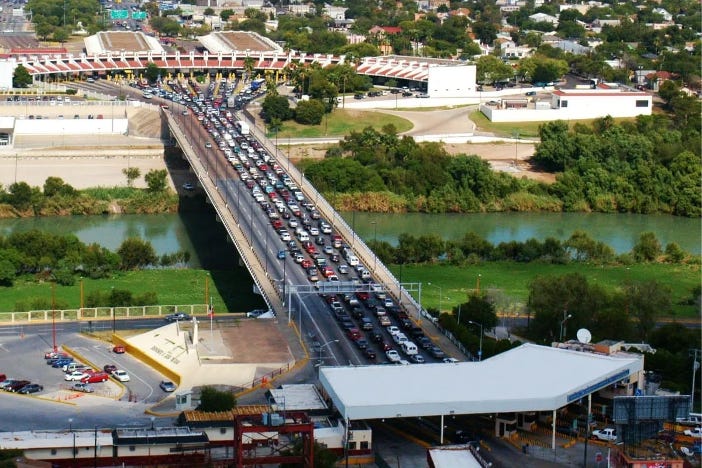
Puente Internacional / Laredo, Texas. El flujo ya existe. La infraestructura, no.
(Please find ENGLISH VERSION below)
Hay una línea que atraviesa este continente de costa a costa, de Tijuana a Matamoros, que genera casi un billón de dólares en comercio cada año. Por ella cruzan diariamente más de tres mil millones de dólares en bienes: autopartes, electrónicos, dispositivos médicos, productos frescos que llegan a las mesas de Norteamérica cuando ningún otro lugar del continente puede producirlos. Es la frontera comercial más activa del mundo.
La infraestructura que la procesa no lo sabe.
México es hoy el principal socio comercial de Estados Unidos, habiendo desplazado a China y Canadá. El intercambio bilateral alcanzó 935 mil millones de dólares en 2024. El transporte terrestre mueve el 72% de ese valor, camiones y trenes conectando cadenas de suministro tan integradas que un vehículo típico cruza la frontera diecisiete veces antes de estar terminado. La integración no es una aspiración ni un proyecto político pendiente. Es un hecho económico cotidiano, profundo, y estructuralmente irreversible.
Lo que no acompaña a ese hecho es la infraestructura que lo merece.
Los puertos de entrada más activos operan por encima de su capacidad original de diseño. Los tiempos de cruce para vehículos comerciales superan con frecuencia las siete horas. Los productos perecederos que viajan en esos camiones representan nueve mil millones de dólares diarios en valor que se deteriora con cada hora de espera. La investigación es precisa: una reducción de diez minutos en los tiempos de espera aduanal incrementaría la producción bruta total entre 1.1% y 1.8% en cada estado fronterizo mexicano. Diez minutos. El costo de la inacción no es abstracto ni difícil de calcular. Es medible, acumulable, y está creciendo al ritmo del comercio que no para.
Porque ese comercio no va a disminuir. Va a multiplicarse.
El nearshoring, la relocalización de cadenas de manufactura desde Asia hacia México para servir al mercado norteamericano, está reescribiendo la geografía industrial del continente. Del mercado global de relocalización estimado en 1.5 billones de dólares para esta segunda mitad de la década, proyecciones serias sugieren que hasta 45% podría dirigirse a México. Los estados fronterizos, Baja California, Sonora, Chihuahua, Coahuila, Nuevo León, Tamaulipas, son los receptores naturales de esa ola. Ya la están recibiendo. La pregunta no es si el flujo llegará. La pregunta es si habrá algo digno de recibirlo.
La brecha entre lo que estas ciudades generan y lo que reciben no es una falla técnica. Es una decisión acumulada.
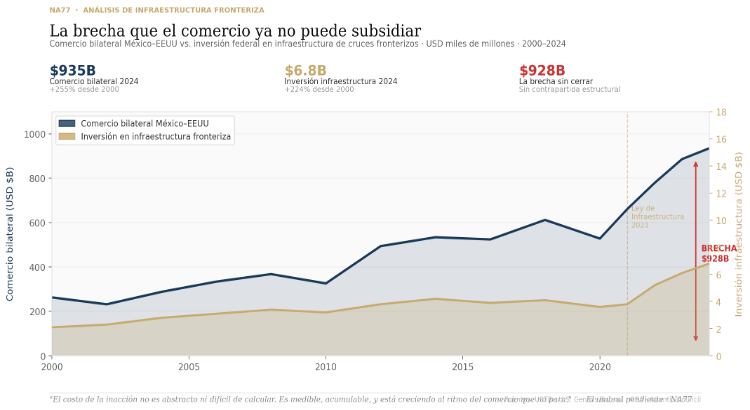
La brecha que el comercio ya no puede subsidiar. Comercio bilateral vs. inversión en infraestructura fronteriza 2000–2024.
• • •
Eduardo Joffroy identificó en esta serie cinco umbrales para la transformación de Norteamérica. El cuarto es infraestructura de ciudades fronterizas. Este ensayo lo desarrolla desde donde ese argumento se vuelve concreto: el capital que lo financia, la comunidad que lo sostiene, y la decisión de construir antes de que la demanda lo exija.
• • •
Un cruce fronterizo no es infraestructura de tránsito. Es la primera institución que el mundo encuentra.
Antes de que se firme un contrato, antes de que se celebre una reunión, antes de que se construya una sola relación comercial, un puerto, un aeropuerto, un cruce terrestre le dice a cada inversionista, cada operador logístico, cada socio potencial exactamente con qué tipo de lugar está tratando. No lo dice con palabras. Lo dice con el tiempo que tarda en procesar un camión. Con la calidad de su tecnología de inspección. Con si el agente aduanal opera desde una cultura de facilitación o desde una cultura punitiva. Con si el cruce tiene energía confiable, conectividad digital, protocolos integrados, o si improvisa cada mañana con lo que tiene.
Esa declaración es instantánea. Y es difícil de desmentir con argumentos posteriores.
La asimetría entre los dos lados de la frontera no es de recursos ni de talento. Es de cultura institucional. El lado estadounidense opera desde un principio de facilitación: cada hora de retraso tiene un costo que el sistema reconoce y trata de evitar. El lado mexicano opera con demasiada frecuencia desde un principio de control, la revisión como acto de autoridad antes que como acto de servicio. El resultado es un sistema que es lento y defensivo precisamente donde necesita ser rápido y abierto.
Eso tiene un nombre técnico en la literatura de desarrollo económico. Se llama gravedad institucional negativa. La infraestructura no atrae, repele. No acumula confianza, la erosiona. Y la erosión es costosa porque opera en ambas direcciones.
Hacia afuera, le dice al mundo que este corredor es un factor de riesgo, no un activo. Hacia adentro, le dice a la comunidad que la rodea algo más difícil de cuantificar pero igualmente real: que nadie ha decidido que ella merece algo mejor. Las ciudades fronterizas mexicanas son, con demasiada frecuencia, las más descuidadas del continente. No porque su función sea menor. Sino porque su función nunca ha sido traducida en inversión proporcional a lo que generan. Y una comunidad que convive durante décadas con infraestructura que no la dignifica aprende, gradualmente, a no esperar que las cosas funcionen. Ese aprendizaje tiene un costo económico directo: en la calidad del capital humano que produce, en su tolerancia al riesgo, en su demanda de instituciones formales sobre alternativas informales.
La infraestructura no es neutral. Declara intenciones.
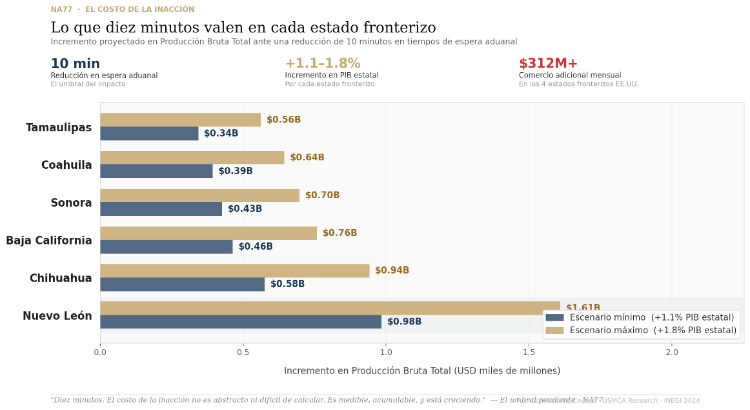
Lo que diez minutos valen en cada estado fronterizo. Incremento proyectado en Producción Bruta Total.
• • •
La pregunta no es cómo mejorar lo que existe. Es qué tendría que construirse si se empezara hoy, sabiendo lo que sabemos sobre los próximos diez años.
La respuesta no es una versión más grande de la infraestructura del siglo pasado. Es una categoría distinta. Un hub fronterizo de clase mundial no se diseña para el flujo actual. Se diseña para el flujo que el nearshoring, la electromovilidad, el comercio digital y la reconfiguración de cadenas de suministro globales van a generar antes de que termine esta década. Construir para lo que ya existe es garantizar obsolescencia desde el primer día.
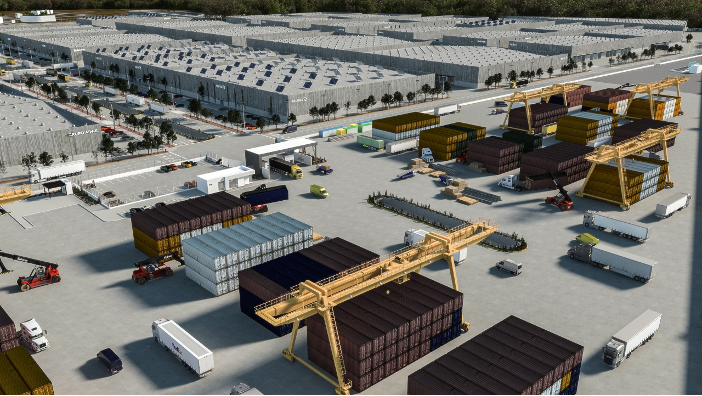
Hub logístico multimodal de clase mundial. El estándar que el nearshoring exige, no el que se improvisa.
El primer componente es energía, y tiene que estar resuelto desde el diseño, no agregado después. Los estados fronterizos mexicanos tienen entre los recursos solares más abundantes del continente. Sonora recibe radiación solar entre las más altas del mundo. Un hub que no aprovecha ese recurso desde su concepción no es un hub de clase mundial, es una instalación industrial con paneles decorativos. La energía renovable integrada no es una concesión a la agenda climática. Es una condición para competir: las empresas globales que están relocalizando operaciones tienen compromisos de emisiones netas que sus consejos de administración monitorean trimestralmente. Un corredor que no puede garantizarles energía limpia, confiable y a precio competitivo no está en su lista de opciones, independientemente de la geografía.
El segundo componente es digital, y opera en dos capas simultáneas. La primera es la plataforma de facilitación comercial: prevalidación documental, trazabilidad en tiempo real, despacho aduanal integrado que reduce días a horas y horas a minutos. El resultado no es solo eficiencia operativa. Es que el costo de ser formal se vuelve inferior al costo de ser informal. Esa inversión de la ecuación es la política de seguridad más efectiva que existe. La segunda capa es la de seguridad activa: monitoreo inteligente, protocolos de verificación que identifican lo ilícito sin detener lo legítimo, tecnología que hace que el cruce legal sea más rápido que cualquier alternativa. Seguridad no como barrera adicional sino como atributo del diseño.
El tercer componente es logístico en el sentido más amplio: capacidad multimodal que conecta el cruce terrestre con corredor ferroviario, con almacenamiento inteligente, con distribución de última milla hacia los mercados de consumo del suroeste americano. Los grandes operadores logísticos globales ya están expandiendo su presencia en la franja fronteriza porque ven lo que viene. Un hub de clase mundial no los atrae después de construirse. Los incorpora desde la mesa de diseño como socios de la infraestructura misma.
El cuarto componente es el que raramente aparece en los estudios de infraestructura y es el que más importa para el largo plazo: la comunidad que lo rodea. Un hub que extrae valor de su territorio sin devolvérselo en forma de servicios, empleo calificado, educación técnica y espacios dignos no es sostenible. No en términos sociales solamente. En términos financieros. Los fondos de infraestructura que comprometen capital a veinte o treinta años saben que la estabilidad social del entorno es una variable del retorno, no una externalidad. Una comunidad que cree en lo que su infraestructura declara sobre ella produce el capital humano que el hub necesita para operar a estándar mundial. Una que no lo cree produce rotación, informalidad y fricción.
La dignidad territorial no es el opuesto del caso de negocio. Es parte de él.
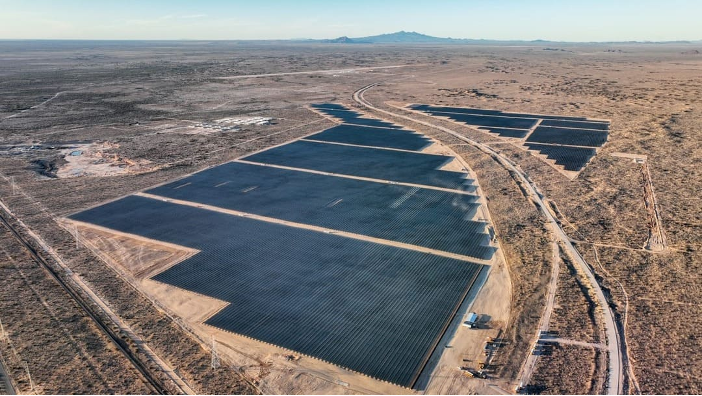
Planta solar en Sonora. El recurso ya existe. La decisión de integrarlo desde el diseño, todavía no.
• • •
Un hub de clase mundial mal gobernado es más costoso que no tenerlo.
No es una afirmación teórica. Es la lección que dejaron décadas de infraestructura pública en América Latina entregada a estructuras que no tenían los incentivos correctos para mantener lo que construyeron. El activo se deprecia. Los estándares se relajan. El capital que llegó con expectativas institucionales se va con lecciones aprendidas. Y la comunidad que creyó en la promesa del proyecto aprende, una vez más, que las promesas grandes tienen vida corta.
La pregunta de quién opera un hub fronterizo de clase mundial no es administrativa. Es estratégica. Y tiene una respuesta técnica precisa que no depende de ninguna ideología política ni de ninguna coyuntura de gobierno.
El operador correcto es aquel cuyos incentivos están alineados con el desempeño de largo plazo del activo, no con los objetivos de corto plazo de quien lo nombró. Eso describe una categoría específica de entidad: operadores privados especializados con concesiones de largo plazo, métricas de desempeño públicas y verificables, y estructuras de gobierno que separan con claridad quien regula de quien opera. No es una figura nueva. Es el modelo que construyó los mejores puertos y aeropuertos del mundo, desde los grupos aeroportuarios latinoamericanos que transformaron infraestructura pública deteriorada en activos de estándar internacional, hasta los operadores portuarios que llevan décadas demostrando que la infraestructura de comercio no requiere propiedad estatal para servir al interés público.
Lo que hace robusto a ese modelo no es la privatización en sí. Es la arquitectura de rendición de cuentas que lo acompaña. Contratos de concesión con estándares de servicio vinculantes. Métricas de tiempos de cruce, volúmenes procesados, incidentes de seguridad y satisfacción de usuarios que se publican con periodicidad y que tienen consecuencias contractuales si no se cumplen. Supervisión regulatoria independiente del operador y del gobierno concedente. Y estructuras de gobierno interno que sobreviven cambios de administración porque no deben su existencia a ninguna administración específica.
Esa arquitectura resuelve el problema que ninguna buena intención puede resolver por sí sola: el de los incentivos mal diseñados. Cuando quien opera la infraestructura gana si funciona bien y pierde si funciona mal, y cuando ese vínculo está establecido en un contrato que ninguna decisión política unilateral puede deshacer, el estándar se mantiene. No porque los operadores sean virtuosos. Porque el sistema está diseñado para que la virtud y el interés propio apunten en la misma dirección.
El capital institucional de largo plazo entiende esto mejor que nadie. Un fondo soberano que evalúa participar en infraestructura fronteriza no está evaluando solo el flujo de comercio subyacente. Está evaluando la calidad de la gobernanza que protege ese flujo a lo largo de décadas. La pregunta que hace antes de comprometer capital no es cuántos camiones cruzan hoy. Es quién garantiza que el activo seguirá funcionando a estándar cuando cambien los gobiernos, cuando cambien los mercados, cuando cambien las personas que tomaron la decisión original de construir.
La respuesta a esa pregunta es la gobernanza. Y la gobernanza no se improvisa después. Se diseña desde el principio, con la misma disciplina con que se diseña la ingeniería del cruce o la estructura financiera del proyecto.
Un hub que no resuelve esto antes de poner la primera piedra no está construyendo infraestructura de clase mundial. Está construyendo el siguiente ejemplo de por qué estas cosas no funcionan.
• • •
El obstáculo convencional para la infraestructura fronteriza de clase mundial no es técnico ni geográfico. Es narrativo. La historia que se cuenta sobre estos proyectos los sitúa en la categoría de obra pública, lo que significa esperar alineación política entre tres gobiernos soberanos, ciclos presupuestales que no coinciden con ciclos de inversión, y voluntad institucional que aparece y desaparece con cada administración. Esa historia ha sido suficientemente costosa. Ha mantenido durante décadas una brecha que el comercio ya no puede seguir subsidiando.
Hay otra historia disponible. Y tiene mejores fundamentos financieros.
La infraestructura logística fronteriza de clase mundial es, por su naturaleza, un activo de retorno estable, largo plazo y respaldado por flujos reales. El comercio bilateral entre México y Estados Unidos no depende de un ciclo político. Depende de cadenas de suministro que tardaron décadas en construirse y que ningún arancel va a desmantelar de manera permanente porque el costo de hacerlo recae sobre ambos lados. Ese es el activo subyacente: flujo estructural, no cíclico. Es exactamente el perfil que los fondos de infraestructura institucional, fondos soberanos, fondos de pensiones, capital de largo plazo buscan cuando diversifican fuera de sus mercados de origen.
La arquitectura de capital para un hub fronterizo de clase mundial sigue una secuencia que tiene su propia lógica. El capital privado entra primero porque puede moverse con la velocidad y la flexibilidad que el capital público no tiene. El capital extranjero estratégico, fondos soberanos con mandatos de infraestructura y horizonte generacional, entra cuando el proyecto tiene estructura, tiene terreno, tiene concesión y tiene un caso financiero que resiste el escrutinio institucional. El capital local estratégico, el que conoce el territorio, las relaciones y los riesgos específicos que ningún modelo financiero captura completamente, es el que da credibilidad al proyecto frente a las comunidades y autoridades locales. Y la banca de desarrollo, el NADB, el IFC, instituciones diseñadas precisamente para reducir el costo de capital en proyectos con alto impacto regional, entra como catalizador que mejora las condiciones para todos los demás.
El gobierno no lidera esta secuencia. Llega cuando el proyecto ya tiene forma, ya tiene capital comprometido, ya tiene el caso construido. Y cuando llega, su única opción razonable es decir que sí a algo que ya funciona sin él.
Eso no es una crítica al gobierno. Es una descripción de cómo se construye infraestructura de clase mundial en economías que no pueden darse el lujo de esperar.
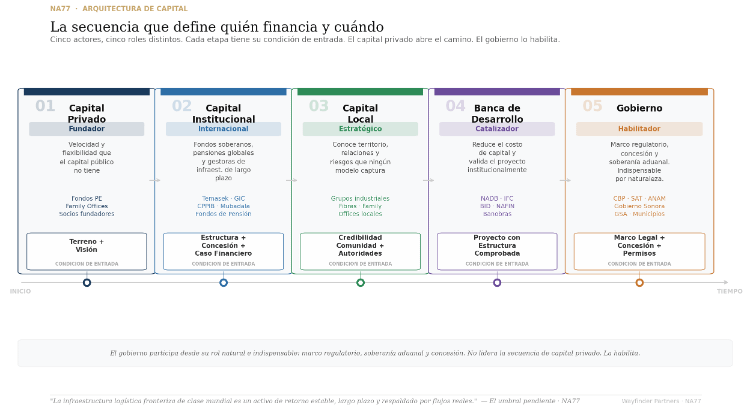
La arquitectura de capital: cinco actores, cinco roles, una secuencia. El gobierno participa como habilitador esencial.
• • •
Norteamérica es ya la región económica más integrada del planeta. No lo decidió en una cumbre. No lo proclamó ningún documento político. Lo construyó, decisión por decisión, cadena de suministro por cadena de suministro, a lo largo de tres décadas de comercio que no paró ni cuando los gobiernos se pelearon ni cuando las pandemias cerraron fronteras ni cuando los aranceles amenazaron con deshacer lo que el mercado había tardado años en tejer.
Lo que no construyó fue la infraestructura que esa integración merece.
La frontera entre México y Estados Unidos tiene más de tres mil kilómetros. A lo largo de ella operan decenas de cruces terrestres, puertos de entrada, corredores logísticos que conectan las economías del continente con una precisión y una interdependencia que ningún mapa político captura completamente. Cada uno de esos nodos es un umbral. Y cada umbral es una declaración, hecha en piedra y acero y tiempo de espera, sobre lo que este continente ha decidido que vale la inversión de construirlo bien.
El nearshoring está forzando una decisión que se postergó demasiado. Las cadenas de manufactura que se están relocalizando desde Asia hacia México no son visitantes. Son inversiones de largo plazo que llegan con expectativas de estándar global y con la movilidad suficiente para irse si el entorno no las sostiene. Brasil está construyendo. Vietnam está construyendo. India está construyendo. La ventana que el momento geopolítico abrió para México y para Norteamérica no es permanente. Tiene la duración de la decisión de invertir o no invertir.
Los nodos donde esa decisión se materializa primero no son las capitales. Son los cruces. Son los puertos. Son las ciudades fronterizas que llevan décadas sosteniendo el flujo continental desde infraestructura que no las dignifica y que por primera vez en su historia tienen a su favor no solo la geografía y la integración económica sino el capital global buscando exactamente el tipo de activo que ellas representan.
Tijuana y San Diego comparten ya una de las regiones de mayor densidad de manufactura avanzada del hemisferio occidental. Ciudad Juárez y El Paso forman el corredor automotriz y electrónico más activo del continente. Nuevo Laredo y Laredo procesan más del 37% del comercio terrestre bilateral. Nogales es la puerta por donde entra a Norteamérica la producción agrícola que alimenta el continente en invierno. Cada uno de esos nodos tiene la demanda, tiene la geografía, y tiene la justificación financiera para convertirse en infraestructura de clase mundial. Lo que ha faltado es la decisión de tratarlos como lo que son: activos estratégicos continentales, no problemas fronterizos locales.
Esa reclasificación no es semántica. Cambia quién financia, quién opera, quién gobierna y quién se sienta a la mesa cuando se diseña el proyecto. Un problema fronterizo local atrae soluciones locales con presupuestos locales y horizontes de un sexenio. Un activo estratégico continental atrae capital institucional de largo plazo, operadores con estándares globales, y el tipo de gobernanza que hace que lo construido dure más que quien lo construyó.
La infraestructura narrativa de Norteamérica, otro de los umbrales que esta serie está construyendo, empieza aquí. No en las capitales donde se firman los tratados. En los cruces donde se procesa lo que esos tratados prometieron. En las ciudades que llevan décadas demostrando, turno por turno, camión por camión, que pueden sostener flujos de clase mundial con lo que les han dado.
El estereotipo de la ciudad fronteriza no sobrevive a un hub de clase mundial que funciona. No porque alguien lo haya refutado con argumentos. Sino porque la realidad construida lo hace irrelevante. Una ciudad con infraestructura digna produce ciudadanos que esperan dignidad institucional. Esa expectativa es contagiosa y acumulable. Es la forma más duradera de cambio cultural que existe, no la que se declara desde un podio sino la que se construye en el territorio y se vive todos los días.
Hay una deuda pendiente con estas ciudades. No sentimental. Económica. Llevan décadas generando valor continental desde infraestructura que no refleja ese valor. El comercio que fluye por sus cruces financia economías que no les devuelven en infraestructura lo que ellas producen en flujo. Esa ecuación es corregible. Y el momento para corregirla no es cuando la demanda desborde lo que existe, sino antes, con la misma lógica con que se construye cualquier activo de largo plazo: adelantarse a la curva, no perseguirla.
Norteamérica no necesita más argumentos sobre su potencial integrado. Tiene 935 mil millones de dólares en comercio bilateral que demuestran que la integración ya ocurrió. Lo que necesita es la disciplina de construir la infraestructura que ese hecho económico exige. Ciudad por ciudad. Cruce por cruce. Con capital que entiende el horizonte, con gobernanza que sobrevive los ciclos políticos, y con el reconocimiento de que las comunidades que sostienen este continente merecen ver ese reconocimiento construido a su alrededor.
Eso no es una visión. Es una decisión.
ENGLISH
The Continent’s Gateway is Unfinished
Why border infrastructure is the decision that defines North America
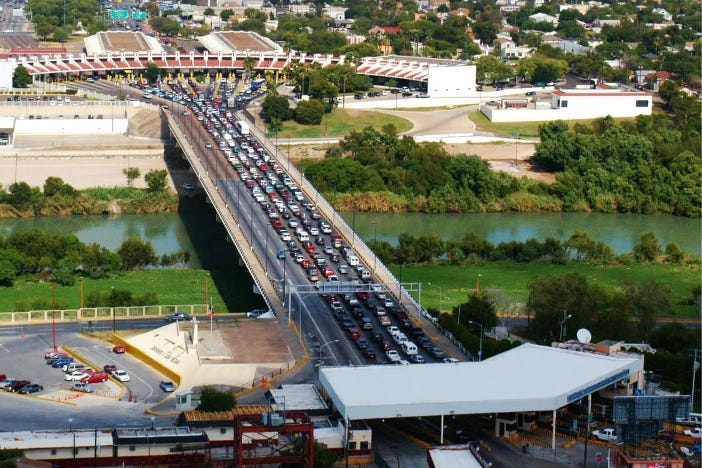
International Bridge / Laredo, Texas. The flow already exists. The infrastructure does not.
There is a line that runs across this continent from the Pacific to the Gulf that moves nearly a trillion dollars in commerce every year. More than three billion dollars in goods cross it daily: auto parts, electronics, medical devices, fresh produce that feeds North America through winters no other region can cover. It is the most active commercial border on the planet.
The infrastructure processing that flow does not know it.
Mexico is today the United States’ largest trading partner, having displaced China and Canada. Bilateral goods and services trade reached 935 billion dollars in 2024. Surface transportation moves 72% of that value, trucks and trains linking supply chains so integrated that a typical vehicle crosses the border seventeen times before it is finished. The integration is not an aspiration or a pending political project. It is a daily economic fact, structural and irreversible.
What has not accompanied that fact is the infrastructure it deserves.
The busiest ports of entry operate above their original design capacity. Commercial vehicle wait times frequently exceed seven hours. The perishable goods moving in those trucks represent nine billion dollars in daily value that deteriorates with every hour of delay. The research is precise: a reduction of just ten minutes in customs wait times would increase gross output between 1.1% and 1.8% in every Mexican border state. Ten minutes. The cost of inaction is not abstract or difficult to calculate. It is measurable, cumulative, and growing at the pace of commerce that does not stop.
Because that commerce is not going to slow down. It is going to multiply.
Nearshoring, the relocation of manufacturing chains from Asia toward Mexico to serve the North American market, is rewriting the industrial geography of the continent. Of the global relocation market estimated at 1.5 trillion dollars for the second half of this decade, serious projections suggest that up to 45% could flow toward Mexico. The border states, Baja California, Sonora, Chihuahua, Coahuila, Nuevo León, Tamaulipas, are the natural recipients of that wave. They are already receiving it. The question is not whether the flow will arrive. The question is whether there will be something worthy of receiving it.
The gap between what these cities generate and what they receive is not a technical failure. It is an accumulated decision.
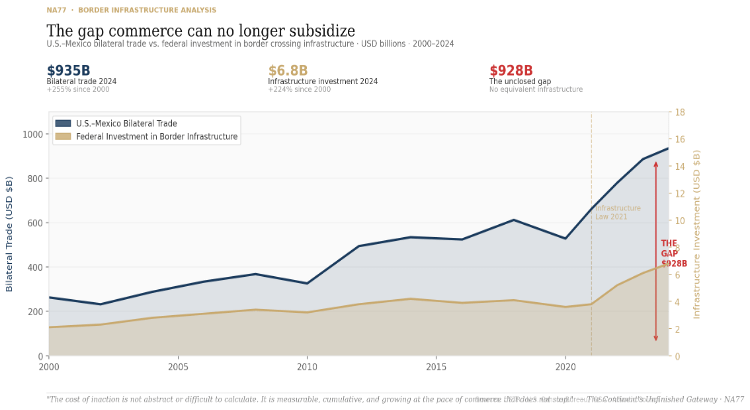
The gap commerce can no longer subsidize. Bilateral trade vs. border infrastructure investment 2000–2024.
• • •
Eduardo Joffroy has identified in this series five thresholds for North America’s transformation. The fourth is infrastructure of border cities. This essay develops that argument from where it becomes concrete: the capital that finances it, the community that sustains it, and the decision to build before demand makes it unavoidable.
• • •
A crossing is not transit infrastructure. It is the first institution the world encounters.
Before a contract is signed, before a meeting is held, before a single commercial relationship is built, a port, an airport, a land crossing tells every investor, every logistics operator, every potential partner exactly what kind of place they are dealing with. Not in words. In the time it takes to process a truck. In the quality of its inspection technology. In whether the customs agent operates from a culture of facilitation or a culture of control. In whether the crossing has reliable energy, digital connectivity, integrated protocols, or whether it improvises every morning with what it has.
That declaration is immediate. And it is difficult to contradict with arguments made afterward.
The asymmetry between the two sides of the border is not one of resources or talent. It is one of institutional culture. The American side operates from a principle of facilitation: every hour of delay has a cost the system recognizes and works to avoid. The Mexican side operates too often from a principle of control, inspection as an act of authority rather than an act of service. The result is a system that is slow and defensive precisely where it needs to be fast and open.
This has a technical name in development economics. It is called negative institutional gravity. The infrastructure does not attract, it repels. It does not accumulate trust, it erodes it. And erosion is costly because it operates in both directions.
Outward, it tells the world that this corridor is a risk factor, not an asset. Inward, it tells the surrounding community something harder to quantify but equally real: that no one has decided it deserves something better. Border cities are too often the most neglected on the continent. Not because their function is minor. But because their function has never been translated into investment proportional to what they generate. A community that lives for decades alongside infrastructure that does not dignify it learns, gradually, not to expect things to work. That learned expectation has a direct economic cost: in the quality of the human capital it produces, in its tolerance for risk, in its demand for formal institutions over informal alternatives.
Infrastructure is not neutral. It declares intentions.
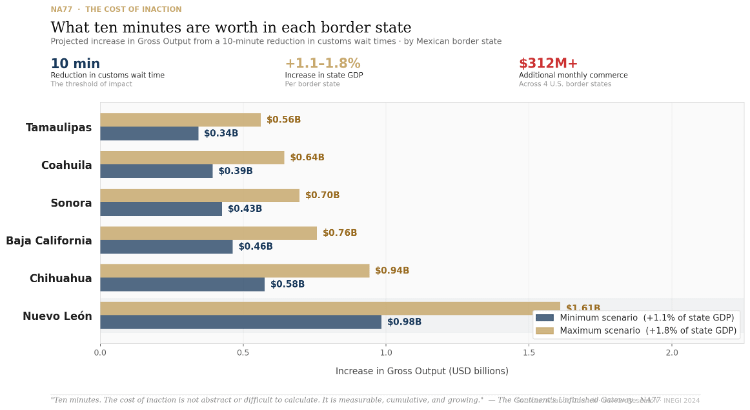
What ten minutes are worth in each border state. Projected increase in Gross Output from a 10-minute wait time reduction.
• • •
The question is not how to improve what exists. It is what would need to be built starting today, knowing what we know about the next ten years.
The answer is not a larger version of last century’s infrastructure. It is a different category. A world-class border hub is not designed for current flow. It is designed for the flow that nearshoring, electromobility, digital commerce, and the reconfiguration of global supply chains will generate before this decade ends. Building for what already exists is guaranteed obsolescence from day one.
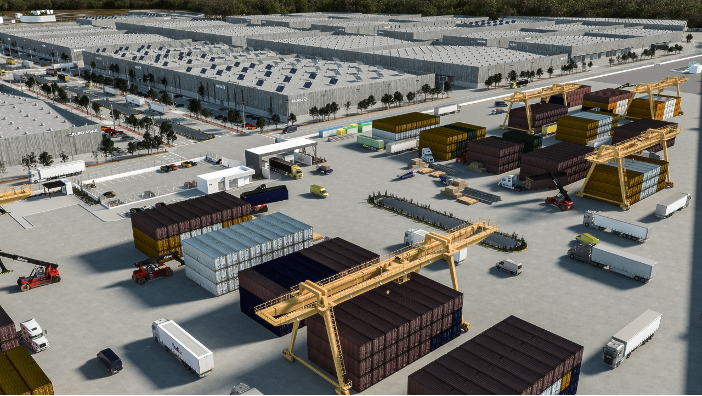
World-class multimodal logistics hub. The standard nearshoring demands, not the one that gets improvised.
The first component is energy, and it must be resolved by design, not added afterward. The Mexican border states have some of the most abundant solar resources on the continent. Sonora receives among the highest solar radiation in the world. A hub that does not leverage that resource from conception is not a world-class hub. It is an industrial facility with decorative panels. Integrated renewable energy is not a concession to the climate agenda. It is a condition for competitiveness: the global companies relocating operations carry net-zero emissions commitments their boards monitor quarterly. A corridor that cannot guarantee them clean, reliable, competitively priced energy is not on their shortlist, regardless of geography.
The second component is digital, operating on two simultaneous layers. The first is the trade facilitation platform: document pre-validation, real-time traceability, integrated customs clearance that reduces days to hours and hours to minutes. The result is not just operational efficiency. It is that the cost of being formal becomes lower than the cost of being informal. That inversion of the equation is the most effective security policy that exists. The second layer is active security: intelligent monitoring, verification protocols that identify the illicit without stopping the legitimate, technology that makes legal crossing faster than any alternative. Security not as an additional barrier but as an attribute of the design.
The third component is logistical in the broadest sense: multimodal capacity that connects the land crossing with rail corridor, intelligent storage, and last-mile distribution toward southwestern American consumer markets. The world’s major logistics operators are already expanding their presence along the border strip because they see what is coming. A world-class hub does not attract them after it is built. It incorporates them from the design table as partners in the infrastructure itself.
The fourth component is the one that rarely appears in infrastructure studies and matters most for the long term: the community that surrounds it. A hub that extracts value from its territory without returning it in the form of services, skilled employment, technical education, and dignified spaces is not sustainable. Not only in social terms. In financial terms. Infrastructure funds committing capital over twenty or thirty years know that the social stability of the surrounding environment is a variable of return, not an externality. A community that believes in what its infrastructure declares about it produces the human capital the hub needs to operate at world standard. One that does not produces turnover, informality, and friction.
Territorial dignity is not the opposite of the business case. It is part of it.
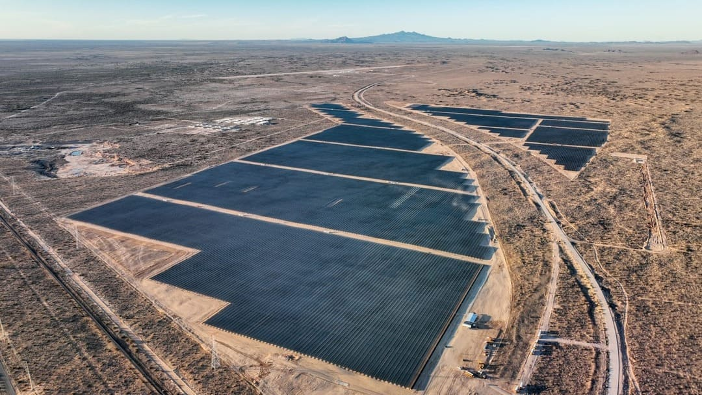
Solar farm in Sonora. The resource already exists. The decision to integrate it from design, not yet.
• • •
A world-class hub poorly governed is more expensive than not having one.
This is not a theoretical claim. It is the lesson left by decades of public infrastructure in Latin America delivered to structures that lacked the right incentives to maintain what they built. The asset depreciates. Standards relax. Capital that arrived with institutional expectations leaves with lessons learned. And the community that believed in the project’s promise learns, once again, that large promises have short lives.
The question of who operates a world-class border hub is not administrative. It is strategic. And it has a precise technical answer that depends on no political ideology and no particular government moment.
The right operator is one whose incentives are aligned with the long-term performance of the asset, not with the short-term objectives of whoever appointed them. That describes a specific category of entity: specialized private operators with long-term concessions, public and verifiable performance metrics, and governance structures that clearly separate who regulates from who operates. This is not a new model. It is the one that built the world’s best ports and airports, from the Latin American airport groups that transformed deteriorated public infrastructure into international-standard assets, to the port operators that have spent decades demonstrating that commercial infrastructure does not require state ownership to serve the public interest.
What makes that model robust is not privatization itself. It is the accountability architecture that accompanies it. Concession contracts with binding service standards. Metrics for crossing times, processed volumes, security incidents, and user satisfaction published regularly with contractual consequences if unmet. Regulatory oversight independent of both operator and conceding government. And internal governance structures that survive changes of administration because they do not owe their existence to any specific administration.
That architecture solves the problem that no good intention can solve on its own: misaligned incentives. When whoever operates the infrastructure gains if it works well and loses if it works poorly, and when that link is established in a contract that no unilateral political decision can undo, the standard holds. Not because operators are virtuous. Because the system is designed so that virtue and self-interest point in the same direction.
Long-term institutional capital understands this better than anyone. A sovereign fund evaluating participation in border infrastructure is not evaluating only the underlying trade flow. It is evaluating the quality of the governance that protects that flow across decades. The question it asks before committing capital is not how many trucks cross today. It is who guarantees the asset will continue performing to standard when governments change, when markets shift, when the people who made the original decision to build are no longer at the table.
The answer to that question is governance. And governance is not improvised afterward. It is designed from the beginning, with the same disciplina with which the crossing’s engineering or the project’s financial structure is designed.
A hub that does not resolve this before breaking ground is not building world-class infrastructure. It is building the next example of why these things do not work.
• • •
The conventional obstacle to world-class border infrastructure is not technical or geographic. It is narrative. The story told about these projects places them in the category of public works, which means waiting for political alignment among three sovereign governments, budget cycles that do not coincide with investment cycles, and institutional will that appears and disappears with each administration. That story has been costly enough. It has maintained for decades a gap that commerce can no longer subsidize.
There is another story available. And it has better financial fundamentals.
World-class border logistics infrastructure is, by its nature, an asset of stable return, long horizon, and backed by real flows. Bilateral trade between Mexico and the United States does not depend on a political cycle. It depends on supply chains that took decades to build and that no tariff will permanently dismantle because the cost of doing so falls on both sides. That is the underlying asset: structural flow, not cyclical. It is exactly the profile that institutional infrastructure funds, sovereign wealth funds, pension funds, and long-horizon capital seek when diversifying outside their home markets.
The capital architecture for a world-class border hub follows a sequence with its own logic. Private capital enters first because it can move with the speed and flexibility that public capital cannot. Strategic foreign capital, sovereign funds with infrastructure mandates and generational horizons, enters when the project has structure, has land, has a concession, and has a financial case that withstands institutional scrutiny. Strategic local capital, the capital that knows the territory, the relationships, and the specific risks that no financial model captures completely, is what gives the project credibility with local communities and authorities. And development banking, the NADB, the IFC, institutions designed precisely to reduce the cost of capital in projects with high regional impact, enters as a catalyst that improves conditions for everyone else.
Government does not lead this sequence. It arrives when the project already has shape, already has committed capital, already has the case built. And when it arrives, its only reasonable option is to say yes to something that already works without it.
That is not a critique of government. It is a description of how world-class infrastructure gets built in economies that cannot afford to wait.
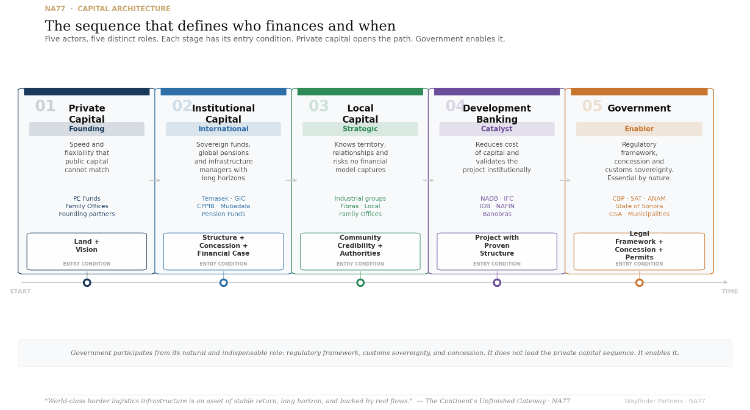
The capital architecture: five actors, five roles, one sequence. Government participates as an essential enabler.
• • •
North America is already the most integrated economic region on the planet. It did not decide this at a summit. No political document proclaimed it. It was built, decision by decision, supply chain by supply chain, across three decades of commerce that did not stop when governments quarreled, when pandemics closed borders, or when tariffs threatened to undo what markets had spent years weaving together.
What it did not build was the infrastructure that integration deserves.
The border between Mexico and the United States stretches more than three thousand kilometers. Along it operate dozens of land crossings, ports of entry, logistics corridors connecting the continent’s economies with a precision and interdependence that no political map captures completely. Each of those nodes is a threshold. And each threshold is a declaration, made in concrete and steel and wait times, about what this continent has decided is worth building well.
Nearshoring is forcing a decision that was postponed too long. The manufacturing chains relocating from Asia to Mexico are not visitors. They are long-term investments arriving with expectations of global standard and with the mobility to leave if the environment does not sustain them. Brazil is building. Vietnam is building. India is building. The window that the current geopolitical moment has opened for Mexico and for North America is not permanent. It lasts exactly as long as the decision to invest or not invest.
The nodes where that decision materializes first are not the capitals. They are the crossings. The ports. The border cities that have spent decades sustaining continental flow from infrastructure that does not dignify them, and that for the first time in their history have in their favor not only geography and economic integration but global capital actively seeking exactly the type of asset they represent.
Tijuana and San Diego already share one of the highest-density advanced manufacturing regions in the western hemisphere. Ciudad Juárez and El Paso form the continent’s most active automotive and electronics corridor. Nuevo Laredo and Laredo process more than 37% of bilateral land trade. Nogales is the gateway through which the agricultural production that feeds North America in winter enters the continent. Each of those nodes has the demand, the geography, and the financial justification to become world-class infrastructure. What has been missing is the decision to treat them as what they are: continental strategic assets, not local border problems.
That reclassification is not semantic. It changes who finances, who operates, who governs, and who sits at the table when the project is designed. A local border problem attracts local solutions with local budgets and horizons of one administration. A continental strategic asset attracts long-horizon institutional capital, operators with global standards, and the kind of governance that makes what is built outlast whoever built it.
North America’s narrative infrastructure, another of the thresholds this series is building, begins here. Not in the capitals where treaties are signed. At the crossings where what those treaties promised is processed. In the cities that have spent decades demonstrating, shift by shift, truck by truck, that they can sustain continental-scale flows with what they have been given.
The stereotype of the border city does not survive a world-class hub that works. Not because someone refuted it with arguments. But because the built reality makes it irrelevant. A city with dignified infrastructure produces citizens who expect institutional dignity. That expectation is contagious and cumulative. It is the most durable form of cultural change that exists, not the kind declared from a podium but the kind built into the territory and lived every day.
There is a debt owed to these cities. Not sentimental. Economic. They have spent decades generating continental value from infrastructure that does not reflect that value. The commerce flowing through their crossings finances economies that do not return in infrastructure what those cities produce in flow. That equation is correctable. And the moment to correct it is not when demand overwhelms what exists, but before, with the same logic with which any long-term asset is built: get ahead of the curve, do not chase it.
North America does not need more arguments about its integrated potential. It has 935 billion dollars in bilateral commerce demonstrating that integration has already happened. What it needs is the disciplina to build the infrastructure that economic fact demands. City by city. Crossing by crossing. With capital that understands the horizon, with governance that outlasts political cycles, and with the recognition that the communities sustaining this continent deserve to see that recognition built around them.
That is not a vision. It is a decision.
Gracias Allen!! No lo pudiste haber puesto mejor. Hoy no hay dignidad ni para las comunidades y en muchas tampoco para la carga que cruza. Podría decir que de los mejores proyectos fronterizos es el CBX de Tijuana - Otay Mesa, atendieron muy bien las necesidades y lograron captar mucho benéfico mutuo. Sin embargo no se ha atendido a la comunidad local de Tijuana en su cruce. Lo mismo se puede decir de la mayoría de las fronteras y sus comunidades/ ciudades que están en el olvido.
Excelente texto. Me parece especialmente poderosa la idea de que un cruce fronterizo no es sólo infraestructura de tránsito, sino una institución: el primer lugar donde Norteamérica muestra si realmente sabe gobernar la integración que ya existe.
La frontera México–Estados Unidos no es una línea marginal. Es uno de los centros materiales del continente. Pero durante demasiado tiempo se le ha tratado como periferia administrativa, no como activo estratégico continental. Ahí está la contradicción: la economía ya funciona a escala norteamericana, mientras la infraestructura, la gobernanza y la imaginación política siguen operando como si cada país pudiera resolver por separado lo que ya es un sistema común.
También me parece clave la dimensión comunitaria del argumento. La infraestructura no sólo mueve mercancías; produce expectativas. Una ciudad fronteriza con infraestructura digna no sólo procesa mejor el comercio. También enseña a sus ciudadanos que merecen instituciones que funcionen.
Ese, para mí, es el punto más importante: la integración norteamericana ya ocurrió. Lo que falta es construir —literalmente— las instituciones que estén a la altura de esa realidad.