
BROKEN REFLECTIONS - US & MEXICO
Governments Are What Citizens Accept and Demand. Here’s What Two Nations Got. Governments Are Not Accidents. They Are Reflections · Paper II of III

Paper I of III of the Series: The Reflexions of Our Nations (Cath up with a Series 1- Governments are not Accidents
A NOTE ON CURRENCY AND SCALE
All currency amounts in this essay are in United States dollars (USD) unless otherwise noted.
When millions or billions are referenced, the U.S. convention is used:
$1 million = 1,000,000
$1 billion = 1,000,000,000
$1 trillion = 1,000,000,000,000
For Mexican peso amounts, USD equivalents are provided for clarity.
I. Two Crises; Two Eras; Two Cycles
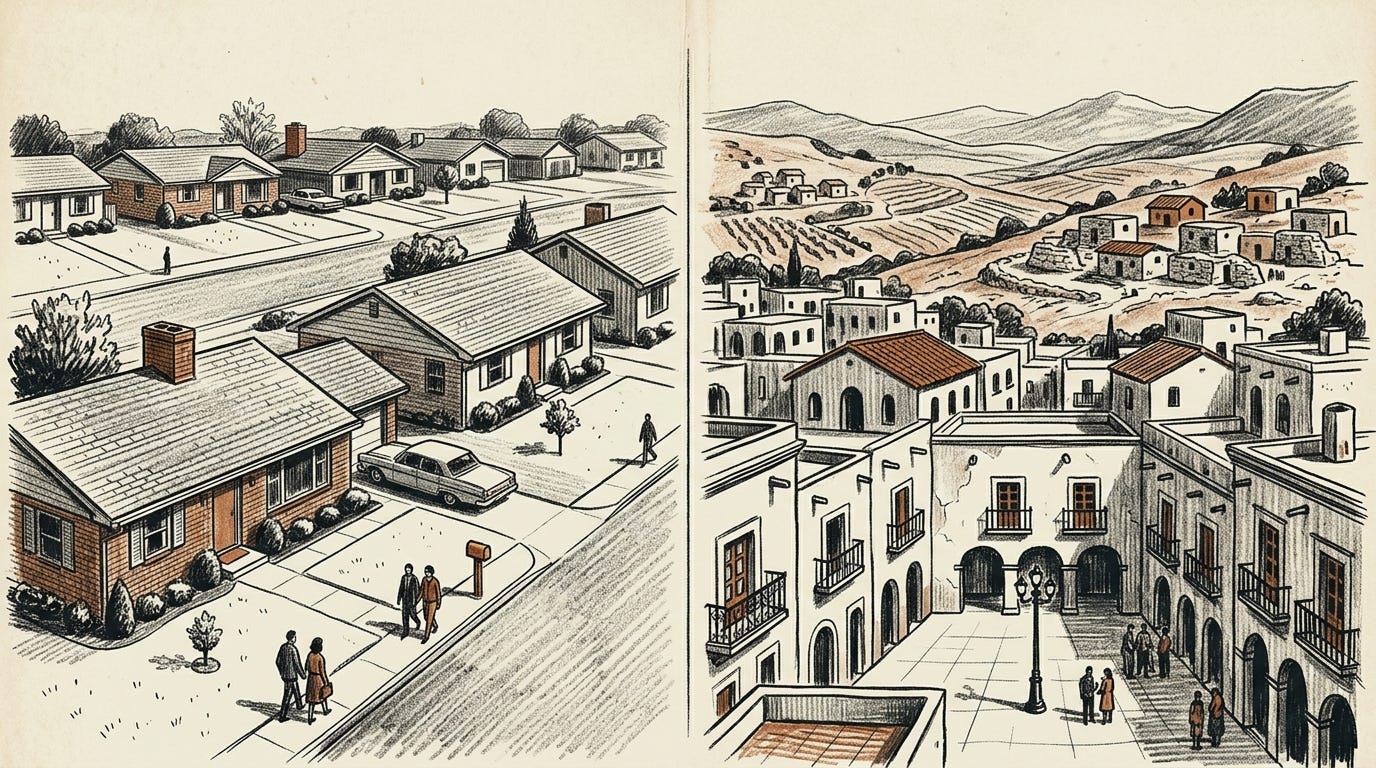
The United States and Mexico appear, from a distance, to suffer the same disease. Both governments are distrusted by their citizens. Both economies concentrate gains at the top. Both citizenries watch their political class operate at increasing distance from their actual lives.
Beyond this surface similarity lies a deeper division. In both nations, citizens are ideologically split. Political polarization deepens the gap between what people believe government should be and what government actually delivers. This ideological fracture makes it harder for either society to build consensus around what needs to be repaired.
The appearance of similarity is deceptive. These are not the same crisis. They are different diseases, in different cycles, in fundamentally different structural positions.
A government is not an accident. It is a reflection. It is what a citizenry has accepted. It is what they have allowed. It is what they have stopped demanding.
II. The United States
The United States is losing something it built. For 77 years after the Second World War, the American platform produced the most broadly distributed prosperity any modern society has ever generated. It worked. The middle class thrived and the wealth gap was not even spoken about.
It is not working as well now — for reasons we will examine — but the country was built on a platform that delivered results through opportunities and good wealth distribution.
The current American crisis is the product of a working platform progressively re-engineered to benefit those at the top and abandon the middle and lower classes. Over time, the gains of the platform moved increasingly toward capital and away from labor. The platform was re-engineered around specific economic interest groups whose continual lobbying in Washington achieved their own ambitions. Here are the numbers:
Today, 1 percent of the population owns 30 percent of total U.S. wealth. More precisely: 905 individuals hold nearly twice as much wealth as 66 million households combined — a Federal Reserve and Forbes data point that transcends slogan. In 2024, the top 1 percent controlled nearly half (49.9 percent) of all equities and mutual fund shares, while the bottom 50 percent held only 1 percent.
From 1979 to 2024, average hourly compensation increased just 29.4 percent (after adjusting for inflation) while worker productivity increased 80.9 percent, according to Economic Policy Institute analysis. Between 1980 and 2022, the bottom 90 percent of U.S. earners had wage growth of just 36 percent, compared to 162 percent for the richest 1 percent and 301 percent for the top 0.1 percent.
Workers produced roughly 81 percent more in 2024 than in 1979. They were paid 29 percent more. The difference — roughly 50 percentage points of productivity — went to capital, not labor.
A child born in 1940 had a 92 percent chance of earning more than their parents. A child born in 1980 had a 50 percent chance. Not 60. Not 70. A coin flip. The American Dream, defined as “your kids will live better than you did,” has been measurably eroded from near-certainty to near-randomness across three generations.
III. Mexico
Mexico is craving something it was promised but never fully received. The post-Revolutionary social contract written into the 1917 Constitution placed the state at the center of national life and committed that state to delivering on behalf of its citizens — education, land, work, dignity.
A century later, the state has delivered selectively, partially, and most reliably to those closest to it. The Mexican crisis is the crisis of a citizenry that has waited patiently for 100 years for that contract to be honored, and has watched its country be torn apart by the political system, by interests closest to power, and by an ever-growing organized crime that now operates at the scale of a parallel state.
Mexico’s economic architecture has never consistently produced a broad middle class, much less a society where wealth creation is widely accessible. But the clearest picture comes not from percentages but from people.
Mexico’s wealth architecture is brutal in its simplicity. At the absolute top: 13 billionaires. Thirteen families. They hold roughly $185 billion USD in combined wealth — approximately 13 percent of Mexico’s entire GDP. One of them, Carlos Slim, holds 6.7 percent of the nation’s GDP alone. Thirteen people. Controlling what a nation produces in a year.
Below that: approximately 310,000 millionaires. Less than one-quarter of one percent of the population. These are owners of significant businesses, large properties, investment portfolios. Together they control roughly another 15-20 percent of national wealth. So roughly 310,000 people — 0.24 percent of the population — control 25-30 percent of everything.
Then the rest of what economists call the “top 10 percent.” That is 13 million people. Teachers, doctors, small business owners, successful professionals. They have savings. They have property. They are comfortable. But they are not wealthy. Most do not have $100,000 USD saved. Many have $50,000 or less. They are the middle class that Mexico has managed to build.
Then everyone else. Sixty-five million people — the bottom half of Mexico. Their average wealth is $1,803 USD. The majority have far less. Millions have negative wealth: they owe more than they own — for housing, education, emergencies they could not pay for.
The poverty line is official: 38.5 million Mexicans live below it. They earn roughly $8,000 to $12,000 USD per year. Some work in the formal economy at minimum wage. Half the workforce operates in the informal sector — no contract, no benefits, no pension, no stability.
Ten million households receive remittances from family members who left Mexico to work elsewhere. Those remittances average $525 USD per month. For those families, that money is survival.
This is not inequality measured in percentages. This is inequality measured in how many people can afford to eat, to send their children to school, to save for anything at all. Thirteen families have so much they cannot spend it in a generation. Sixty-five million have so little they cannot think beyond next month.
IV. What the Reflections Show
Both reflections are broken. They were broken by different mechanisms, on different timelines, by different actors. The break in the American reflection is recent — perhaps fifty years old, depending on how you count — and the country still carries the memory of the platform working as designed.
The break in the Mexican reflection is older, structural, and inherited. Many Mexicans alive today have never known the system to work for them at all.
But underneath those opposite shapes, there is one mechanism the two countries share. In both, at the moment of greatest financial crisis in living memory, the political class chose to protect the institutions that caused the crisis at the direct expense of the citizens who did not. In the United States, that moment had a name: TARP. In Mexico, it had another: FOBAPROA.
Two countries, two crises, two bailouts, one structural decision — make the citizen pay, so the system can survive.
That decision is the clearest single piece of evidence either country has produced about whose interests its government actually serves. It is the argument of this paper.
V. The American Reflection: How a Platform Stopped Building
The American post-war platform was not an accident. It was a deliberate institutional architecture, built by a generation that had lived through the Depression and the war and had decided — with bipartisan consensus almost unimaginable today — that the country would never allow either to happen again.
Three pillars held that architecture up.
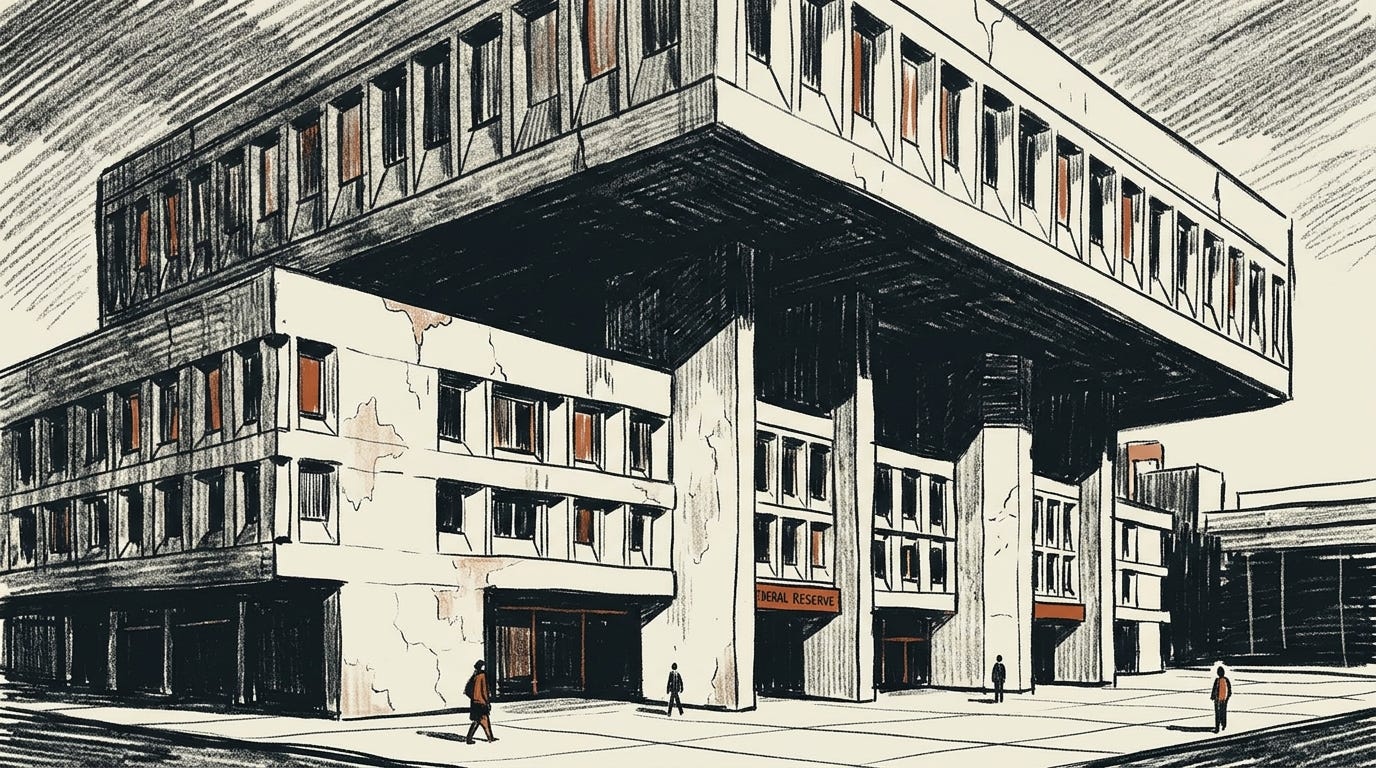
The first was the Glass-Steagall Act of 1933, which separated commercial banking from investment banking. Banks that held the savings of ordinary Americans were not permitted to gamble those savings on speculative trading. The wall was structural, not moral. Congress did not trust bankers to restrain themselves, so Congress restrained them.
The second was Bretton Woods, the 1944 monetary architecture that pegged the dollar to gold and made the United States the anchor of global finance. The system was not designed to enrich American capital. It was designed to make sure that the international financial system would never again collapse the way it had in the 1930s, taking democracies with it.
The third was the postwar social compact — the GI Bill, mass home ownership, mass college education, wages that rose with productivity, and a tax structure under which the highest American earners paid marginal rates of 70 percent or more without anyone considering this exceptional.
The compact was not socialist. It was the operating assumption of a country that had concluded, from very recent and very painful experience, that broad prosperity was the foundation of national strength.
For three decades, these three pillars held. The American middle class became the largest, wealthiest, most upwardly mobile population in human history. Black and Latino Americans were not equally included at the start; that fuller story is the subject of its own paper. But the structural fact is that the platform, working as designed, lifted the median American citizen further and faster than any modern society had managed before.
Then, beginning in 1971, the architecture began to be dismantled.
The end of Bretton Woods that year unpegged the dollar from gold and gave way to a financial system increasingly governed by capital flows rather than by the productive economy those flows were supposed to serve.
Through the 1980s and 1990s, that shift accelerated. Wages and productivity, which had risen together for thirty years, decoupled. Workers kept producing more. Pay stopped following. The gap was captured by capital. Manufacturing began leaving the American heartland — slowly at first, and then, after China’s entry into the World Trade Organization in 2001, in waves that hollowed out entire regions.
It is important to be precise about what happened here. The United States did not lose its manufacturing base because Americans became lazy or because foreign countries cheated.
The United States lost its manufacturing base because the American policy class made a strategic choice — first to engage China as a Cold War endgame, then to integrate China economically as a managed transition — and accepted the domestic consequences of that choice without ever building the compensatory mechanisms that would have protected the American middle class from absorbing the full cost.
The asymmetry of that integration deserves attention. Under NAFTA and later USMCA, Mexican manufacturing is held to a regional content rule of roughly 60 percent — meaning a meaningful share of any product traded duty-free across North America must be made on the continent.
It is also worth stating clearly: most of those manufacturing plants in Mexico are actually owned and operated by American corporations producing at lower cost within an integrated North American platform, then re-exporting to the United States where the value is captured.
So when politicians describe Mexican exports as evidence of an unfair trade deficit, the assessment is often incomplete. Mexico receives the labor, the services, and the local investment. The capital and the profit return north. This is not a flaw in the system. It is how the system was designed.
No such discipline — neither the regional content rule nor the labor and environmental floor — was imposed on Chinese, Vietnamese, or Southeast Asian manufacturing relative to the American market. American corporations could offshore to economies with weaker labor enforcement and lower environmental cost and still enjoy unimpeded access to the American consumer to maximize their profits from the end sale of their products.
A platform that protects capital also requires mechanisms that return part of that value to the workers, regions, and institutions that make the platform possible. That return did not come. The asymmetry was never rebalanced.
The third dismantling was the slow conversion of the American home — for most of the twentieth century, the single largest store of middle-class wealth — into a globally traded asset class. The Glass-Steagall repeal in 1999 removed the wall that had stood for sixty-six years. Within a decade, the mortgages of ordinary Americans were being packaged, sliced, mispriced, and sold into global capital markets at a scale and complexity no regulator fully understood. When the system collapsed in 2008, it took the savings, the homes, and the retirement security of millions of Americans with it.
The 2008 crisis produced the clearest single piece of evidence in modern American history about whose interests the platform was actually protecting. In October of that year, Congress passed the Troubled Asset Relief Program — TARP — authorizing the Treasury to spend up to $700 billion USD to stabilize American financial institutions. The disbursed amount ultimately reached approximately $426 billion USD. The banks were saved. The American taxpayer absorbed the risk the financial system had created. By 2014, after years of repayments and asset sales, the Treasury was able to claim that TARP had been technically repaid.
That accounting is true and it misses the point.
What was not repaid, and could not be repaid, was the social contract. Roughly ten million American families lost their homes to foreclosure in the years following the crisis.
The institutions that had created the instruments causing the crisis were preserved, recapitalized, and in many cases emerged larger and more concentrated than before. The principle that no institution should be too large to be allowed to fail — the principle Glass-Steagall had been written precisely to enforce — was inverted. Too-big-to-fail was not a flaw in the platform. After 2008, it was the operating logic of the platform.
The deeper truth is that too-big-to-fail was not designed by greedy bankers. It was designed by a United States Congress that, over thirty years, removed the structural firewalls that had prevented financial institutions from becoming large enough to take the country down with them. Glass-Steagall was repealed in 1999. Within nine years, the system its repeal had freed collapsed and was rescued by the citizens it was supposed to serve. That sequence is not an accident. It is the predictable consequence of removing a wall built, in 1933, precisely because the country had already learned what happens when the wall is not there.
The American citizen has not forgotten this. The collapse of trust in the federal government from 77 percent in 1964 to 17 percent today is not a mystery. It is a receipt. The citizens have watched the platform stop building for them. They have watched their wages decouple from their productivity, their manufacturing base leave for economies that bear less responsibility than their own, their homes become an asset class traded by people who will never visit them, and their savings put at risk by institutions their own government had decided were too large to be allowed to fail.
They have paid the bill. They have never been repaid.
That is the American reflection. It was a platform that worked. It was dismantled, one structural firewall at a time, by the very institutions that were supposed to maintain it.
The pieces are still there. The wealth is still there. The American potential is there. The capacity is still there. What has broken is the relationship between the platform and the citizens it was originally built to serve.
VI. The Mexican Reflection: A Hundred Years of Patience
The Mexican story begins where the American story ends — at the question of what a citizenry owes its government, and what its government owes back.
The 1917 Mexican Constitution, written after a revolution that cost approximately one million lives, made a specific bet. It placed the state at the center of national life. Article 27 vested ownership of land and subsoil in the nation. Article 123 made labor protections a constitutional matter rather than a contractual one.
The Mexican state was constituted not as a platform for citizens to pursue their own ends, but as an actor charged with delivering, on behalf of its citizens, the outcomes that the revolution had demanded — education, land, work, dignity.
This was not a small bet. It was a contract.
The citizen would entrust the state with the largest share of national economic decision-making, and the state, in return, would deliver. That was the promise written into the founding document. Every Mexican born since 1917 has been a party to it.
For three decades, the contract held. From roughly 1940 to 1970 — the period economists came to call the Mexican Miracle — the economy grew at an average of 6.6 percent per year, one of the fastest sustained growth rates anywhere in the world at the time. Inflation held below 3 percent. The population doubled while the economy grew sixfold. Primary school enrollment tripled.
A real Mexican middle class began to form in Mexico City, Monterrey, and Guadalajara. The state-as-actor model, under the conditions of mid-century protected-market development, produced the most prosperous Mexico the modern world had seen.
Then, as the global order shifted, Mexico encountered the same kind of test the United States encountered at the end of Bretton Woods. The conditions that had made the Mexican Miracle possible — protected markets, managed currency, a global financial order that tolerated state-led development — were no longer available.
The 1970s brought the oil shock, the 1980s brought the debt crisis, and the country that had grown at 6.6 percent for three decades entered a period of fiscal emergency from which, by some measures, it has never fully recovered.
What Mexico did with that pressure is the structural decision that defines everything after.
In 1982, facing a debt crisis the state could no longer service, President José López Portillo nationalized the banking system. It was a sovereign act justified by the political logic of the post-revolutionary contract — when private capital fails, the state steps in on behalf of the citizen.
Eight years later, in 1990, the Salinas administration reversed that decision and reprivatized the same banks, selling eighteen institutions for approximately $12 billion USD to a small group of well-connected Mexican investors.
The price was favorable. The supervisory framework around the new private banks was minimal. Loans were extended aggressively. Risk controls were weak.
In December 1994, the Tequila Crisis arrived. The peso collapsed. The newly reprivatized banks, holding portfolios of bad loans they could not service, faced insolvency.
The Mexican government’s response was FOBAPROA — the Fondo Bancario de Protección al Ahorro, originally created in 1990 as a deposit insurance fund. Beginning in 1995, FOBAPROA was used to absorb the bad debts of the same banks the government had reprivatized five years earlier. The ultimate absorbed amount reached approximately 552 billion pesos — roughly 14 to 15 percent of Mexico’s GDP at the time, a figure proportionally larger than what the United States would later absorb through TARP.
In 1998, after years of political debate, the Mexican Congress converted FOBAPROA’s liabilities into public debt under a successor institution, IPAB — the Instituto para la Protección al Ahorro Bancario.
That debt has been serviced by Mexican taxpayers ever since. The difference is the duration of the consequence. The American bailout was paid back in dollars while the social contract decayed. The Mexican bailout was never paid back at all. It was converted into a permanent claim on the future of every Mexican citizen.
That is the Mexican parallel to the American story. The mechanism is the same: at the moment of greatest financial crisis, the political class chose to protect the institutions that caused the crisis at the direct expense of the citizens who did not.
FOBAPROA did not happen in isolation. It happened inside a power architecture that has, with notable consistency, used moments of crisis and ordinary governance to shift public cost toward citizens while benefits concentrated around politically connected actors.
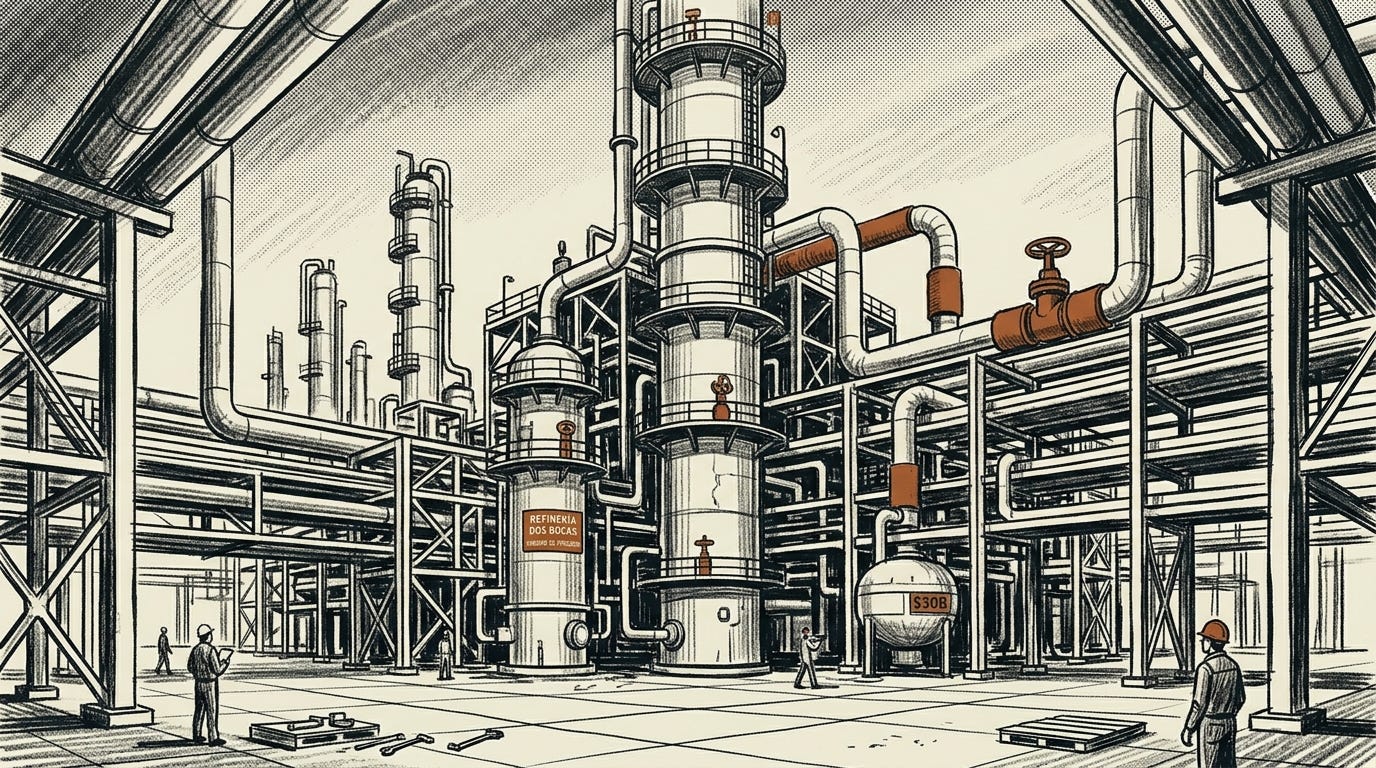
The architecture is visible in several places: the reprivatization of the banks in 1990; the PEMEX contracting system that produced an oil company with roughly $84 billion USD in debt and negative net equity by 2025; the CFE counter-reform in 2024 that removed independent energy regulators. The Dos Bocas refinery, the Tren Maya, and the AIFA airport followed the same pattern — approved budgets that doubled, environmental costs deferred, independent oversight eliminated.
These are not unrelated incidents. They are the same architecture, expressing itself through different decades and different actors.
Then there is the binational variant of the architecture — the one that does not show in the federal budget because it operates against it. Huachicol fiscal, the customs misclassification scheme in which refined fuel imported from the United States is declared at Mexican ports of entry under non-fuel tariff codes to evade import duties and the IEPS fuel tax, has been documented by Mexican investigative press at an annual cost to the Mexican fisco of approximately $3 to $5 billion USD.
The architecture is precise: the official policy was to build Dos Bocas to stop importing gasoline. The unofficial reality, running parallel to that policy, was to import the same gasoline tax-free through customs fraud the government had every administrative means to detect and chose, across multiple administrations, not to dismantle. A scheme of this scale cannot survive without coordinated complicity inside the system that is supposed to police it.
And underneath all of it, the structural cost to the Mexican economy of organized crime, state capture, lost investment, lost tourism, and talent flight runs into the trillions USD. Since 2006, when the federal government launched the current security strategy, Mexico has accumulated more than 463,000 homicides and more than 130,000 disappeared. These are the costs of a state unable to monopolize legitimate force.
It is here, in honesty, that one defensible counter-argument deserves to be acknowledged. The Mexican state’s protective architecture — for all its costs — has prevented the catastrophic populist collapses that have devastated other Latin American economies. Mexico has not become Venezuela. Its currency, while volatile, has not hyperinflated. Its institutions, however captured, have continued to function.
There is a real argument that the cost of the post-revolutionary contract has been the price of “stability.” But if the highest standard is simply avoiding collapse, then a country has accepted too narrow a definition of success. What stability has purchased, over a hundred years, is not the prosperity the contract promised. It is the absence of catastrophe. And the absence of catastrophe is not the same as the fulfillment of a promise.
Across every party and every administration since 1990, the same architecture has persisted.
The Mexican citizen has watched all of this. Voted in every cycle. Built businesses against constantly shifting rules. Educated children at personal cost in a public system the state never modernized. Buried family members lost to a security collapse.
And, when the country offered them no path forward, sent their best young people north.
This is where the Mexican story arrives at its hardest fact.
In 2024, remittances from Mexicans living and working in the United States and Canada to families in Mexico reached approximately $63 billion USD. They were larger than Mexican oil revenue. Larger than foreign direct investment. Larger than tourism. The single largest source of foreign income for the country was the wages of its own working-age citizens, sent home from somewhere else.
Most young Mexicans today help pay their parents’ living expenses. This is not a sentimental observation. It is what $63 billion USD in remittances actually means at the household level. An entire generation has shifted, by necessity, from building their own futures to subsidizing the lives of the generation that raised them — because the country those parents stayed in did not produce the conditions under which their children could afford to stay, build, and accumulate at the same time.
A country whose largest export is the labor of its own youth has received a silent verdict from its citizenry. It is the most honest measurement available of a contract that was made in 1917 and has not been kept.
That is the Mexican reflection. A citizenry that has waited 100 years with extraordinary patience. A state that has, with equal consistency, honored that patience for the few and not for the many.
A bailout that the citizen is still paying. A political system that continues to concentrate power and privilege. And a generation of young Mexicans whose answer to the broken promise has been to leave the country and pay the rent of the parents the country left behind.
In May 2026, the global capital market priced what this paper has named. Moody’s cut Mexico’s sovereign credit rating to Baa3 — one notch above junk — naming weak growth, fiscal rigidity, and continuing support to PEMEX. S&P had moved Mexico’s outlook to negative eight days earlier. Fitch reached the equivalent conclusion in 2020. All three major rating agencies now place Mexico at the threshold of speculative grade — at a moment when global oil prices should be lifting an oil-exporting economy, not exposing one.
The architecture is no longer something only Mexicans can see. It is now priced.
VII. The Broken Reflection
What does a broken reflection say about the citizens looking into it?
The United States shows a reflection of citizens who built something strong and watched it be dismantled without enough resistance. The American citizen saw the platform stop building for them and, for decades, did not find the language or the force to demand it be rebuilt. They accepted it. They allowed it. They stopped demanding the promise be kept.
Mexico shows a reflection of citizens who have been promised much and delivered little, yet continued to participate in the system. For a hundred years, the Mexican citizen has voted, has worked, has hoped — even as the state treated them selectively. They accepted this. They allowed this. They stopped believing the promise would be kept.
Both reflections show something broken: a citizenry that has lost the power to demand governments serve them.
VIII. What Citizens Demand Now
The United States and Mexico face a shared future question, but not yet a shared answer.
The American challenge is to redesign a platform that creates opportunity again without abandoning the middle class for a second time. It is to build institutions that serve citizens, not institutions that citizens serve. It is to remember that broad prosperity is not a luxury. It is the foundation of national strength.
The Mexican challenge is different but equally urgent: to build citizen capacity, institutional accountability, and trust in state systems after a century of incomplete delivery. It is to transform from a state-as-actor model — where the government delivers selectively — to a state-as-platform model where citizens have the tools, information, and stability to build for themselves.
Both challenges are generational. Both depend on a citizenry that has decided, together, that the work is theirs.
For now, the diagnosis is on the page. The reflections are broken. The citizens are still here.
IX. Paper III: Building the Citizenry
This paper is the diagnostic. It has named what is broken in each country’s reflection and what the two breaks share underneath. It has not proposed a repair. That is deliberate. Diagnosis and treatment are different disciplines.
Paper III — Re=Building the Citizenry — turns from the broken reflections to the harder question: If the political class in both countries has stopped reflecting the citizens they govern, and if the citizenry has not yet organized the response, then what kind of citizen — what kind of education, financial independence, civic infrastructure, and collective memory — can produce governments worthy of it?
The next question is not simply what policy should change. It is what kind of citizenry can produce governments worthy of it.
For now, the diagnosis is on the page. The reflections are broken. The citizens are still here.
What they build next is the only story that matters.
Eduardo Joffroy is the founder and editor in chief of The North American — 77, a bilingual editorial platform on North American integration.
This is Paper II of three in Governments Are Not Accidents. They Are Reflections. — a continental trilogy on governance, society, and the architecture of citizenship.
Catch Up to with Series i: Series 1
NA77 · ONE FUTURE. THREE NATIONS.