
A North American Era for the next Generation
From Trade Integration to Institutional Convergence

The Next Stage of Integration

In 1945, the United States made a decision that reshaped the global order.
It could have left Germany and Japan economically weakened for a generation. Instead, it chose reconstruction — not only of infrastructure, but of institutions: property rights, judicial predictability, capital market transparency, and administrative capacity.
The result was not dependency, but durable alliances and decades of shared prosperity.
North America today faces a quieter, but equally important, evolution.
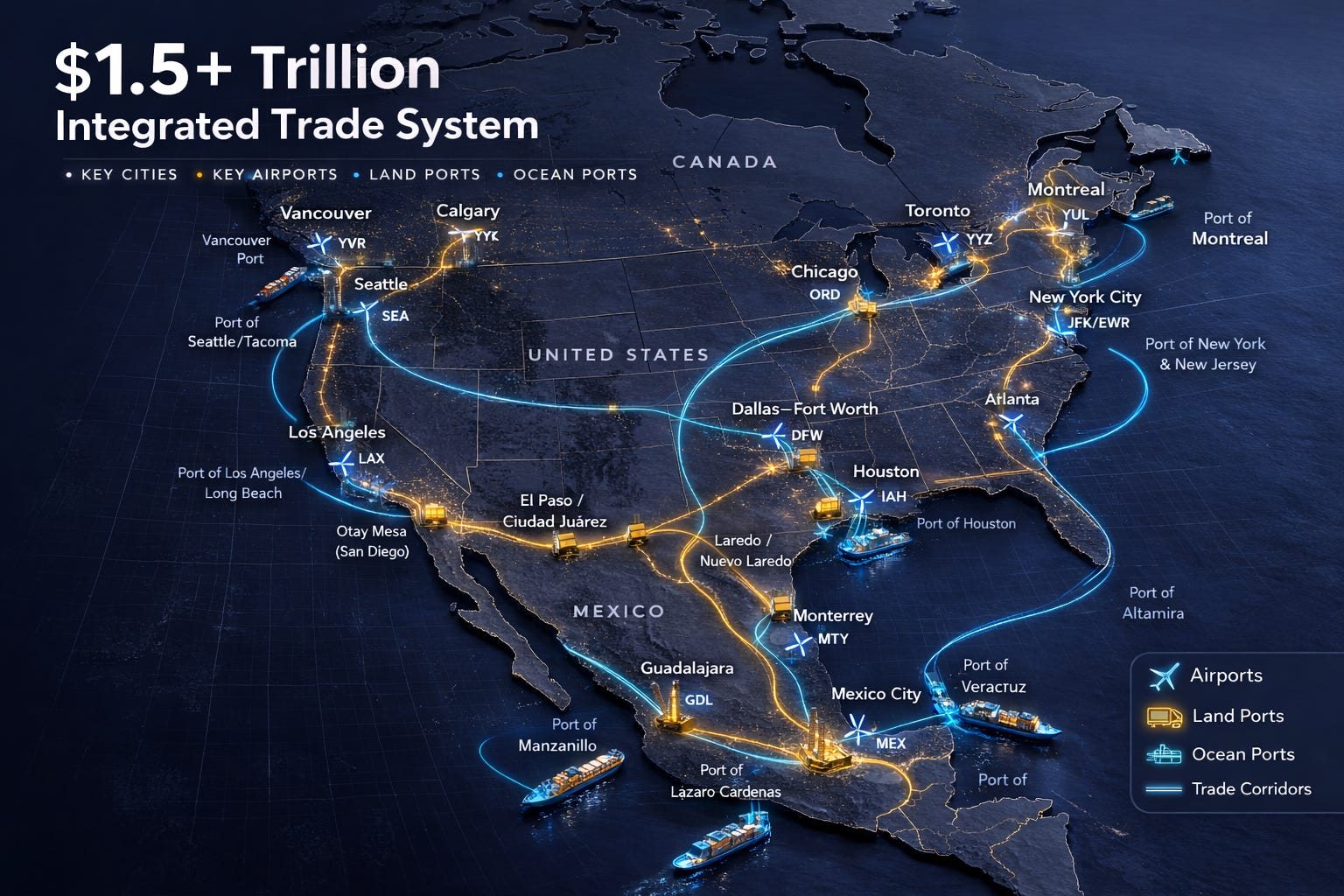
Over the past three decades, the United States, Canada, and Mexico have built one of the most integrated trade platforms in the world. Supply chains span borders seamlessly. Energy, agriculture, manufacturing, and technology ecosystems are deeply intertwined.
Production is continental.
The next stage is institutional.
—
A Shared Economic Engine
The scale of integration is undeniable.
The United States and Mexico trade roughly $1 trillion annually. Total North American goods trade exceeds $1.5 trillion per year. Millions of jobs in all three countries depend on cross-border supply chains.
Mexico provides demographic dynamism and industrial depth.
The United States provides capital scale, innovation capacity, and global financial reach.
Canada contributes institutional stability, natural resources, and advanced governance frameworks.
Each nation strengthens the others.
But as integration deepens, differences in regulatory predictability, judicial efficiency, and enforcement consistency create friction within the system.
This is not a question of culture or political cycles. It is a matter of institutional alignment.
Uncertainty increases risk premiums.
Higher risk premiums slow long-term capital formation.
Over time, asymmetry inside an integrated system becomes a shared cost.
The goal is not uniformity.
It is coherence.
—
The Convergence That Never Fully Came
If North America already operates as an integrated economic engine, income trajectories should reflect that reality.
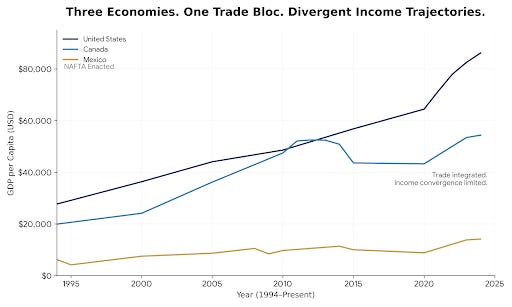
Since NAFTA came into force in 1994, trade expanded dramatically. Capital flowed. Supply chains fused. Industrial clusters deepened.
But income convergence has been uneven.
In the mid-1990s, Mexico’s GDP per capita stood at roughly one-fifth that of the United States. Three decades later, that gap has narrowed only modestly. Today, U.S. GDP per capita exceeds $80,000. Canada stands above $50,000. Mexico remains near $14,000.
This is not a moral comparison.
It is a structural one.
Trade integration alone did not produce income convergence.
In every durable regional bloc, the lower-income member eventually narrows the gap. South Korea converged within Asia. Poland converged within the European Union. Convergence is not charity.
It is compounding.
When the lower-income member scales upward:
• Demand expands for higher-value goods and services.
• Capital markets deepen.
• Institutional capacity strengthens.
• Political stability improves.
• Risk premiums decline across the bloc.
When convergence stalls, asymmetry hardens.
And asymmetry inside an integrated system becomes friction.
The opportunity for North America is not to artificially equalize outcomes.
It is to unlock Mexico’s output ceiling.
If Mexico were to reach $25,000 GDP per capita over the next two decades — still below Canada, still well below the United States — the resulting expansion would add more than a trillion dollars in scale to the continental economy.
That expansion would not weaken the United States or Canada.
It would amplify them.
Alignment compounds.
Fragmentation taxes.
“Trade integrated rapidly after 1994. Income convergence moved more slowly.”
—
The Demographic and Strategic Opportunity
Mexico’s median age is approximately 29 — nearly a decade younger than the United States and more than a decade younger than Canada. That demographic profile represents a long-term growth advantage for the continent as a whole.
At the same time, U.S. manufacturing investment has reached historic highs, and Canada continues to expand its role in energy, advanced materials, and critical minerals. Capital is moving toward North America as global supply chains reorganize.
A Clear & Present Opportunity: to transform geographic proximity into strategic power.
Mexico has the human capital, industrial base, and geographic position to evolve further up the value chain — not only as a manufacturing center, but as a design, engineering, and research partner fully integrated into continental capital markets and innovation ecosystems.
The United States and Canada benefit directly from that evolution.
A stronger institutional framework in one country reinforces confidence in all three.
Alignment compounds.
So does fragmentation.
—
From Trade to Institutional Convergence
Trade agreements created the platform.
The next phase is deeper cooperation in institutional capacity, regulatory transparency, and long-term policy continuity.
This does not require surrendering sovereignty. It requires strengthening it — through clarity, predictability, and shared standards where integration already exists.
Several principles could guide this evolution over the coming decades:
First, sustained investment in legal and regulatory modernization — digital commercial courts, transparent rulemaking processes, and predictable enforcement mechanisms that reduce friction for cross-border enterprise.
Second, structured trilateral cooperation among institutions — judicial exchanges, regulatory dialogue, shared best practices, and measurable improvements in commercial dispute resolution timelines.
Third, strategic continuity that extends beyond electoral cycles — long-term coordination on energy integration, infrastructure corridors, border modernization, and security cooperation.
North America does not compete as three isolated economies.
It competes within a global landscape increasingly shaped by coordinated blocs and long-term industrial strategies.
Predictability is a strategic asset.
Institutional trust is a growth multiplier.
—
A Generational Perspective
Institutional convergence is not a single negotiation or review cycle. It is a generational process.
It requires patience, repetition, and steady commitment across administrations in Washington, Ottawa, and Mexico City.
It requires recognizing that strengthening institutional capacity in any one of our countries strengthens the entire continental platform.
North America’s geography is permanent.
Its strategic coherence is a choice.
If integration continues to deepen while institutional asymmetry persists, costs will gradually accumulate across the system.
If alignment progresses — even incrementally — scale and confidence will compound over time.
The question is not whether North America will remain integrated.
It is whether we will match our economic reality with institutional clarity.
The handshake that matters is not signed once.
It is reinforced over generations.